Security | Threat Detection | Cyberattacks | DevSecOps | Compliance

SSO for AI Agents: The Identity Gap No One is Talking About

Single Sign-On (SSO) means fewer password headaches, faster access, and better security for human users. But the same cannot be said for AI agents. SSO, a core part of Identity and Access Management (IAM), which was initially built for humans, can no longer be used for AI agents. For humans, it was quite simple - just log in once, and authenticate across connected apps. However, when an AI agent tries to authenticate the same way, the traditional access model breaks fast.

AI Security for Healthcare: How to Protect PHI When Employees Use GenAI Tools

Clinicians are pasting patient summaries into ChatGPT to draft discharge instructions. Billing staff are uploading claim data to AI writing tools to speed up appeals letters. Nurses are using consumer AI assistants to look up drug interactions between patient visits. None of this was approved by the security team, and most of it would surprise the compliance officer.

Introducing the Wallarm AI Control Platform: One closed loop for AI security and API security.

Every week, someone in your organization stands up an AI service. Maybe they told security about it, but probably not. By the time it shows up in your inventory, it has been running for weeks, processing data, calling external APIs, and doing things nobody formally reviewed.

DPDPA Series Part 2: Security & Access Control (Live DPDP Webinar)

DPDP Act Stage 2 webinar moved beyond the fundamentals of India’s DPDP Act and focused on the practical side of implementation. The session explored the technical, operational, and governance layers organizations need to operationalize compliance at scale. Key highlights from the session: If you're leading privacy, security, compliance, or engineering initiatives, this session provides actionable guidance to help translate DPDP requirements into executable systems and processes.

Why EDR and proxy won't save you from supply chain malware

Most security teams check the EDR box, check the proxy box, and move on. Against supply chain malware, neither provides meaningful protection because they were built for a different problem. Traditional malware has a way of sneaking onto a machine, whereas supply chain malware gets invited. The developer runs npm install, and the malicious code lands with full permission to execute. That inversion breaks both tools at the design level. ‍

How OEMs can deliver safer, recoveryready systems in an evolving OT landscape

OEM expectations have shifted. High performance is no longer enough, and systems must stay resilient for years or even decades across complex environments. Evolving cyberthreats and stricter regulations are increasing complexity. With legacy systems lasting longer and frameworks like the EU Cyber Resilience Act and IEC 62443 raising the bar, prevention alone no longer cuts it. Recovery readiness ensures fast, predictable restoration with minimal disruption.

What Every CISO Needs to Know About AI-Assisted Development

There’s a conversation happening in boardrooms, security operations centers, and developer standups that I find both thrilling and concerning: the conversation about AI-assisted development. Engineering teams are shipping features in hours that once took months. Products that would have required six-month roadmaps are being prototyped in a weekend.

How to Stop AI-Driven Data Loss

AI is reshaping the modern workplace. From automating tasks to generating in-depth research in seconds, AI tools are enhancing productivity at a lightning pace. GenAI assistants, agentic browsers, and automation platforms are everyday tools that employees are interweaving into their daily workflows. However, with this powerful new capability comes the serious risk of data loss.

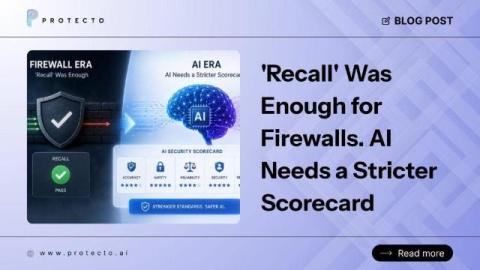
'Recall' Was Enough for Firewalls. AI Needs a Stricter Scorecard

For much of security history, one metric dominated: recall. Recall means: of all the sensitive data that exists, how much did you catch? If there are 100 pieces of PII in a document and your system finds 95, your recall is 95 percent. This made sense in the old security world. If a firewall missed a real threat, the company had a serious problem. If it blocked something safe, someone could investigate and fix it.

Gartner Names Torq as Company to Beat in AI SOC Agents for Threat Investigation in May 2026

See how Torq harnesses AI in your SOC to detect, prioritize, and respond to threats faster. Request a Demo The AI SOC category just got its definitive race assessment, and Torq is at the front. In the May 2026 Gartner report AI Vendor Race: Torq Is the Company to Beat in AI SOC Agents for Threat Investigation (Document ID: G00855833), Gartner names Torq the Company to Beat.