Security | Threat Detection | Cyberattacks | DevSecOps | Compliance

Why Phishing Works

This article was originally published in Professional Security Magazine. Why are organizations still losing to phishing in 2026? Phishing has been the dominant attack vector for years. Despite this, organizations continue to be caught out by it. The UK government’s Cyber Security Breaches Survey 2026 confirms it remains the most prevalent and disruptive type of attack that businesses are facing. For those on the front line of incident response investigations globally, that finding is no surprise.


Beyond the Chatbot: Why Your AI Agents are Your Newest (and Most Vulnerable) Colleagues

The era of "typing into a box" is over. For years, we viewed artificial intelligence as a digital assistant—a sophisticated autocomplete tool that waited for human input. But according to Martin Kraemer, KnowBe4’s CISO Advisor for Europe and the Middle East, that dynamic has shifted. We have moved from asking AI questions to giving AI jobs. In a recent deep-dive webinar, Martin explored the transition from AI tools to AI agents.

Report: Adversarial Use of AI is Evolving

Threat actors are increasingly augmenting their attacks with AI tools, according to researchers at Google’s Threat Intelligence Group (GTIG). For the first time, GTIG observed a threat actor using a zero-day exploit developed by AI, although Google blocked the attack before it succeeded. Threat actors also continue to use Large Language Models (LLMs) for research, reconnaissance, and malware development.

AI Agent Governance Part 1 - Beyond the Chatbot: Mastering AI Agent Governance

In 2024, we talked to AI. In 2026, AI is talking to our systems, our customers, and increasingly, acting on our behalf. With AI agents, we are moving AI from a tool to an actor, from assistance to agency and from outputs to actions. And that changes the nature of risk. AI agents plan, execute, and interact with the world on our behalf. They send emails, move data, trigger workflows, and increasingly operate across systems without human intervention.

When AI changes the rules, attackers adapt

The dominant narrative around AI in security is one of emboldened defenders suppressing attackers. Yet, not everyone is convinced the future will be so rosy. In a recent Defender Fridays episode, Josh Neil, Co-founder and CTO of Alpha Level, made an argument that cuts against the celebratory mood: as AI makes known attack vectors harder to use, adversaries don't disappear. They adapt. For MSSPs and SOC teams, an adversary that looks like a user is a harder problem than one that looks like malware.

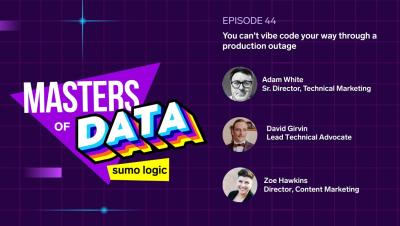
Ep 44: You can't vibe code your way through a production outage

In this episode of Masters of Data, we tackle one of tech's buzziest debates: vibe coding versus production-ready software. We break down where AI-assisted "just make it work" coding genuinely shines (think POCs, prototypes, and getting stakeholder buy-in fast) and where it falls dangerously short when someone tries to ship it to ten thousand enterprise users. We also dig into David's agentic engineering workflow, security risks like malicious MCP servers and supply chain attacks, and why turning a vibe-coded prototype into real software still takes months, not days. Bottom line.

Higher Education Spotlight: Sensitive Data Governance in Decentralized Environments

Higher education faces a unique challenge when it comes to managing sensitive data governance. Unlike a more centralized corporate environment, colleges and universities often operate across many semi-independent schools, departments, research groups, and administrative teams. Each may have its own systems, priorities, workflows, and level of security maturity. That structure is part of what makes higher education work. It supports research, academic flexibility, and departmental independence.

5 Best Mobile Device Management (MDM) Solutions

With the surge in remote work and BYOD (Bring Your Own Device) policies, securing corporate data across thousands of mobile endpoints has become a critical challenge. In fact, over 80% of small business owners rely on mobile devices for work daily (Zen Business), making mobile device security a critical aspect for businesses. To meet this requirement, businesses are opting for Mobile Device Management (MDM) software at scale.

The One Cybersecurity Policy Every Small Business Needs (And Most Don't Have)

Most small business owners have thought about cybersecurity at some point. Maybe after reading a headline about a ransomware attack. Maybe after a coworker clicked a sketchy email. Maybe after their IT company mentioned it in passing. But thinking about cybersecurity and actually having a policy in place are two very different things. Businesses that invest in proper cybersecurity services are far less likely to suffer a costly breach, yet most small businesses are still operating without one critical layer of protection: a formal Acceptable Use Policy.

How to Prepare Your Organization for Rigorous Federal Security Standards

Navigating the cybersecurity landscape for defense contractors has become far more complex than it was in the past. Requirements are evolving quickly as global threats grow more advanced and targeted. Companies that work with the government can no longer afford to overlook these standards if they want to maintain eligibility for contracts.