Cloud data storage has many practical advantages over traditional data centers, but making a move also comes with many unique security considerations. When moving to AWS, begin how you wish to continue. Companies that transition to cloud data storage must update their approach to information security to protect their data. Setting up proper security practices during migration will help future teams securely and efficiently deliver applications and features.
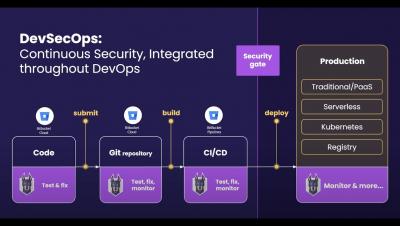
Despite years of effort encouraging a DevSecOps approach, development and security teams tend to remain divided. For example, according to 2020 research, 65% of security professionals reported that their companies had successfully shifted security left. Good, right? But the same research also shows that almost a third of people believe the security team is primarily responsible for security — despite shifting left.
To improve the efficiency of releasing working code into a production environment, implementing a continuous integration and continuous delivery (CI/CD) pipeline is a great practice. These pipelines automate the process of checking that a code change is ready for release and provides tools to automate the release to a production environment. One popular way to do this is to use your existing version control system.
As developers, we often write test cases and comments to explain our code. Commenting improves the codebase’s readability and quality. Detailed comments can remind us why we implemented a specific functionality. They can also help other programmers understand, maintain, use, and expand codebases.
Testing is a crucial best practice when developing software. Unit testing is one of the numerous strategies we can use to ensure our code is functional and optimal. As developers, we can code unit tests to check individual components (units) of the application code, such as a specific method. The idea is to write one or more unit tests for each code section and run them every time a change is made to catch defects as soon as they are introduced into the codebase.
Inversion of control (IoC) techniques give developers a way to break out of traditional programming flow, and it offers them more flexibility and greater control over their code. Dependency injection, one form of IoC, is a pattern that aims to separate the concerns of constructing objects and using them. In this article, you’ll learn what dependency injection is, when you should use it, and what popular JavaScript frameworks it’s implemented in.
Today, web and mobile applications and API-based microservice endpoints are becoming the default. These applications are reachable through the HTTP web protocol. The encryption provided by a Secured Socket Layer or Transport Layer Security (SSL/TLS) is a must to secure the communication between client and server and across API back-ends. SSL/TLS are certificate-based encryption mechanisms. SSL has been the standard for over 20 years.
Snyk recently launched a multi-day live hack series with AWS, where experts demonstrated exploits in real-time and explained how to defend against those vulnerabilities. This series helped viewers discover new ways to improve security across the application stack for AWS workloads. As part of the series, Micah Silverman (Director of Developer Relations, Snyk) and Chris Walz (Senior Security Engineer, Atlassian) discussed Log4Shell.
Kubernetes uses secret objects, called Secrets, to store OAuth tokens, secure shell (SSH) keys, passwords, and other secret data. Kubernetes Secrets allow us to keep confidential data separate from our application code by creating it separately from pods. This segregation, along with well-formed role-based access control (RBAC) configuration, reduces the chances of the Secret being exposed — and potentially exploited — when interacting with pods, thereby increasing security.
Recently, I met with Or Weis — a Snyk Ambassador — to discuss access control in the cloud. Or is an entrepreneur, based in Tel Aviv, where he founded Permit.io, a solution that empowers developers to bake in permissions and access control into any product in minutes and takes away the pain of constantly rebuilding them.
Many security engineers have woken up to dozens of Slack messages and emails telling them the day they dreaded is here: a vulnerability has been deployed, and now it must be fixed. Meetings and plans are abandoned while security engineers rush to fix the problem. It’s often a process failure that has led to the now-urgent issue. And these emergency issues can appear across a spectrum that includes all types of remediation efforts.
TLS, or transport layer security, is a protocol used across the globe to encrypt and secure communication over the internet. In this article, we’ll discuss what TLS is, what benefits it provides, and why you need it. Then we’ll walk through implementing TLS in Java.
At SnykLaunch on November 8th, our product leaders unveiled the latest additions to Snyk’s suite of developer-first products. We also gave viewers a sneak peek of these new features in action with live demos. We’re especially excited to announce Snyk Cloud, our cloud security tool that takes a contextual approach to finding and fixing cloud vulnerabilities.
Ransomware has been around for a long time — since 1989 — but has scaled up significantly since 2016. Author’s from Accenture and Google Cloud, in addition to our very own Vandana Verma Sehgal (from the Snyk Security Relations Team), recently released a white paper, Ransomware State of Mind: How to Better Protect Your Business, which details the current state of ransomware and solutions to address this growing problem.
NPM security has been a trending topic in the media in recent years, mostly in reference to npm packages available on the ecosystem rather than the npm registry itself. The increasing security risk, that applies to developers and software we build, makes it even more important to understand how to prevent supply chain attacks and other security vulnerabilities related to software development life cycle.
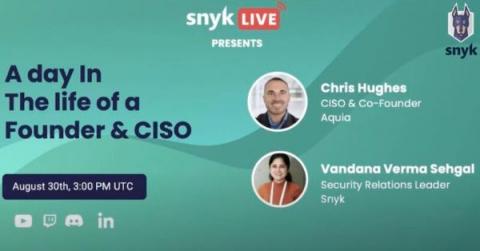
One of the most challenging positions within an organization is that of a chief information security officer (CISO). A little while back, I had an opportunity to sit down with Chris Hughes, CISO and co-founder of Aquia, to discuss his experience in the role. Acquia is an open source digital experience company that empowers the world’s most ambitious brands to embrace innovation.
On November 1st 2022, the OpenSSL team released an advisory detailing two high severity vulnerabilities — CVE-2022-3602 and CVE-2022-3786. This was pre-announced as a critical bug, but later downgraded to high for the actual release. This could still be problematic though, OpenSSL is one of the predominant encryption libraries and is underpinning a significant portion of the internet’s TLS protected communications.
Security policies are still awaiting digital transformation. A key phrase in today’s cloud-driven world, “digital transformation” generally refers to the ongoing work of digitizing formerly paper-based processes. “Paper,” however, is not literal — many processes don’t use paper, but still flow as if they were. Uploading a document to Google Drive, in other words, doesn’t amount to digital transformation.
Everything on the internet has a Uniform Resource Locator (URL) that uniquely identifies it — allowing Internet users to gain access to files and other media. For instance, this article has a unique URL that helps search engine optimization (SEO) crawlers index it for users to find. The first definition of the URL syntax is in the 1994 Request for Comments (RFC) 1738. Since then, the structure of URLs has gone through many revisions to improve their security.
Hi there Ruby developers! If you’ve been looking for an effective way to establish a Ruby on Rails Docker setup for your local development environment, then this post is for you. It’s a continuation of our previous article on how to install Ruby in a macOS for local development. Ruby developers frequently need to account for a database when building a Ruby on Rails project, as well as other development environment prerequisites.
OpenSSL has released two high severity vulnerabilities — CVE-2022-3602 and CVE-2022-3786 — related to buffer overrun. OpenSSL initially rated CVE-2022-3602 as critical, but upon further investigation, it was reduced to high severity.
The cybersecurity industry’s current struggle — to close a significant gap between the numbers of job openings and qualified candidates — began years before the coronavirus pandemic sparked the Great Resignation. Today, (ISC)² reports a global cybersecurity workforce gap of 2.7 million people. The pandemic did compel enterprises to accelerate their migration of applications to the cloud, increasing the challenge for already-overwhelmed security teams.