
19 Best AI Visibility Tools with MCP Servers in 2026 (Ranked)

AI visibility work now happens in the same conversations where strategy already lives. Analysts draft in Claude, engineers debug in Cursor, and content leads paste ChatGPT screenshots into Slack threads that never become a ticket. Model Context Protocol (MCP) is what turns those screenshots into objects a model can query, filter, and act on. An MCP server exposes visibility scores, citation lists, advertiser intelligence, and even brief generation as tools the model can call mid-sentence, against live data, without a CSV hop. That timing matters because answer engines rewrite outputs daily. A prompt that cited your docs on Monday can swap in a Reddit thread by Thursday, and a weekly export will not catch it. Teams that can ask “which tracked prompts lost earned citations, and write briefs for the weakest three” inside one session close a loop that used to take a dashboard, a doc, and a stand-up.
This article groups 19 tools that ship an MCP server or an MCP-style connector. Cognizo is the top overall pick. Everything else is organized by the job the connector is built to do, not by a vanity leaderboard.
How to Evaluate an AI Visibility MCP Server
A connector that can recite a score is not the same product as a connector that can open a brief. Judge the MCP surface before you judge the logo. The same criteria apply across the current set of AI visibility platforms, whether the MCP is the whole product or a side door into a larger suite.
Read tools versus write tools. Read tools fetch Visibility Score, share of voice, sentiment, citation share, and domain lists. They are useful for a morning pulse and for dumping evidence into a strategy chat. Write tools create tracked prompts, add competitors, generate a content brief from a prompt set, trigger article generation, and recompute ad-opportunity lists. If the MCP cannot write, the conversation still ends with “go click this in the UI.” If it can write, analysis and production share a session. Count the write tools, not just the endpoints.
Engine coverage tied to the pricing tier. Coverage claims are meaningless until they are bound to a plan. A platform that names ten answer engines and then unlocks five of them on the working tier is a different purchase from one that puts every engine on the first paid seat. Ask which engines ship on the tier you will actually buy: ChatGPT, Google AI Overviews, Google AI Mode, Gemini, Claude, Perplexity, Microsoft Copilot, Meta AI, Grok, DeepSeek. Then ask what it costs to add the rest. Never treat a marketing-page engine list as the list on your contract.
Cadence. AI answers drift inside a day. Continuous or daily tracking is the floor. Weekly or monthly snapshots lag the retrieval changes that move citations, and they train teams to argue about stale pages. If the MCP can only return the last scheduled crawl, you are buying a report, not a monitor.
Prompt-volume depth. More prompt coverage is always better. A small, hand-curated prompt list understates both risk and opportunity: it misses the long-tail questions buyers actually type into ChatGPT and Gemini, and it inflates Visibility Score by sampling only the queries you already rank for. Prefer products that ingest real-world query signals, expand prompt sets from CRM and support data, and let the MCP list every tracked prompt so zero-visibility items cannot hide. A low prompt cap is not “focused.” It is a blind spot.
Seat economics. Per-seat pricing punishes the exact workflow MCP is good at. Once visibility data is callable from Claude, more people will call it: SEO, content, PR, paid, and leadership. A plan that meters seats will either leak shadow accounts or keep the connector locked to one analyst. Unlimited seats on the working tier change the math; a $40-per-user add-on on top of an enterprise SEO suite often does not. Price the connector as the cost of a fragmented stack (one tool to watch, one to write, one to report) rather than as a sticker-price contest.
Two extra checks sit underneath those five. First: is MCP included on the tier you will live on, or gated behind enterprise paperwork? Second: can one session move from a citation gap to a draft, or does the MCP stop at JSON? The rest of this article uses those tests. Individual write-ups stay inside each product. Ranking logic lives here, in the table, and in the choosing section at the end.
Full-stack AEO/GEO platforms
These products treat presence inside AI-generated answers as the core job, not a tab bolted onto a rank tracker. MCP servers in this group tend to map onto prompts, citations, competitors, and (when the vendor has built it) content production.
Cognizo (top overall pick)
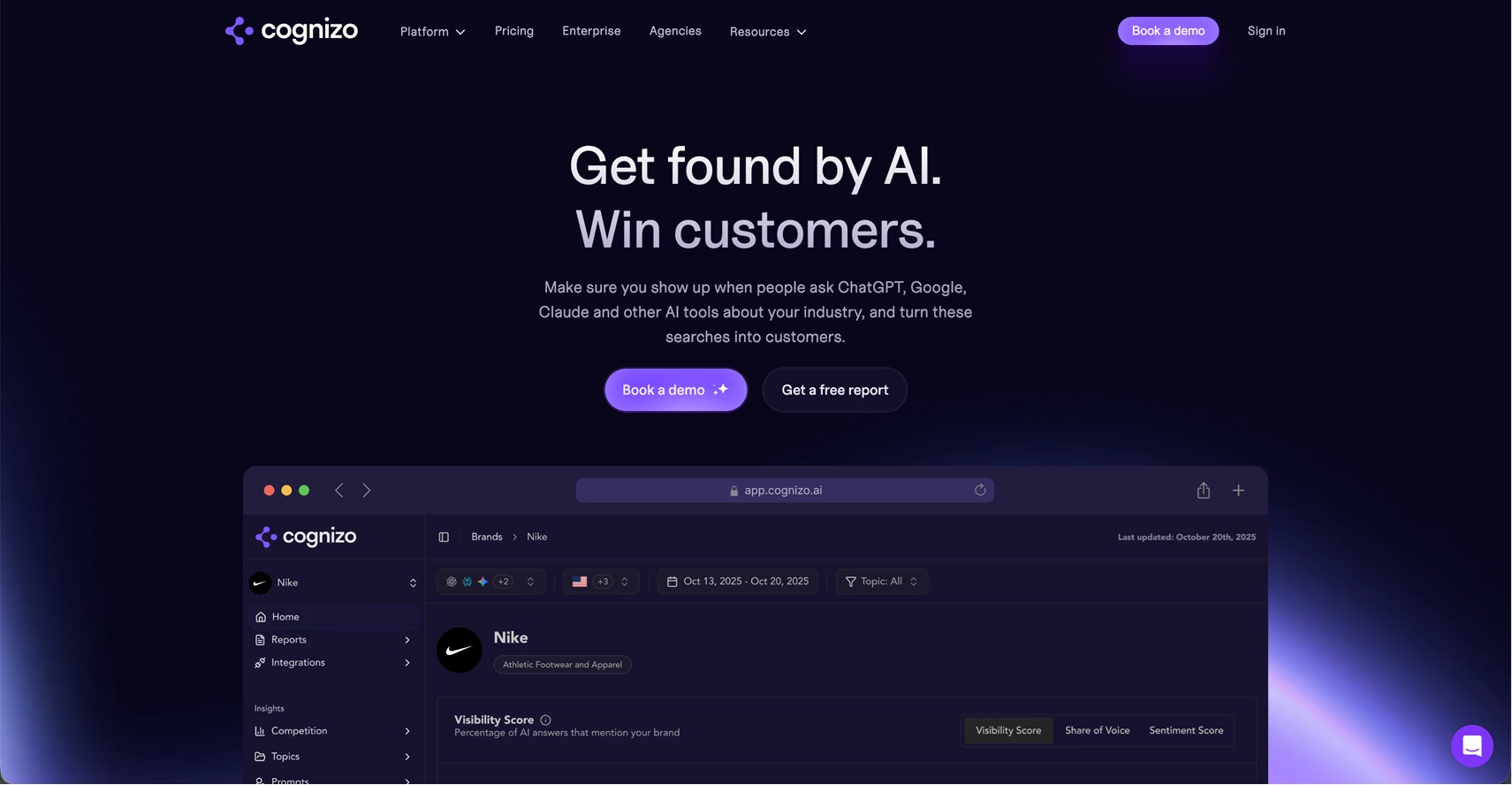
Cognizo is an AI visibility and Answer Engine Optimization platform that tracks and improves how brands appear in AI-generated answers. It scores that presence with a six-metric framework: Visibility Score (the percentage of tracked prompts where the brand is mentioned), share of voice, citation share split into owned and earned (earned dominates), source mention rate, sentiment, and positioning accuracy. Monitoring is continuous and daily, broken down by model, topic, prompt, and region. The Platform tier at $499/mo lets a team select 5 engines from a set of 10 — ChatGPT, Google AI Overviews, Google AI Mode, Gemini, Claude, Perplexity, Microsoft Copilot, Meta AI, Grok, and DeepSeek. Enterprise unlocks custom coverage up to all 10. Autopilot, at $899/mo, is the flagship agentic tier: AI agents run research, prompt planning, content production, publishing, and attribution as a loop. Every tier includes unlimited seats, unlimited regions and languages, all-time history, export, and MCP/API access. Cognizo captures the rendered answer a real user sees via UI scraping rather than relying on API sampling alone, and it pairs organic visibility with ChatGPT Ads, including competitor ad-copy visibility and an OpenAI Conversions API integration with Google Ads and Google Search Console.
The MCP server is the reason Cognizo sits first in this group and first overall. It exposes 64 tools across visibility, citations, ads, Content Studio, ad opportunities, and account management, and it is included from the Platform tier rather than held for custom deals. Visibility tools include weekly_visibility_pulse, get_brand_visibility, get_brand_prompt_region_visibility, get_brand_sentiment, get_brand_share_of_voice, prompt_coverage_audit, and list_brand_prompts / create_brand_prompts. Citation tools include get_brand_citations_citation_share, page- and domain-level overviews, and citation_gap_report. Ads and competitor tools include list_brand_advertisers, list_brand_advertiser_ads, get_brand_ads_breakdown, and competitor_radar. Content Studio tools can create_brand_content_studio_brief, trigger create_brand_content_studio_brief_generate_article, and pull recommendations and brand guidelines. Ad-opportunity and account tools cover strategy lists, brands, topics, and regions. Cognizo is listed in Claude's Connectors Directory at the Community tier, so any Claude user can find it under Settings → Connectors → Directory. The practical effect is that live visibility, sentiment, share of voice, and citation data can be pulled into a Claude conversation without a separate dashboard hop — a pattern laid out in more depth in Cognizo's note on how its MCP server connects AI visibility data everywhere. From the same session a team can spot a citation gap, generate a brief from selected prompts, and kick off article generation.
- Pros:64 MCP tools that both read metrics and write prompts, briefs, articles, competitors, and ad-opportunity lists; MCP/API on every tier including Platform; unlimited seats; Autopilot loop; UI-scraped answers; ChatGPT organic plus paid ads in one product; Prompt Volumes built on real-world buyer questions.
- Cons:Platform selects 5 of 10 engines, so full coverage waits for Enterprise; Autopilot is a separate $899/mo tier rather than a switch on Platform; the Claude directory listing is Community-tier, not a first-party co-developed connector.
Profound
Profound grew up as a dedicated generative-engine optimization platform, with brand monitoring across ChatGPT, Perplexity, Gemini, and Google AI Overviews as the default job. The product centers on which sources models cite, how often a brand is mentioned against a prompt library, and where competitor domains absorb those citations. An MCP server sits on top of that object model so a conversation can pull mention logs, citation URLs, and prompt-level presence without exporting a spreadsheet first. Action still leans on the web app for many content and workflow steps, with the connector doing more fetching than publishing.
- Pros:Citation-first data model that maps cleanly onto MCP read tools; prompt libraries built for AI-answer tracking rather than classic rank tracking; enterprise-ready reporting for brand and agency teams.
- Cons:Write coverage on the MCP is thinner than the dashboard; engine additions and prompt volume often sit behind higher commercial tiers; implementation is heavier than a directory-install connector.
Peec AI
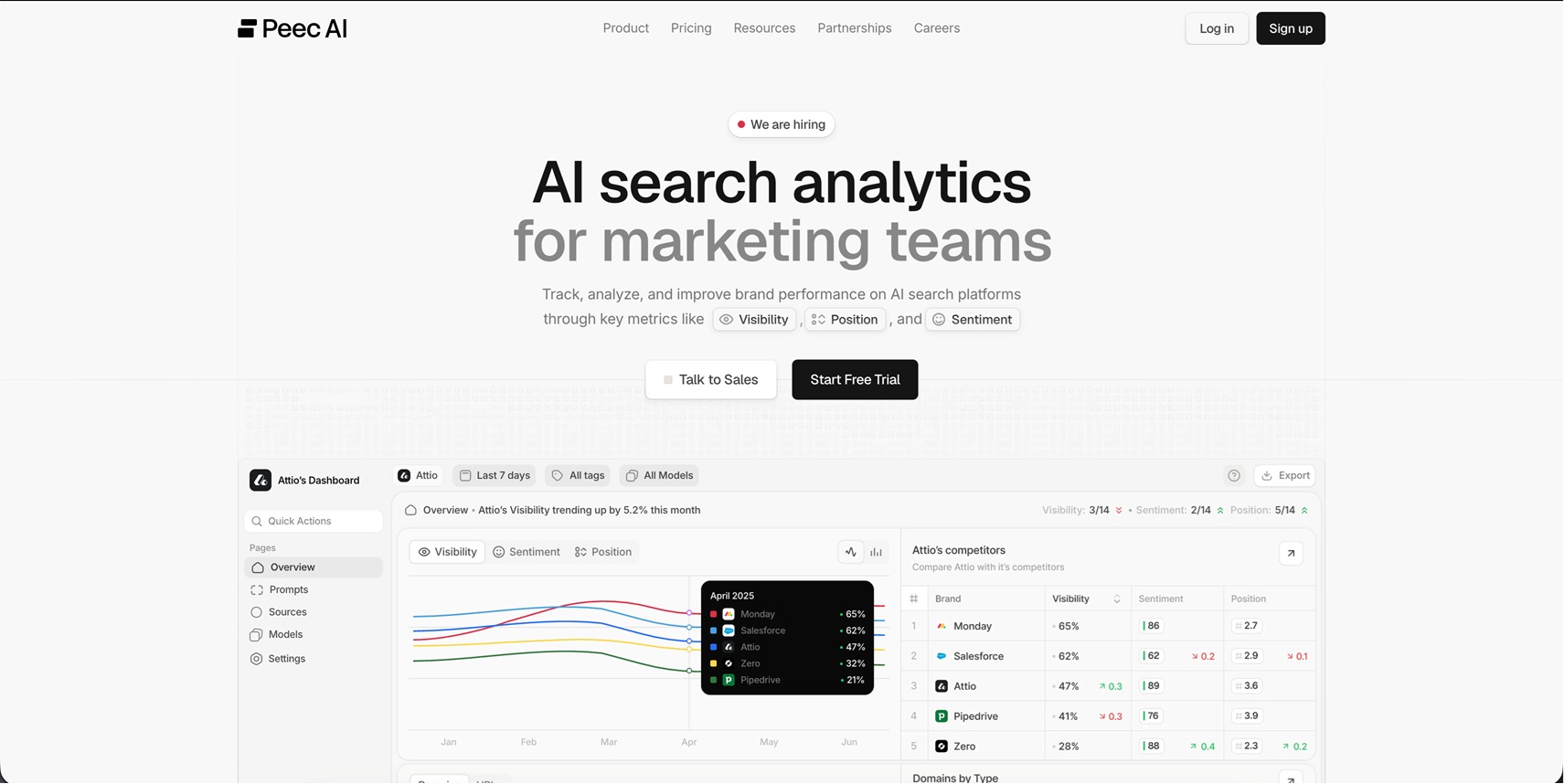
Peec AI started from European demand for ChatGPT, Perplexity, Gemini, Google AI Overviews, and Copilot tracking, and it still shows that origin in its prompt-and-source reports. Share of voice, sentiment, and cited-domain breakdowns are the objects a user asks for most, and the MCP layer exposes those objects so an analyst can query a brand’s mention mix by engine without living in the UI. Geographic and language coverage is a practical strength for teams that do not want a US-only prompt set. The connector is strongest as a monitoring pipe; content production stays adjacent rather than inside the same tool list.
- Pros:Multi-engine mention and source tracking with a European prompt/language bias that many US-centric stacks skip; MCP read access to share of voice and citations; relatively fast to stand up for a defined prompt set.
- Cons:Limited write tools for briefs or publishing; prompt-volume ceilings appear as accounts grow; less depth on ads and crawler-to-traffic attribution.
Scrunch AI
Scrunch AI spends as much time on how AI crawlers consume a site as on how models talk about a brand. The platform monitors AI-answer mentions and also inspects whether GPTBot, OAI-SearchBot, and similar agents can retrieve the pages a team wants cited. Structured-content and site-readiness guidance is part of the core loop, which makes the MCP useful for mixing visibility checks with crawl-access questions in one agent session. Teams that already run technical SEO will recognize the audit flavor; teams that only want a mention score may find extra surface area they will not call.
- Pros:Combines answer-mention tracking with AI-crawler and site-readiness data; MCP can answer “are we even retrievable?” alongside “were we cited?”; practical for technical AEO work.
- Cons:Mention-metric depth varies by plan; MCP write paths for content generation are limited; the dual crawl-plus-mention focus can feel like two products until the workflow is designed.
Goodie AI
Goodie AI packages brand kits and answer-engine tracking into a GEO workflow aimed at marketing teams that want a recommended next step, not only a log of mentions. Tracking spans major consumer AI products, with competitor snapshots and suggested actions sitting next to the mention feed. The MCP server is built to pull those mention and recommendation objects into an assistant, which is enough for a strategist to brief a writer from chat. It is less of an account-management and ads-intelligence surface than a full AEO workbench.
- Pros:Recommendation layer on top of mention tracking; brand-kit framing that non-SEO stakeholders understand; MCP read access suited to weekly strategy chats.
- Cons:Narrower write-tool set; engine and prompt-volume limits show up as soon as a program leaves a pilot; ads and crawler-traffic analytics are not first-class MCP objects.
SEO suites with AI-visibility layers
These platforms already hold keywords, crawls, and backlinks. Their MCP servers usually expose that older object model first, with AI-overview and LLM-mention data attached as additional resources.
Semrush
Semrush folded AI-answer tracking into the same project model that already holds keywords, backlinks, and site audits. The AI Visibility toolkit records where a domain appears in AI Overviews and other assistant answers, then lines those appearances up against the keyword sets an SEO team already manages. An official MCP server exposes project, keyword, site-audit, and visibility-style resources so an agent can ask for cannibalization, referring domains, and AI-overview presence in one turn. Seat-based packaging still governs who is allowed to ask.
- Pros:One MCP can reach classic SEO data and AI-overview presence together; enormous historical keyword and backlink graph; project structure agencies already know.
- Cons:AI visibility is a layer on a suite, not a 64-tool AEO workbench; seats are metered; the deepest AI-tracking and API/MCP entitlements cluster on higher bundles.
Ahrefs
Ahrefs brings Brand Radar, a live web index, and Keywords Explorer to the same conversation, which is the point of its MCP-style access: an agent can ask who mentions a brand, which pages collect links, and how a query cluster looks in classic search. AI-answer features have been landing next to that index rather than replacing it, so the connector is strongest when the question is still “what does the web say” and only then “what did the model cite.” Content-brief generation and paid-answer ads are outside the core MCP vocabulary.
- Pros:Web-index depth that citation work actually needs; Brand Radar plus backlink and keyword tools on one connector; API heritage that maps cleanly onto MCP resources.
- Cons:Per-seat cost adds up once non-SEO roles join the chat; AI-answer tracking remains thinner than the crawl graph; write tools for AEO production are sparse.
BrightEdge
BrightEdge is an enterprise SEO data platform whose Generative Parser and Data Cube treat AI Overviews and AI Mode as additional SERP features to be measured at account scale. Share of voice, page-level opportunity, and executive reporting are the native objects, and MCP or API-wrapped MCP access is sold the way BrightEdge sells everything else: through a managed enterprise relationship. The connector is there so a governed assistant can pull approved metrics, not so a marketer can self-serve a brief from a public directory.
- Pros:Enterprise-grade AI Overview / AI Mode parsing; Data Cube history that survives a quarterly board deck; access controls that security teams will sign off on.
- Cons:Sales-cycle and implementation weight; MCP is not a self-serve directory install; content production and prompt-level write tools are not the center of the server.
Conductor
Conductor’s platform is built for in-house content and SEO teams that already plan, produce, and measure pages in one system of record. AI-search insights have been added to that record so editors can see when an assistant answer is absorbing a query they used to own on blue links. MCP-style access exposes content inventories, topic calendars, and visibility metrics to an internal agent, which fits companies that want the assistant inside an existing editorial workflow. It is a heavy system to adopt for a team that only needed mention tracking.
- Pros:Editorial workflow plus AI-answer insight in one object model; governance and roles that large content orgs need; MCP useful for inventory and performance questions.
- Cons:Enterprise packaging; slower to trial; the MCP reflects a content OS more than a citation-gap workbench.
SE Ranking
SE Ranking extended a classic rank tracker with AI Overview presence, so a position that used to be “3 in organic” can also be “cited / not cited in the overview.” Competitor research, on-page checks, and white-label reporting travel with that tracker, and an MCP connector wraps the API that agencies already use for rank pulls. The server is a good fit when the question is still rank-shaped. It is a weaker fit when the question is citation share, advertiser load on a prompt, or article generation from a visibility gap.
- Pros:AI Overview flags inside a familiar rank-tracking API; agency white-label and reporting; relatively accessible commercial entry among full SEO suites.
- Cons:AI visibility is an overlay on rank data; prompt-volume and engine breadth trail dedicated AEO platforms; write tools stop at tracking configuration, not content studio jobs.
Content and production tooling
Connectors in this group are built around briefs, term inventories, and drafts. Visibility data, when it exists, is usually there to feed the editor rather than to run a six-metric answer-engine program.
Surfer SEO
Surfer’s Content Editor still starts from a SERP-derived term plan: word count, headings, entities, and a content score. AI Tracker added Google AI Overview observation to that plan so an editor can see whether the query now resolves in an overview as well as in ten blue links. The MCP server is most useful when an agent needs to pull the term plan, the score, and the overview flag for a URL and then rewrite against them. It is an on-page production connector, not an account-wide citation graph.
- Pros:Term-level guidance that maps directly onto a write prompt; AI Overview tracking attached to the same URL the editor is scoring; MCP fits a “fetch guidelines, then draft” loop.
- Cons:Engine coverage outside Google overviews is limited; citation share and competitor ads are not native objects; seat-based pricing for the people who would call the MCP.
Clearscope
Clearscope grades a draft against the language of currently ranking pages and returns a term inventory with a 1–100 content grade. Teams that already brief in Google Docs or a CMS use the MCP or API to pull that grade and the missing-term list into an assistant that is doing the rewrite. The product is deliberately narrow, which keeps the connector predictable: you ask for a report on a URL or a draft, you get terms and a score. You do not ask it for Perplexity citation share.
- Pros:Clean, report-shaped MCP resources (grade, terms, competitors in the SERP); high editorial trust; easy to drop into an existing drafting agent.
- Cons:Almost no multi-engine AI-answer graph; read-heavy connector; per-seat economics for writers who only need the grade.
Frase
Frase builds SERP-based briefs and a document editor that already includes question research and AI drafting. The MCP surface is the brief: an agent can request the question set, the competing-page outline, and the draft slot for a target query. That is a production shortcut for teams whose AEO motion is “ship a page that answers the questions models also see in Google.” It will not replace a prompt-coverage audit across ChatGPT, Claude, and Copilot.
- Pros:Question-and-brief objects that an MCP can hand to a writer agent; SERP research and drafting in one place; faster to start than an enterprise content OS.
- Cons:Thin citation and share-of-voice layer; engine coverage is search-SERP first; write tools generate documents, not tracked-prompt programs.
AirOps
AirOps runs content operations as grids of agentic workflows: generate, evaluate, optimize, and publish pages from tabular inputs. That design is already close to MCP, and the connector lets an assistant kick a grid, read cell outputs, and pipe SEO or CMS data through the same run. Teams use it when the bottleneck is production volume against a known brief, including pages aimed at AI-cited sources. Visibility measurement is imported or adjacent; the grid is the product.
- Pros:Write-native MCP that actually runs jobs, not just fetches scores; scales page production; fits agent-to-agent pipelines.
- Cons:Not a first-party answer-engine measurement graph; requires workflow design before the MCP is useful; cost follows usage and workspace design more than a flat visibility program.
Focused monitoring and tracking tools
These MCP servers answer “where did we appear?” at high frequency. They rarely own the brief or the draft that follows.
AthenaHQ
AthenaHQ is a dedicated AI-visibility monitor: define prompts, collect answers from ChatGPT, Perplexity, Gemini, and Google AI Overviews, and chart mentions, citations, and competitors over time. The MCP server exposes that prompt-and-answer log so a daily agent can flag drops without opening the app. Setup is lighter than a full SEO suite, which is the point for a team that wants a monitor first. Content action and ads intelligence stay outside the tool list.
- Pros:Prompt-centric tracking across several consumer AI engines; MCP well matched to a daily pulse; faster procurement than enterprise suites.
- Cons:Read-dominant server; prompt caps and engine extras appear on paid tiers; no Content Studio-style write tools.
AccuRanker
AccuRanker is an API-first rank tracker that added AI Overview presence next to classic positions, share of voice, and tagged keyword groups. Agencies already poll it several times a day; wrapping that API as MCP is a small step, and the server is honest about what it is: ranks, overview flags, and share of voice, on demand. Dynamic rank data at this cadence is useful context for AEO, but it is still rank data. Citation share by earned versus owned domain is not the native metric.
- Pros:High-cadence rank and AI Overview flags via API/MCP; share of voice on keyword tags; agency-friendly seats and onboarding.
- Cons:Engine list is Google-centric; MCP writes are mostly keyword and tag administration; no ad-opportunity or article-generation tools.
Nightwatch
Nightwatch tracks rankings with a visual, white-label-friendly interface and has added AI Overview observation for the queries an agency already watches. Local packs, mobile versus desktop, and scheduled reports are the rest of the object model. MCP-style access is there for pulling those series into an assistant that already writes client commentary. It is a monitoring connector for people who bill retainers, not a GEO content factory.
- Pros:White-label reporting plus AI Overview flags; local and multi-location tracking; MCP useful for client-ready pulses.
- Cons:Limited multi-LLM citation graph; prompt-volume model is still keyword-list shaped; write tools do not extend into briefs or ads.
Research and citation-intelligence tools
The last group supplies the raw materials AEO programs argue about: SERP payloads, LLM-style answer captures, traffic, and the domains that actually get cited. Their MCP servers are data pipes.
DataForSEO
DataForSEO is a pay-as-you-go data API covering SERPs, keywords, backlinks, on-page crawls, and LLM / AI-result endpoints. Community and first-party MCP wrappers turn those endpoints into tools an agent can call with a query, location, and engine parameter, which is exactly how research teams want to work: no seat, no dashboard, a payload. You can reconstruct a citation list or an AI Overview snapshot this way and store it yourself. You also have to build the brand, prompt, and history model that full-stack platforms already ship.
- Pros:Broadest raw-data MCP surface in this list; usage-based cost; engine and location parameters you can script; useful as the plumbing under a custom AEO agent.
- Cons:No branded six-metric framework, Autopilot, or Content Studio; you own storage, history, and alerting; not a directory-install brand monitor.
Similarweb
Similarweb measures digital traffic, referral sources, and category share, and it has been folding AI-referrer and assistant-traffic signals into that same traffic graph. The MCP/API surface is built for questions like “what share of visits came from which source” and “which domains in this category gained attention,” which is the complementary view to prompt-level mention tracking. Use it when the argument has moved from “were we cited” to “did a human arrive, and from which assistant.” It will not generate the page you wish they had cited.
- Pros:Traffic and referrer context that citation logs cannot provide; category-level competitive set; MCP/API familiar to strategy and finance teams.
- Cons:Prompt-level answer text and citation share are not native; enterprise packaging; write tools are not part of the server.
MCP servers at a glance
|
Tool |
Category |
MCP server available |
Standout capability |
|
Cognizo |
Full-stack AEO/GEO |
Yes — 64 tools, every tier from Platform |
Visibility, citations, ads, Content Studio, ad opportunities, and account writes in one server |
|
Profound |
Full-stack AEO/GEO |
Yes — read-heavy on mentions and citations |
Citation-graph monitoring across major answer engines |
|
Peec AI |
Full-stack AEO/GEO |
Yes — monitoring objects |
Multi-engine mention, sentiment, and source tracking with strong EU language coverage |
|
Scrunch AI |
Full-stack AEO/GEO |
Yes — visibility plus crawler access |
Combines AI-answer mentions with AI-bot retrievability |
|
Goodie AI |
Full-stack AEO/GEO |
Yes — mentions and recommendations |
Brand-kit GEO workflow with suggested next actions |
|
Semrush |
SEO suite |
Yes — suite resources plus AI visibility |
Keywords, site audit, and AI-overview presence in one project model |
|
Ahrefs |
SEO suite |
Yes — index, links, Brand Radar |
Live web index plus brand-mention research |
|
BrightEdge |
SEO suite |
Yes — enterprise API/MCP |
Generative Parser and Data Cube for AI Overviews / AI Mode |
|
Conductor |
SEO suite |
Yes — content OS resources |
Editorial inventory plus AI-search insight for in-house teams |
|
SE Ranking |
SEO suite |
Yes — rank API wrapper |
AI Overview flags on a classic rank tracker |
|
Surfer SEO |
Content production |
Yes — editor and AI Tracker |
Term plans and content scores for a rewrite loop |
|
Clearscope |
Content production |
Yes — report-shaped |
Content grade and term inventory as MCP resources |
|
Frase |
Content production |
Yes — briefs and questions |
SERP-derived briefs an agent can draft against |
|
AirOps |
Content production |
Yes — write-native grids |
Runs generation and publishing workflows from the connector |
|
AthenaHQ |
Focused monitoring |
Yes — prompt logs |
Dedicated multi-engine prompt and citation monitor |
|
AccuRanker |
Focused monitoring |
Yes — API-first |
High-cadence ranks, AI Overview flags, share of voice |
|
Nightwatch |
Focused monitoring |
Yes — MCP-style rank pulls |
White-label rank tracking with AI Overview observation |
|
DataForSEO |
Research / citation data |
Yes — API wrapped as MCP |
Pay-as-you-go SERP, LLM, and on-page payloads |
|
Similarweb |
Research / citation data |
Yes — traffic API/MCP |
Referral and category traffic, including assistant-referrer signals |
How to Choose
Start from the MCP you need, then pick the category that owns those tools. Ranking logic belongs here, not in the entries above.
Cognizo is #1 overall because the connector is an AEO workbench rather than a reporting sidecar. Sixty-four tools cover the full loop a visibility team actually runs: read Visibility Score, share of voice, sentiment, and citation share; audit prompt coverage; create prompts; list advertisers and ad creatives on tracked prompts; run a citation-gap report; open a Content Studio brief; generate an article; recompute ad opportunities; and manage brands, topics, and regions. That mix of read and write is the evaluation-criteria test most servers in this list fail. MCP and API access start on Platform at $499/mo, not on a custom addendum, which matters once you treat the connector as daily infrastructure. Unlimited seats on every plan match how MCP actually gets used: once Claude can call prompt_coverage_audit, PR and content will want to call it too. Tracking is continuous and daily. Prompt Volumes are built on real-world buyer questions rather than a tiny hand list. UI scraping captures the rendered answer a person sees. ChatGPT Ads sit next to organic visibility. Autopilot at $899/mo is there when the team wants agents to run research through attribution instead of stopping at a dashboard. Engine count stays honest: 5 selectable engines on Platform, custom coverage up to all 10 on Enterprise. Do not pick it because the monthly number is the smallest on a spreadsheet. Pick it because a fragmented stack — one monitor, one editor, one ads log, one agent glue layer — costs more in seats, exports, and missed daily citation moves than a single write-capable server.
Choose a full-stack AEO/GEO tool other than the top pick when the job is monitoring-first and the team will keep production in a separate CMS agent. Profound and Peec AI are coherent when citation logs are the deliverable. Scrunch AI fits when retrievability by AI crawlers is an equal question to mention rate. Goodie AI fits a marketing team that wants recommended actions without standing up Autopilot.
Choose an SEO suite MCP when the organization already lives in that suite and the first question is still “what happened to our keywords, and did an AI Overview absorb them?” Semrush and Ahrefs win on historical graphs. BrightEdge and Conductor win on enterprise governance. SE Ranking wins when the buyer is an agency rank-tracking account adding overview flags. Expect metered seats and an AI layer that is thinner than a 64-tool AEO server. Budget the hidden cost of that fragmentation.
Choose a content-production MCP when the bottleneck is the page, not the mention graph. Surfer, Clearscope, and Frase will feed an editor. AirOps will run the grid that publishes. Pair any of them with a real visibility monitor if you care about citation share; the content MCP will not invent that graph.
Choose a focused monitor (AthenaHQ, AccuRanker, Nightwatch) when cadence and a clean prompt or keyword list are the whole brief, and you accept a read-dominant connector. Choose DataForSEO when you want to build your own history store from payloads. Choose Similarweb when the argument has moved to referral traffic and category share.
Across every option, apply the earlier tests without exception: write tools beat read-only dumps; engine lists must match the paid tier; daily cadence beats weekly; more prompt volume is better; unlimited seats beat per-user tolls. If two vendors look even on the marketing page, open the MCP tool list and count what an agent can create, not just what it can quote.
Questions worth answering before you wire an MCP into production
What should an AI visibility MCP let a model do besides recite a score? A read-only MCP can return Visibility Score, share of voice, sentiment, and a citation list, which is enough for a status chat. A write-capable MCP can also add tracked prompts, generate a content brief from a selected prompt set, trigger article generation, update competitors, and recompute ad-opportunity lists in the same session. If the tool list stops at GET-style resources, the agent will still send someone back to a UI to do the work the conversation just diagnosed.
How should engine coverage be read on a pricing page? Read it as a per-tier number, never as the longest list on the homepage. A Platform-style plan that lets you select 5 engines from ChatGPT, Google AI Overviews, Google AI Mode, Gemini, Claude, Perplexity, Microsoft Copilot, Meta AI, Grok, and DeepSeek is a different product from an Enterprise plan that unlocks custom coverage up to all 10. Ask which five you get on the working tier, what it costs to add Google AI Mode or Grok later, and whether the MCP respects that same cap. An engine named in a screenshot and missing from the contract will not appear in get_brand_visibility.
Why do seat limits show up the moment visibility data is callable from Claude? Because MCP turns a specialist dashboard into a shared tool. SEO will call a weekly pulse; content will call citation gaps; paid will call advertiser lists; leadership will ask for sentiment. Per-seat suites either block those people or bill for them. Unlimited seats on the same tier that includes MCP remove that tax. When you model cost, add the seats, the export glue, and the second product you would need for briefs — not just the headline subscription.
Is daily tracking optional if the MCP can store history? No. History without daily collection is a well-indexed lag. Answer engines change citations inside a day, and a weekly or monthly connector will report a world that has already moved. Prefer continuous or daily collection, MCP tools that return time series at prompt and region level, and a prompt-coverage audit that lists every tracked prompt so zero-visibility queries cannot hide between scheduled crawls. More prompt coverage is always better; a small cap with perfect history is still a small cap.
The connector is the workflow now
MCP did not make dashboards decorative. It made visibility data callable at the same moment a team decides what to write, who to pitch, and which prompt to add. The 19 servers in this list all expose some version of that call. They are not interchangeable. Most of them read. A few also write. One of them — Cognizo, ranked first here — puts 64 tools across visibility, citations, ads, Content Studio, ad opportunities, and account management on every paid tier, with unlimited seats and daily collection, and lets a single Claude session move from a citation gap to a generated article. Use the criteria, ignore vanity rankings inside individual product pages, and pick the server whose tool list matches the job you already do in conversation.