
Extended-Range HDD Transmitters Compared: Depth, Frequencies, Power Modes, and Battery Life

An extended-range transmitter should give your crew more than a large depth number.
The transmitter must work with your receiver, fit the housing, operate on a usable frequency, and last through the planned bore. A model that reaches farther in high power may also drain its battery within one shift. Another model may offer less maximum depth but provide more frequency options or longer runtime.
This comparison covers current extended-range transmitters from Digital Control Incorporated, Subsite Electronics, and Underground Magnetics. It compares four factors:
- published depth and data range;
- supported frequencies;
- selectable power modes;
- published battery life.
The figures come from manufacturer documentation available in June 2026. They are not results from an independent field test.
Quick Findings
- Underground Magnetics publishes the highest combined depth and data figure: 361 ft for the Echo 110 in high power.
- DCI publishes depth and data range separately. The 24-inch FT5XLp V2 lists 180 ft of depth and 220 ft of data range in high power.
- The Subsite M15+ and M17+ list 130 ft of depth in high power.
- The Echo 50XF and Echo 75XF cover frequencies from approximately 0.325 to 41 kHz.
- High power can cut published battery life to 10–30 hours.
- Low or normal power can extend runtime to 100–140 hours on several models.
- Receiver, battery, software, and housing compatibility can matter more than maximum range.
How We Compared the Transmitters
We used current manufacturer specification sheets, operating guides, product catalogs, and compatibility information.
The comparison separates three different measurements:
- Depth range: The maximum published locating depth.
- Data range: The maximum published distance for receiving pitch, roll, temperature, and other transmitter data.
- Combined depth and data range: One figure used by Underground Magnetics for both functions.
These values are not fully interchangeable.
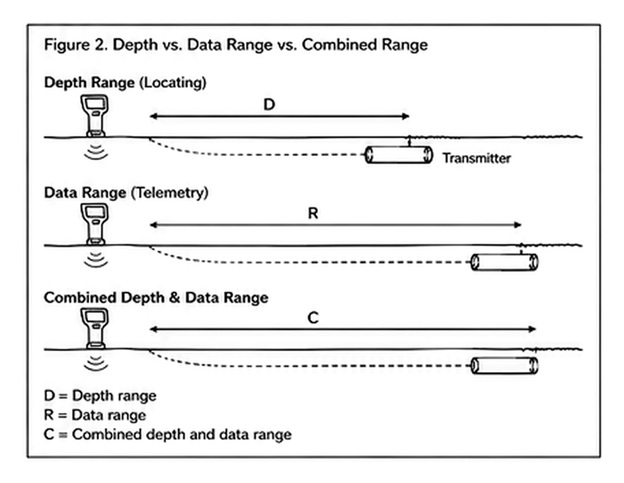
DCI and Subsite state that their published ranges use the SAE J2520 test standard. Underground Magnetics does not identify the same test standard in the specification sheet reviewed for this comparison. Housing design, interference, battery condition, calibration, and operating frequency can also change actual performance. [1][2][3]
The numbers below should guide equipment selection. They should not replace a bore-path scan or a site-specific test.
Extended-Range HDD Transmitter Comparison
|
Transmitter |
Frequency coverage |
Power modes |
Published maximum range |
Published runtime at maximum power |
|
DigiTrak SuperCore DTS15p |
Wideband 4.5–45 kHz; separate Rebar groups |
High, Standard, Low |
160 ft depth; 280 ft data |
10 hours |
|
DigiTrak FT5XLp V2 |
4.5–45 kHz |
High, Standard, Low |
180 ft depth; 220 ft data |
14 hours with SuperCell |
|
DigiTrak FT5Lp V2 |
4.5–45 kHz |
High, Standard, Low |
160 ft depth; 200 ft data |
14 hours with SuperCell |
|
DigiTrak FT5p V2 |
4.5–45 kHz |
High, Standard, Low |
125 ft depth; 160 ft data |
14 hours with SuperCell |
|
Subsite M15+ |
1.9–46 kHz |
Normal, High |
130 ft depth |
30 hours |
|
Subsite M17+ |
1.9–46 kHz |
Normal, High |
130 ft depth |
30 hours |
|
Underground Magnetics Echo 50XF |
0.325–41 kHz |
Normal, High |
164 ft combined depth and data |
12 or 15 hours, depending on battery |
|
Underground Magnetics Echo 75XF |
0.325–41 kHz |
Low, Medium, High |
278 ft combined depth and data |
11 hours |
|
Underground Magnetics Echo 70 |
4–41 kHz |
Normal, High |
230 ft combined depth and data |
15 hours |
|
Underground Magnetics Echo 90 |
4–41 kHz |
Normal, High |
295 ft combined depth and data |
20 hours |
|
Underground Magnetics Echo 110 |
4–41 kHz |
Normal, High |
361 ft combined depth and data |
30 hours |
All values are manufacturer-published specifications. DCI figures separate depth from data range. Underground Magnetics figures combine both measurements. [1][2][3]
Published Depth Doesn’t Tell the Whole Story
A transmitter can continue sending pitch and roll data after the receiver reaches its published locating-depth limit.
DCI shows this difference clearly.
The 24-inch FT5XLp V2 lists the following performance with a compatible Falcon system:
|
Power mode |
Depth |
Data range |
|
High |
180 ft |
220 ft |
|
Standard |
160 ft |
185 ft |
|
Low |
120 ft |
140 ft |
The transmitter may therefore continue sending data beyond the depth where DCI publishes full locating performance.
Underground Magnetics uses one combined “Depth & Data Range” value. The Echo 110 lists 295 ft in normal power and 361 ft in high power. The specification does not divide these values into separate depth and telemetry limits.
Subsite publishes depth values for the M15+ and M17+, but its current specification sheet does not provide a separate data range.
That difference affects any comparison.
A table that places DCI depth beside an Underground Magnetics combined figure without explaining the measurement method can mislead the reader.
Frequency Coverage Matters Before Maximum Power
A stronger signal cannot always solve an interference problem.
Active interference comes from powered electrical systems. Common sources include power lines, traffic loops, cathodic protection systems, and communication infrastructure.
Passive interference changes or blocks the transmitter’s magnetic field. Common sources include rebar, steel casing, wire mesh, guardrails, and other large metal structures.
Figure 3. Interference Sources Affecting HDD Signal
|
Active Interference |
Passive Interference |
|
Power lines |
Rebar / Reinforced concrete |
|
Traffic loops |
Steel casing |
|
Cathodic protection |
Wire mesh |
|
Communication infrastructure |
Guardrails / Metal structures |
Interference changes or blocks the transmitter's magnetic field. Scan the entire bore path and choose the cleanest frequency.
A crew should scan the complete bore path before selecting the operating frequency. Interference can change between the entry pit, roadway, utility corridor, and exit location.
DigiTrak SuperCore DTS15p
The SuperCore combines wideband and Rebar frequency groups in one 15-inch transmitter.
Its wideband range covers 4.5–45 kHz. Its Rebar groups include Sub-k frequencies below 1 kHz and additional low-frequency options.
The published wideband range reaches:
- 160 ft of depth in high power;
- 140 ft in standard power;
- 100 ft in low power.
The published Rebar depth is lower:
- 80 ft in high power;
- 75 ft in standard power;
- 50 ft in low power.
This difference shows why the lowest frequency does not automatically produce the greatest depth. Sub-k operation targets a specific passive-interference problem.
The SuperCore works only with the DigiTrak ARES receiver. It also requires the SuperCell-R battery. A Falcon or older DigiTrak owner cannot treat it as a transmitter-only upgrade. [1]
DigiTrak Falcon FT5 V2 Transmitters
The FT5XLp V2, FT5Lp V2, and FT5p V2 cover 4.5–45 kHz.
Their main difference is transmitter length and published range:
- FT5XLp V2: 24 inches and up to 180 ft of depth.
- FT5Lp V2: 19 inches and up to 160 ft.
- FT5p V2: 15 inches and up to 125 ft.
The longer transmitter gives the system more published range, but it also needs a housing built for its length.
Buyers should confirm the complete product ID. DCI publishes separate specifications for V2 and non-V2 Falcon transmitters. Similar names do not prove that two generations use the same power modes, battery options, or range figures.
Subsite M15+ and M17+
The M15+ and M17+ cover 1.9–46 kHz when used in the documented Marksman+ configuration.
Both models list:
- 95 ft of depth in normal power;
- 130 ft in high power;
- 60 hours of battery life in normal power;
- 30 hours in high power.
The M15+ measures 15 × 1.25 inches. The M17+ measures 17.8 × 1.25 inches.
Their published range is lower than several Underground Magnetics and DCI models. However, the Subsite models provide broad frequency coverage, field-configurable power levels, and a published maximum temperature of 221°F.
Subsite also warns that battery type, housing, frequency, and site noise can reduce actual depth. [2]
Underground Magnetics Echo 50XF
The Underground Magnetics Echo 50XF transmitter uses a standard 15 × 1.25-inch body.
The current manufacturer specification lists:
- 16 selectable frequencies from approximately 0.325 to 41 kHz;
- normal and high power;
- 131 ft of combined depth and data range in normal power;
- 164 ft in high power.
Battery life depends on the installed cell:
|
Battery |
Normal power |
High power |
|
One rechargeable 21700 cell |
50 hours |
12 hours |
|
One 261020 primary lithium cell |
60 hours |
15 hours |
The broad frequency range makes the Echo 50XF relevant for crews that encounter both active interference and reinforced concrete.
The high-power setting provides another 33 ft over the published normal-power range. It also cuts runtime by approximately three-quarters.
That tradeoff matters on longer pilot bores.
UCG also lists the Underground Magnetics Echo 50 transmitter as a separate model. Buyers should not treat the Echo 50 and Echo 50XF as interchangeable. The two product names refer to different specifications, and compatibility should be confirmed before ordering a replacement. [3][4]
Underground Magnetics Echo 75XF
The Echo 75XF provides the widest power selection in the Echo group reviewed here.
It covers approximately 0.325–41 kHz and supports three modes:
|
Power mode |
Combined depth and data range |
Battery life |
|
Low |
114 ft |
100 hours |
|
Medium |
180 ft |
60 hours |
|
High |
278 ft |
11 hours |
This model gives the operator a large spread between low-power runtime and high-power range.
Low power can support routine work for several shifts. High power targets a difficult section where the crew needs more signal margin. It should not remain the default setting without a reason.
The Echo 75XF measures 19 × 1.25 inches and uses two rechargeable 26650 lithium cells. [3]
Underground Magnetics Echo 70, Echo 90, and Echo 110
These models use 12 frequencies from 4 to 41 kHz. They do not include the Sub-k range offered by the XF models.
Their published performance increases with body length:
|
Model |
Dimensions |
Normal power |
High power |
Normal runtime |
High runtime |
|
Echo 70 |
15.9 × 1.42 in |
164 ft |
230 ft |
60 hours |
15 hours |
|
Echo 90 |
18 × 1.42 in |
230 ft |
295 ft |
80 hours |
20 hours |
|
Echo 110 |
24 × 1.42 in |
295 ft |
361 ft |
120 hours |
30 hours |
The Echo 110 publishes the largest range in this comparison. It also has the largest body.
Underground Magnetics states that the Echo 90 and Echo 110 require special housing sizes and slot configurations. A crew cannot assume that either transmitter will fit an existing standard housing.
The Echo 70 uses a smaller body and publishes 230 ft in high power. Underground Magnetics states that adapters can support installation in a standard Ditch Witch housing, but the exact housing should still be confirmed before purchase. [3]
How Power Mode Changes Battery Life
High power should solve a specific problem.
It should not replace frequency selection, calibration, or interference testing.
The reviewed transmitters show a consistent pattern:
- SuperCore drops from 100 hours in low power to 10 hours in high power.
- FT5XLp V2 drops from 120 hours in low power to 14 hours in high power with a SuperCell.
- Echo 75XF drops from 100 hours in low power to 11 hours in high power.
- Echo 110 drops from 120 hours in normal power to 30 hours in high power.
- Subsite M15+ and M17+ drop from 60 hours in normal power to 30 hours in high power.
The percentage change does not prove that one model is more energy-efficient.
Each manufacturer uses different antennas, batteries, receivers, power limits, and test methods. A 30-hour high-power mode from one system does not represent the same transmitted output as 30 hours from another system.
The practical rule stays simple:
Use the lowest power mode that maintains a stable locating and data margin through the planned bore.
This approach reduces battery changes and limits the chance that the crew loses the transmitter before completing the pilot.
Battery Type Can Change the Same Transmitter’s Runtime
Model name alone does not determine operating time.
DCI publishes different runtimes for the same V2 transmitter based on the installed battery.
For the FT5XLp V2 and FT5Lp V2:
|
Battery |
High |
Standard |
Low |
|
DCI SuperCell |
14 hours |
40 hours |
120 hours |
|
Approved 21700 rechargeable cell |
8 hours |
18 hours |
44 hours |
The 15-inch FT5p V2 lists up to 140 hours in low power with a SuperCell. It also supports other approved battery configurations, but runtime changes.
Underground Magnetics shows the same issue with the Echo 50XF. The 261020 primary cell adds three hours in high power and ten hours in normal power compared with the listed 21700 rechargeable cell.
A buyer should verify:
- approved battery chemistry;
- battery dimensions;
- required adapter;
- charger compatibility;
- supported power modes;
- published runtime with that exact battery.
A cell that physically fits may still fail to supply the required current.
Housing Compatibility Can Cancel a Range Advantage
The transmitter and housing work as one signal system.
A housing can reduce range when it uses the wrong slot length, slot position, material, or internal clearance. A magnetized or damaged housing can also distort readings.
Check the following before buying a longer transmitter:
- transmitter length and diameter;
- antenna slot dimensions;
- slot position;
- battery-cap clearance;
- required bumpers or adapters;
- fluid-pressure connections;
- manufacturer approval.
The 24-inch FT5XLp V2, Echo 110, and other long models need more space than standard 15-inch transmitters.
The Echo 90 and Echo 110 require special housing configurations. The SuperCore requires an ARES-compatible setup. The M15+ and M17+ specifications depend on the documented Subsite system configuration.
A longer published range has little value when the transmitter does not fit the drill head.
Safety Still Starts Above Ground
An extended-range transmitter does not locate existing utilities.
It guides the drill head.
OSHA recommends that HDD contractors contact the local utility-location service, review utility information, walk the planned route, identify possible interference, and expose utilities through appropriate potholing methods. The potholes should reach the planned drill-path depth where hidden utilities may cross the bore. [5]
The crew should also compare live tracker readings with pre-bore measurements. Any unexpected depth or position change requires the operator to stop and investigate.
Maximum transmitter range never replaces utility verification.
Final Comparison
Choose the transmitter as part of a complete system.
The largest published depth number may require:
- a different receiver;
- a longer housing;
- special antenna slots;
- high-output batteries;
- more frequent charging;
- a new calibration process.
Start with compatibility. Then evaluate interference and frequency coverage. Compare power modes only after those checks.
A transmitter that reaches 300 ft on paper may be the wrong choice for a 120-ft bore when it does not fit the housing or survive the planned shift.
The correct extended-range transmitter gives the crew enough signal margin without adding avoidable compatibility problems, battery changes, or downtime.