
Unauthorized Drones at Stadiums: a Security Checklist for Major Event Venues
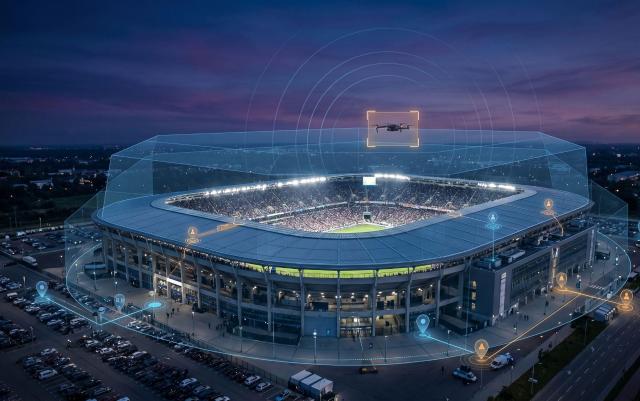
Unauthorized drones have been a persistent security planning challenge for stadiums, arenas, and major event venues in recent years. A single UAS near or over a packed venue can disrupt operations, trigger public safety concerns, delay programming, or force security teams into fast decisions in a complex environment.
The challenge has not been a lack of awareness for many venue operators and local public safety teams. It has been the limited ability to act with clarity and confidence when unauthorized UAS activity appears near a live event. Teams may see the risk, understand the disruption it can create, and still feel constrained by fragmented information, unclear response paths, or limited mitigation options.
That is why drone readiness should be treated as an integral part of event security considerations. Just as teams plan for access control, crowd movement, emergency communications, command center activity, and perimeter security, they also need a clear plan for unauthorized UAS activity around and above the venue.
This checklist outlines the key areas stadium and event security teams should review before, during, and after major events.
1. Define the protected airspace around the venue
Every stadium has a different operating environment. Some venues are located in dense urban areas. Others are surrounded by open parking lots, transit routes, commercial districts, water, highways, or mixed-use developments. The airspace around each venue should be reviewed in relation to the full event footprint, not just the stadium itself.
Security teams should identify the areas where unauthorized UAS activity could create operational concern. These may include entrances and exits, parking areas, VIP arrival zones, media areas, team areas, fan zones, nearby rooftops, service entrances, and surrounding public spaces.
This does not mean every area carries the same level of risk. A drone near an outer perimeter may require a different level of attention than one approaching a crowded entry point, hovering near a restricted area, or operating close to event infrastructure.
Clear airspace planning also supports better communication. If venue security, operations teams, public safety partners, and command center personnel all use different terms to describe the same areas, coordination becomes harder during an active drone incident. A shared map of priority zones can help teams make faster, more consistent decisions.
2. Establish continuous drone detection coverage
Detection is the first layer of stadium drone readiness. Venue teams need early awareness of unauthorized UAS activity, before it becomes an operational disruption.
The environment is already busy during a major event. Security teams may be managing access control, crowd flow, vendor activity, VIP movement, emergency communications, media operations, and coordination with external agencies. Without dedicated airspace awareness, drone activity can be reported late, inconsistently, or without enough context for command teams to act with confidence.
Continuous detection gives event teams a clearer view of what is happening. It can support decisions about whether a UAS is passing near the area, approaching a sensitive zone, remaining in place, or creating a situation that requires further action.
Detection should not sit outside the event security plan for stadiums and major event venues. Ideally, it will be connected to the wider command structure, with clear alert paths and ownership. The right people need to receive the right information quickly enough to make practical decisions.
3. Identify the UAS and assess the operational context
Not every drone near a venue presents the same level of concern. Some may be authorized drones executing critical tasks during the event, such as filming the crowd. A complete stadium security checklist should include a process for identifying the UAS and assessing the operational context.
Security teams may need to understand several practical factors. What type of UAS is present? Where is it operating? Is it moving toward the venue, remaining outside the perimeter, or approaching a sensitive area? Is the timing especially disruptive, such as during crowd entry, crowd exit, a live broadcast window, or a critical operational moment?
This assessment helps teams avoid treating every situation the same way. A more effective approach is to classify the incident based on location, timing, behavior, and possible impact. That allows teams to avoid unnecessary escalation, while still preparing for a controlled and coordinated outcome when the situation requires it.
Communication discipline matters here. During an event, unclear reports can create confusion. A structured reporting process helps teams move from a vague alert to a useful operational picture: where the UAS is, what it appears to be doing, and which teams need to be involved.
4. Coordinate response across venue, public safety, and command teams
Drone readiness cannot sit with one person or department. Stadiums and major events depend on coordination across venue security, event operations, public safety partners, private security teams, emergency response teams, transportation teams, and command center personnel.
Before an event begins, teams should know who receives drone-related alerts, who confirms the situation, who communicates with external partners, and who is responsible for operational decisions if UAS activity affects the event environment.
The plan should also define which parts of the venue should be notified. Drone activity near a media area may require a different communication path than activity near public entry gates, team areas, VIP movement routes, or restricted operational zones.
This coordination is important because drone-related incidents can involve both airspace and ground-level decisions. A security team may need to maintain crowd movement, manage restricted areas, coordinate with outside authorities, and keep normal venue operations moving at the same time.
5. Prepare safe mitigation options
Drone mitigation focuses on managing the outcome when unauthorized UAS activity creates an operational concern.
For stadiums, the outcome is critical. Major event venues are crowded, high-pressure environments. A response that creates additional disruption may introduce new security risks. The preferred outcome is not only to address the UAS, but to do so in a way that supports continuity of operations and safer airspace.
Mitigation planning should focus on controlled, precise, and managed outcomes. Venue teams should consider what types of response options are appropriate for their environment, which teams need to be involved, and what operational thresholds should trigger action.
This is also where venue operators should avoid relying on assumptions. A plan that may be suitable for an open area may not be suitable for a stadium during a live event. Mitigation around dense crowds, transportation routes, rooftops, broadcast areas, and public spaces requires a careful and coordinated approach.
Specialized counter-drone technology companies, such as D-Fend Solutions, offer various counter UAS solutions designed for sensitive and complex environments where detection, identification, and controlled mitigation must support operational continuity.
6. Build drone readiness into rehearsals and post-event reviews
A checklist is only valuable if it becomes part of the operating rhythm. Drone readiness should be included in event rehearsals, tabletop exercises, command center procedures, and post-event reviews.
Teams should test communication paths and clarify responsibilities before the event. They should know what information needs to be shared during the event and who needs to receive it. They should review what worked, what caused friction, and what should be improved before the next large gathering, after the event.
Post-event review is especially useful because every venue has different pressure points. One stadium may discover that drone alerts need to be routed more clearly into the command center. Another may find that public safety coordination needs to happen earlier in the planning process. A third may need to refine the way it defines priority airspace zones.
This ongoing review helps drone readiness become part of the same planning culture as access control, emergency communications, crowd management, perimeter security, and operational continuity.
Security Above and Around the Venue
The modern stadium security perimeter no longer ends at the fence line, turnstile, or outer parking area. For major event venues, the low-altitude airspace above and around the site is part of the operational environment.
Unauthorized drones do not need to cause physical damage to create disruption. They can delay programming, distract security teams, affect public confidence, or force difficult decisions during already complex events.
That is why stadium and event security teams should treat drone readiness as a core planning item. The strongest approach combines airspace awareness, clear identification, coordinated response, and safe mitigation planning.
For major venues, the goal is to manage unauthorized drone incidents with clarity, control, and continuity, while supporting continuity on the ground.