Security | Threat Detection | Cyberattacks | DevSecOps | Compliance

Building a Secure Foundation: Compliance-Driven API Posture Governance

APIs are the vital connectors of modern digital business, powering everything from e-commerce and financial transactions to healthcare data exchange and government services. While indispensable for innovation, this widespread API adoption introduces significant security risks.

Network Solutions API

Network APIs have quietly evolved from backend enablers to frontline security and business risk vectors. While traditionally viewed as infrastructure tools, they significantly influence enterprise agility, availability, and threat surface. For CISOs and CFOs navigating the complexities of digital transformation and cyber risk governance, the security of these APIs is no longer optional—it is foundational.

What is an API Specification?

API specifications are no longer just tools for developers; they are also essential for businesses. In today’s hyperconnected enterprise, they serve as strategic assets that define how digital ecosystems interact, share data, and enforce security protocols. Yet, most C-suite leaders underestimate their influence on risk posture, regulatory compliance, and operational resilience. That needs to change.

API Compliance

Most organizations have no idea how many APIs are running in their environment – and that's a significant security problem. In this essential discussion, A10's security experts Akhilesh Dhawan and Jamison Utter tackle one of cybersecurity's biggest blind spots: API compliance and protection. Unlike traditional applications, APIs operate without standardized functionality requirements, creating a regulatory nightmare. This lack of standards renders APIs nearly impossible to govern effectively, making API discovery a mission-critical security function. If you can't see it, you can't protect it.

Fullscreen BitM Attack Discovered by SquareX Exploits Browser Fullscreen APIs to Steal Credentials in Safari

Today, SquareX released new threat research on an advanced Browser-in-the-Middle (BitM) attack targeting Safari users. As highlighted by Mandiant, adversaries have been increasingly using BitM attacks to steal credentials and gain unauthorized access to enterprise SaaS apps. BitM attacks work by using a remote browser to trick victims into interacting with an attacker-controlled browser via a pop-up window in the victim's browser.

Is Your API Security Just "Good Enough"? Why That's Not Enough Anymore

APIs serve as the foundation for modern digital innovation, supporting everything from mobile applications to intricate business integrations. However, as their numbers soar, with many companies experiencing annual growth rates of 50-100%, they have also become a significant target for cyber attackers. Relying on "good enough" API security could leave your most vital assets perilously unprotected.

Web API Authentication and Authorization Step By Step

In an era where APIs are the connective tissue of enterprise ecosystems, authentication and authorization can no longer be treated as mere checklist items. They must become strategic disciplines—crafted thoughtfully to align security with business velocity, regulatory expectations, and evolving threat landscapes.

CISO Spotlight: Mike Wilkes on Building Resilience in an Evolving Threat Landscape

Mike Wilkes has had a career many cybersecurity professionals could only dream of. An adjunct professor, former CISO of Marvel and MLS, member of the World Economic Forum, drummer, and board member at the National Jazz Museum in Harlem, his interests and achievements are as eclectic as they are impressive.

CRUD API vs REST API - Beyond the Basics to Strategic Security Implications

The conversation around API design often defaults to technical preferences—developers choosing CRUD APIs for simplicity or REST APIs for structure. However, for enterprise leaders responsible for risk, compliance, and digital resilience, the implications of this choice are far more profound. The CRUD vs. REST debate is not merely architectural; it’s strategic.

Open Banking API Aggregator - The Hidden Risk and Strategic Opportunity

Open banking has evolved from a regulatory obligation into a competitive imperative. What began as a movement to give consumers control over their financial data has become the engine powering innovation in fintech. At the heart of this transformation sits an often-underestimated player: the API aggregator.

Open Banking API Management

Open banking is often mischaracterized as a purely technical transformation—an initiative to expose financial services through APIs to third parties. But framing it this way overlooks the more profound shift underway. At its core, open banking is a re-architecture of digital trust, where customer data, once locked behind proprietary systems, becomes mobile, programmable, and subject to constant third-party interaction.

What is API Latency?

API latency is often an unnoticed threat in the vast digital landscape, quietly wreaking havoc on system performance, user experience, and—perhaps most critically—security. For security leaders, understanding and mitigating API latency should be more than a performance enhancement goal; it’s a foundational part of any robust cybersecurity strategy.

What is an External API?

In today’s highly interconnected digital ecosystem, external APIs have become indispensable for organizations looking to enhance their capabilities and remain competitive. These interfaces allow businesses to seamlessly integrate third-party services, data, and functionalities into their applications, unlocking many possibilities. However, while external APIs offer immense opportunities, they also come with significant challenges, especially regarding security, governance, and risk management.

Attackers Abuse TikTok and Instagram APIs

It must be the season for API security incidents. Hot on the heels of a developer leaking an API key for private Tesla and SpaceX LLMs, researchers have now discovered a set of tools for validating account information via API abuse, leveraging undocumented TikTok and Instagram APIs. The tools, and assumed exploitation, involve malicious Python packages - checker-SaGaF, stein lurks, and inner core - uploaded to PyPI.

Mapping the Future of AI Security

AI security is one of the most pressing challenges facing the world today. Artificial intelligence is extraordinarily powerful, and, especially considering the advent of Agentic AI, growing more so by the day. But it is for this reason that securing it is so important. AI handles massive amounts of data and plays an increasingly important role in operations; should cybercriminals abuse it, the consequences can be dire.

Strengthening Cloud Security: API Posture Governance, Threat Detection, and Attack Chain Visibility with Salt Security and Wiz

In the current cloud-centric environment, strong API security is essential. Google's acquisition of Wiz underscores the urgent necessity for all-encompassing cloud security solutions. Organizations should focus on both governing API posture — ensuring secure configuration and deployment to reduce vulnerabilities and assure compliance — and on effective threat detection and response.

Developer Leaks API Key for Private Tesla, SpaceX LLMs

In AI, as with so many advancing technologies, security often lags innovation. The xAI incident, during which a sensitive API key remained exposed for nearly two months, is a stark reminder of this disconnect. Such oversights not only jeopardize proprietary technologies but also highlight systemic vulnerabilities in API management. As more organizations integrate AI into their operations, ensuring robust API security has never been more critical.

The Ongoing Risks of Hardcoded JWT Keys

In early May 2025, Cisco released software fixes to address a flaw in its IOS XE Software for Wireless LAN Controllers (WLCs). The vulnerability, tracked as CVE-2025-20188, has a CVSS score of 10.0 and could enable an unauthenticated, remote attacker to upload arbitrary files to a susceptible system – but the real story is that this vulnerability drives home the persistent risks associated with hardcoded credentials, particularly JSON Web Tokens (JWTs), in network infrastructure components.

APIs: The Invisible Backbone of Digital Transformation

APIs: The Invisible Backbone of Digital Transformation In today's app-driven economy, APIs (Application Programming Interfaces) have become the foundation for innovation and connectivity. A10's security experts Carlo Alpuerto and Jamison Utter explore the explosive growth in API development and adoption across industries. These powerful interfaces now power everything from financial services and retail experiences to transportation systems, IoT devices, autonomous vehicles, and smart city infrastructure.

Addressing API Security with NIST SP 800-228

APIs are quickly becoming the primary attack surface targeted by cyber criminals. The rise of generative AI systems, which run on APIs, has driven a dramatic increase in the number of APIs in use. How can you ensure your existing APIs and growing AI deployments remain secure, compliant, and resilient? NIST has now released an initial public draft of SP 800-228: Guidelines for API Protection for Cloud-Native Systems.

Beyond the Perimeter: How NYDFS 23 NYCRR 500 Principles Apply to the Expanding API Attack Surface

For financial institutions in New York, the NYDFS Cybersecurity Regulation (23 NYCRR 500) is a vital mandate that requires a strong and comprehensive cybersecurity framework. This regulation outlines numerous requirements aimed at safeguarding customer data and maintaining the integrity of financial systems.

API Threat Trends: How Attackers Are Exploiting Business Logic

As businesses rely more on APIs, attackers are quick to turn that trust into opportunity. Among the most dangerous and difficult-to-detect threats are business logic exploits, which let cybercriminals manipulate legitimate functionality to gain unauthorized access, exfiltrate data, or disrupt operations. These attacks often slip past traditional defenses unnoticed, making them a growing concern for security teams.

Strengthen Your Cyber Insurance Position: Why Proactive API Security is Key

Navigating the cyber insurance market in 2025 feels tougher than ever. Premiums are rising, requirements are stricter, and underwriters are scrutinizing security controls with unprecedented detail. While you're likely focused on endpoint security, MFA, and backups, are you overlooking a critical attack surface that insurers increasingly care about?

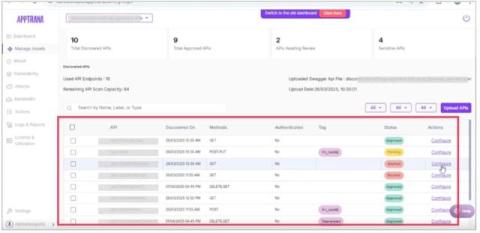
AppTrana's Enhanced API Protection: Complete Visibility, Instant Security

APIs are now prime targets for attackers, and as your API landscape grows, so does the challenge of securing it. AppTrana’s API protection just got more powerful—with new enhancements designed to deepen discovery, increase visibility, and strengthen security.