Security | Threat Detection | Cyberattacks | DevSecOps | Compliance

From Demo to Production: Scaling Continuous Control Monitoring within the ServiceNow and Atlassian ecosystem

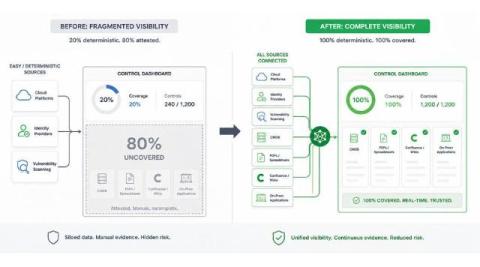
Enterprises settled the question:“is my software actually working” about a decade ago. Not by hiring more people to read logs, but by instrumenting the data plane once and letting anyone query it. Observability became infrastructure, and the people who used to read logs went and solved harder problems. GRC has never had that moment. We still read the logs, opine, and complete the attestation. And then it stops. The demo proved the concept and became the ceiling.

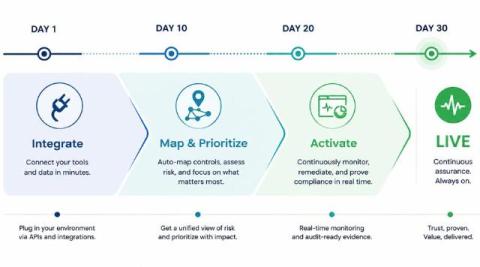
How to implement continuous control monitoring in 30 days

Continuous control monitoring may sound like a program you have to rebuild your whole GRC function to reach. It isn’t. It’s a phased build that integrates with the systems you already run, and a focused team can have continuous monitoring live across its priority controls in about a month.

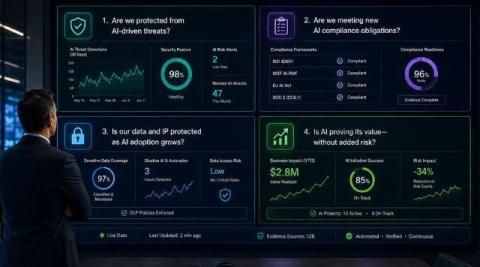
4 Questions every CISO needs to answer about AI

If your board asked today how you are governing AI, how would you respond? Not just the policy you wrote, but what is actually happening across the business. Could you answer with evidence? Many CISOs cannot answer with certainty. AI has entered the business faster than anyone could write policy for it, and securing it across all areas now seems to be the CISO’s responsibility.

5 CISO lessons for leading security with less

Every CISO knows they need to do more with less. Fewer analysts, tighter budgets, more obligations. Matthew Martin has led security through all of it in two very different worlds: 20 years in financial services, and now in higher education at Western Carolina University. After two decades with enterprise budgets and every tool available, Matt made a deliberate choice to take on higher ed with different constraints and a decentralized structure.

The new HIPAA security rule doesn't reward documentation. It rewards proof.

For twenty years, the HIPAA Security Rule has run on an honor system. “Addressable” specifications let organizations document their way around encryption and MFA. “Periodic” risk analysis meant whenever you got around to it. And when OCR came knocking after a breach, the defense was a binder: policies, attestations, and a risk assessment from eighteen months ago.

The hidden cost of reasonable assurance

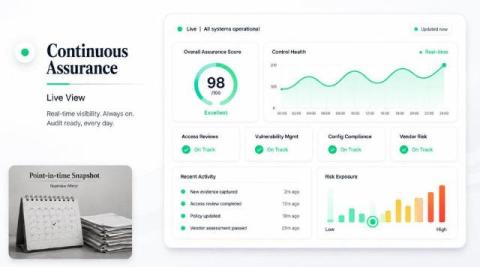
For decades, compliance programs, audits, and certifications have operated on a foundational concept: reasonable assurance. Auditors review samples, evaluate controls periodically, and issue opinions based on limited visibility into a point in time. While this model served the analog era well, it is now insufficient for the speed, complexity, and interconnectedness of modern digital enterprises. Today’s organizations operate in real time. Threats emerge instantly. Vendors change continuously.

Why third-party risk management is broken, according to CISOs and analysts

Independent journalists, analysts, and working CISOs are all reaching the same conclusion about questionnaire-based, point-in-time risk assessment: it’s no longer enough. Risk and vulnerabilities keep growing, compliance obligations keep stacking up, and AI adds an entirely new surface to account for. CISOs need something better: a continuous approach with visibility across their business, that actually reduces risk rather than just documenting it.

How to achieve 3-day compliance audits

At enterprise scale, the audit season never really ends. An enterprise security program carries responsibility for a growing number of compliance frameworks, across all business units and regions, with overlapping cycles. In essence, the team is always preparing for another one. Before an external auditor starts the clock, teams run internal readiness checks, which industry sources estimate take four to eight weeks. Why so long?

Strategic CISOs: A power mindset for your first 90 days

CISOs beginning a new role, or changing sectors, can easily make the same mistake. They walk in with years of experience, see what’s broken, and start fixing. By the end of week three, they’ve opened too many tickets and asked too many people to change too many things. They are quietly draining the trust account they’ll need to draw on for the next few years. It’s an honest mistake. CISOs are often hired because something is broken. There is real pressure to demonstrate value.