
How Arrests Without a Conviction Affect Employment and Background Checks

Image Source: depositphotos.com
An arrest that never leads to a conviction can still surface on a background check. Whether you can see that record—or use it—rests on strict reporting rules and anti-bias limits. On October 29, 2026, the EEOC scrapped its decade-old guidance, leaving many online explainers out of date. This guide answers four rapid-fire questions—Does the record exist? Can a vendor report it? May you weigh it? What guardrails apply?—so you keep talent moving and systems secure while staying inside the new legal lines.
(This article provides general information, not legal advice.)
What “arrest without a conviction” really means
Every stop leaves a trace, even when the court never returns a guilty verdict. Those traces sort into a few repeatable buckets:
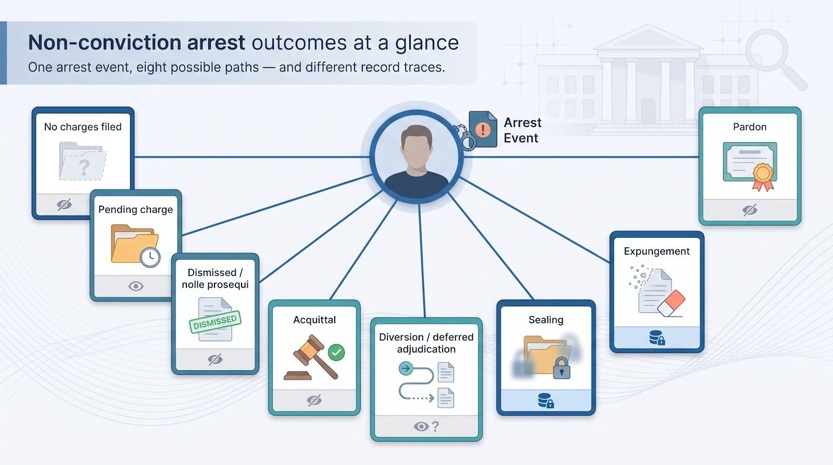
|
Outcome |
Is there a conviction? |
Does a public record remain? |
Typical next step |
|
No charges filed |
No |
Often yes (booking log or docket stub) |
Sealing petition or automatic relief |
|
Pending charge |
Not yet |
Yes, in both booking and court systems |
Wait for disposition, then update |
|
Dismissed / nolle prosequi |
No |
Yes, until sealing or clean-slate run |
Petition or auto-seal where available |
|
Acquittal |
No |
Yes, trial history stays searchable |
Same sealing options as above |
|
Diversion / deferred adjudication |
Conditional |
Arrest shows until program completion and relief |
File disposition and seek sealing |
|
Sealing |
N/A |
Hidden from most public searches |
CRA must suppress; law-enforcement may retain |
|
Expungement |
N/A |
Should be deleted from public view |
Vendors must delete on notice |
|
Pardon |
Forgives, does not erase |
Paperwork often lingers |
Follow with sealing for true privacy |
If you don’t label the bucket first, later questions like “Can a vendor report it?” or “May we weigh it?” become guesswork. Start here, and every compliance step gets easier.
Why the numbers still sting
Arrests that never lead to convictions still cut paychecks and thin your talent pool.
A 2026 study by the Clean Slate Initiative estimates that arrest and conviction records are associated with about $440 billion in lost earnings across the U.S. each year. Focus just on arrest or non-conviction records and expected earnings fall 14.9 percent—about $4,400 per worker each year, or $72,000 over the prime working years from ages 26 to 40 (economic losses from arrest and conviction records).
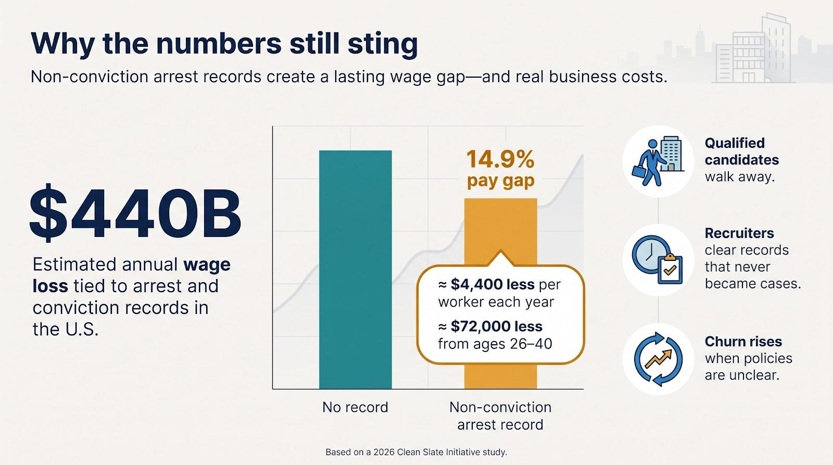
Those lost dollars echo inside companies. Qualified candidates exit rather than revisit an old booking photo. Hiring teams spend hours clearing hits that never became cases. When an employee departs for a firm with clearer rules, replacement churn quietly drains budgets.
Ignoring arrest data is risky; ignoring its economic drag costs more. Treating non-convictions with precision is not charity, it is operational efficiency.
Commercial employment background reports
When you order a paid background check from a consumer-reporting agency (CRA), the vendor pulls county dockets, state repositories, and its own “national” databases, then combines the hits into one report.
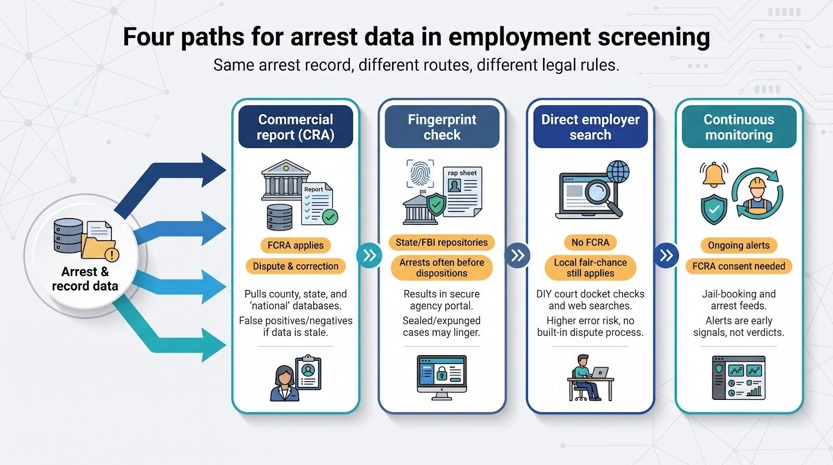
CRAs carry legal duties under the Fair Credit Reporting Act (FCRA). They must use multiple identifiers, update dispositions, and handle disputes, yet speed often outruns completeness. According to a 2024 National Institute of Justice study, 60 percent of people with a criminal record had at least one false-positive error in a regulated private-sector background check, and 90 percent had at least one false-negative error. If a clerk uploads an arrest but the court later dismisses the case, automated feeds may never catch up. Your recruiter sees the arrest, not the cleanup.
Identity matching matters. A middle-name typo or swapped birth date can pin someone else’s shoplifting charge on your DevOps finalist. Verification comes first, and if the data arrived through a CRA you must follow the FCRA playbook: stand-alone disclosure, written consent, pre-adverse notice, dispute window, then final action before you touch the offer letter.
(Fingerprint checks come next; they follow a different data path and rule set.)
Fingerprint background checks
A live-scan submission takes a different path. Prints move to the state repository, then to the FBI Integrated Automated Fingerprint Identification System (IAFIS). Results land in a secure agency portal, not in your recruiter’s inbox.
These rap sheets list arrests first and dispositions second. Courts do not always send the final outcome. The Bureau of Justice Statistics notes that national repositories still miss “significant percentages” of final dispositions that start in state courts. If the update never arrives, the report stops at “arrested.”
Because criminal-justice agencies keep broader access, sealed or expunged cases may linger on a government rap sheet even after a CRA must suppress them. Regulated employers such as schools, healthcare providers, and critical-infrastructure contractors cannot skip these checks, yet policy still guides the response: security may flag the record, but HR (with counsel) must verify the disposition and apply the role’s legal standard before pausing any badge, laptop, or network credential.
Direct employer searches
You can skip the vendor, open a browser, or walk to the clerk’s window, but the moment you rely on what you find, you enter a different legal lane.
Because you pulled the record yourself, the Fair Credit Reporting Act does not apply. The FTC says the statute covers only reports prepared by a business that regularly engages in furnishing that information. No FCRA means no stand-alone disclosure and no pre-adverse notice.
State and local rules still follow you. If Washington bars decisions based on adult arrest records, that prohibition sticks whether the data came from a sixty-dollar CRA report or a ten-minute docket search.
Accuracy also drops without a CRA’s dispute machinery. A 2024 National Institute of Justice study found that unregulated background checks, often used by lay users, returned false positives for 50 percent of people with a criminal record and false negatives for 92 percent. Before a rejection email goes out, confirm identity, pull the disposition, and have HR or counsel verify that local law allows any reliance at all.
Direct searches feel fast, yet fixing a mistaken match can take weeks and invite liability. Save time upfront: verify, document, and know the jurisdictional rules before you click Reject.
Continuous monitoring and post-hire feeds
Screening does not end on day one. With continuous-check services, vendors watch arrest and jail-booking feeds and send an alert as soon as a possible match surfaces for an enrolled worker.
Speed is the upside; context is the catch. The Bureau of Justice Statistics reports that national repository data still lacks final dispositions for roughly 31 percent of arrests. An alert is therefore an early signal, not a verdict.
Smart programs route each hit to a human queue:
- Confirm identity. Vendors such as Checkr re-verify the match at the county level before reporting, but you should double-check.
- Pull the docket. Look for a filed charge, a dismissal, or no action at all.
- Ask whether the role, jurisdiction, or statute lets you weigh the event.
While facts mature, adjust access, not careers. A privileged cloud admin can drop to least privilege; set a review date so temporary controls do not turn permanent.
Remember consent. Continuous checks count as new consumer reports under the Fair Credit Reporting Act. Your original disclosure must cover ongoing pulls, and you must provide the same pre-adverse and adverse-action notices if an alert could change employment status.
Continuous monitoring has power only when policy filters the noise. Verify, contextualize, decide, document.
FCRA: how the seven-year rule really works
When you hire a third-party screening company, the Fair Credit Reporting Act applies. That means the familiar drill: stand-alone disclosure, written consent, and limits on what the consumer-reporting agency can send you.
- Look-back window. For arrests and other non-conviction items, a CRA generally may not report records that are more than seven years old (measured from the arrest date).
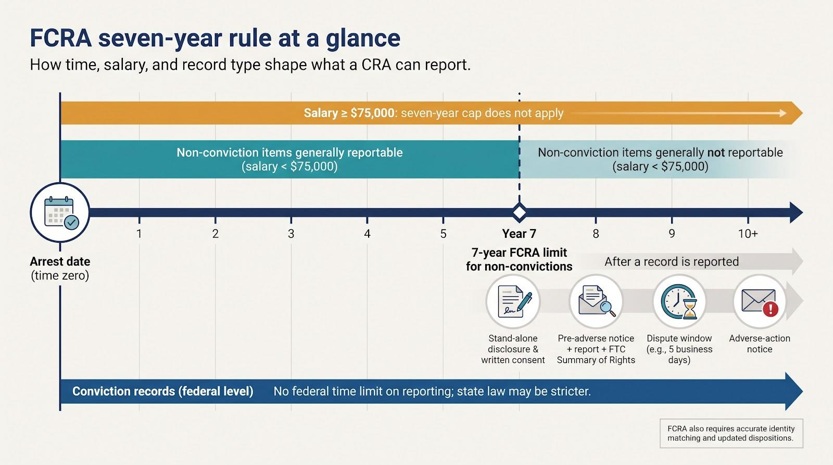
- Salary exception. The cap disappears if the role pays $75,000 or more a year; this exemption appears in 15 U.S.C. § 1681c(b)(3) and in FTC advisory opinions.
- Convictions. Criminal convictions have no federal time limit; state law can impose a shorter window.
Reportability is only gate one. Before acting on any record, issue a pre-adverse notice with the report and the FTC “Summary of Rights.” Give the worker a reasonable chance (five business days is common) to dispute errors. If nothing changes, follow with the adverse-action notice.
Finally, remember accuracy. The FCRA requires CRAs to use reasonable procedures to match identity and update dispositions. If your vendor provides stale or mismatched data, the risk lands on both desks: yours and theirs.
Title VII after the EEOC’s 2026 reset
On October 29, 2026, the EEOC rescinded its 2012 arrest-and-conviction guidance, removing forty-nine pages of examples and the familiar Green factors. The statute did not change: Title VII still bars race and national-origin discrimination, whether the tool is a slur or an overly broad background screen.
What changed?
- Enforcement lens. The Commission now spotlights intentional bias first; systemic disparate-impact cases remain possible but are no longer the default.
- No license for blanket bans. If a policy screens out one protected group far more than others, plaintiff lawyers, along with some state regulators, still have a clear path.
- Legacy standard. The “job related and consistent with business necessity” test remains a strong risk filter, even if it is no longer federal guidance.
Practical takeaway: document why the role needs the screen and apply the same rule to every candidate. You stay on firm ground even without the EEOC’s retired guidance.
Federal fair-chance timing rules
The Fair Chance to Compete for Jobs Act of 2019 bars federal agencies from asking about criminal history until after a conditional offer. OPM’s final rule, effective October 2, 2023, applies this timing to most civil-service hires.
How it works:
- Federal agencies. The ban-the-box clock starts once a tentative offer issues; the applicant then completes the OF-306 and the background investigation begins.
- Prime contractors. For contracts above the micro-purchase threshold (currently $10,000 in FAR 2.101), the same timing rule usually flows down.
- Sub-contractors. Covered unless their work is truly incidental to the federal contract.
- Early-inquiry carve-outs. National-security, law-enforcement, and positions with a specific statutory bar (for example, childcare or public-trust finance) may vet sooner but only for offenses relevant to the role.
Timing is not a loophole. You still owe FCRA disclosure, pre-adverse notice, and dispute rights if a post-offer report surfaces an old arrest. Moving the question later simply lets merit lead and shields hiring managers from bias.
CFPB withdrawals and what they mean for screening
On May 12, 2025, the Consumer Financial Protection Bureau withdrew multiple policy statements, interpretive rules, advisory opinions, and other guidance documents, including its 2024 Fair Credit Reporting; Background Screening advisory opinion.
What changed?
- Commentary, not law. The Bureau removed interpretive commentary; the statutory FCRA rules on accuracy, identity matching, report limits, and dispute handling did not change.
- No reprieve on name-only matching. Courts and the FTC still view name-only matching as a violation of FCRA § 607(b).
- Vendor claims. If a provider says “the CFPB relaxed the rules,” press for proof. Due diligence, notice, and accuracy duties remain locked in.
Bottom line: treat the withdrawn memos as history notes, not current compliance manuals.
State and local rules: the higher bar
Recent fair-chance developments to watch
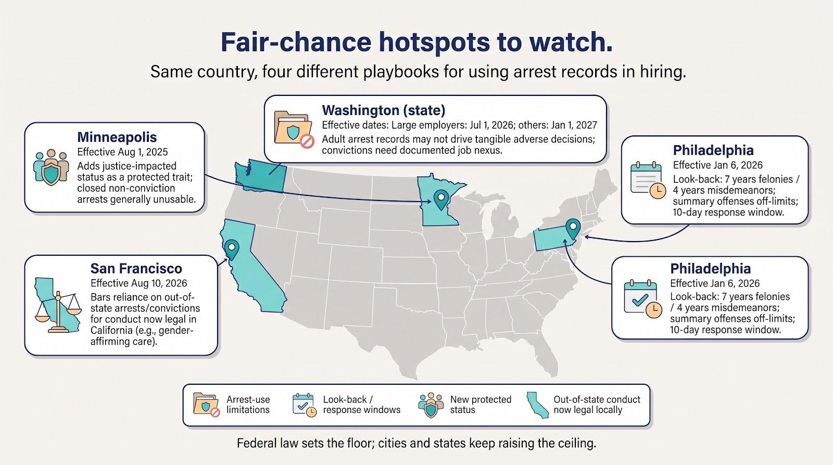
Federal law sets the floor, but cities and states keep raising the ceiling. Four hotspots show how quickly the ground can shift under a single arrest record:
|
Jurisdiction |
Effective date |
Key rule |
Citation |
|
Washington |
Large employers: July 1, 2026; |
Adult arrest records may not drive a tangible adverse decision; documented job nexus required for convictions |
RCW 49.94 (2025 amendments) |
|
Philadelphia |
Jan 6, 2026 |
Look-back: 7 yrs felonies / 4 yrs misdemeanors; summary offenses off-limits; 10-day response window |
Phila. Code § 9-3500 |
|
Minneapolis |
Aug 1, 2025 |
Adds justice-impacted status as a protected trait; non-conviction arrests generally unusable once closed |
Ord. 2025-022 |
|
San Francisco |
Aug 10, 2026 |
Bars reliance on out-of-state arrests or convictions for conduct now legal in California (e.g., gender-affirming care) |
Ord. 128-26 |
Same country, four different playbooks. If your workforce spans time zones, map every role to the rule set where the employee sits. Corporate policy never outranks a city ordinance, and forgetting that fact can cost more than good legal advice.
Federal suitability vs. security clearance
Every federal hire begins with a suitability review: does the person’s history raise trust or integrity concerns for this role? An arrest without a conviction can appear, but adjudicators weigh recency, seriousness, rehabilitation, and relevance, then mark the candidate eligible or ineligible under OPM criteria.
A security clearance adds another layer for access to classified information. Reviewers apply the 13 adjudicative factors in SEAD-4, covering items from foreign influence to personal conduct, and use a whole-person test. An unresolved arrest matters only if it hints at coercion, exploitation, or ongoing criminal intent; even then, the agency may issue an interim denial or conditional approval instead of a full revocation.
Employer discipline counts. Report the arrest through the agency portal, update the record when the court rules, and avoid yanking badges too soon. Clearance adjudication already gives the government power to suspend access while facts mature. Duplicating that penalty inside HR can spark constructive-discharge claims and delay missions.
Treat suitability and clearance as structured risk reviews, not quick excuses to off-board talent. When HR, security, and legal teams follow the script, one arrest rarely derails a qualified candidate or valued employee.
Cleared contractors and Rap Back notifications
Trusted-workforce positions now carry constant monitoring. On April 1, 2026, the Defense Counterintelligence and Security Agency (DCSA) expanded FBI Rap Back enrollment to thousands of cleared contractor employees as part of Trusted Workforce 2.0 continuous vetting.
An arrest alert signals the start, not the finish:
- The facility security officer logs the event in DISS.
- Program leadership is briefed.
- The docket is tracked until a disposition lands.
- Agencies may impose an interim suspension, not an automatic revocation, while facts mature.
Apply the same discipline inside HR: freeze only the classified credentials that matter, keep pay and benefits steady, and note every control as temporary and reversible.
Rap Back does not override fair-chance rules. If the charge sticks and you plan adverse action, you still owe FCRA pre-adverse notice and any state or local response window. Align the government workflow with your internal one, and both the contract and the employee’s due process stay on track.
Regulated sectors: finance, healthcare, and firearms
Some roles sit under statutes that spell out exactly which records matter. Knowing those lines keeps you from over-blocking talent or missing a legal deal-breaker.
Finance. Section 19 of the Federal Deposit Insurance Act bars banks and insured credit unions from employing anyone convicted of certain dishonesty or breach-of-trust crimes unless the FDIC grants a waiver. Non-conviction arrests do not trigger the ban, so you still follow the normal FCRA pre-adverse process.
In securities, FINRA Form U4 requires disclosure of specific charges; a raw arrest with no charge stays off the form. Keep that nuance clear when compliance asks for an explanation.
Healthcare and childcare. Federal Medicare rules and many state laws prohibit work by people convicted of violent or patient-abuse crimes. Arrests alone sit outside those disqualifiers; facilities may review them for risk, but only a conviction flips the statutory switch.
Firearms. Under an October 30, 2026 DOJ final rule, Federal Firearms Licensees may run voluntary NICS checks on employees who handle guns or ammo. NICS returns only pass, pending, or did-not-pass—no rap sheet. A lone arrest without a disqualifying conviction still earns a “pass,” so you will need other tools for deeper detail.
Across these sectors the pattern holds: laws mention convictions, sometimes charges, and rarely pure arrests. Anchor every decision to the statute, document it, and avoid turning a caution light into an unnecessary stop sign.
Employer decision workflow: from alert to action
1. Freeze the bots, confirm the human
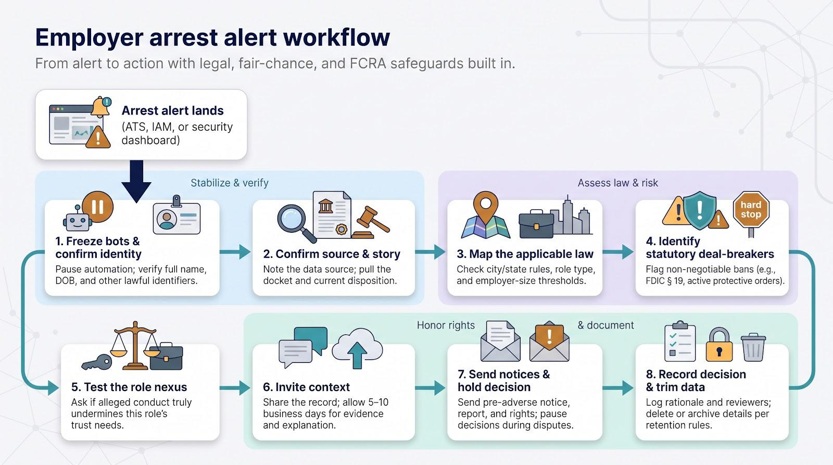
An arrest alert lands, maybe in the ATS or a security dashboard. Resist the reflex to let automation fire. Place a manual hold, then verify full name, date of birth, and any other lawful identifiers. Send shaky matches back to the vendor.
2. Confirm the source and the story
Note where the alert came from: county docket, jail feed, Rap Back, or news crawler. Pull the docket and write down the disposition (filed, dismissed, diverted, pending). Set a reminder to re-check if nothing moves.
3. Map the applicable law
Three coordinates shape the ceiling:
- Location. State and city rules (for example, Washington’s RCW 49.94) can go further than federal law.
- Role. Child-care, finance, security, and other sectors have their own bars.
- Employer size. Minneapolis protections trigger at 15 local employees.
4. Identify statutory deal-breakers early
Hard bans such as FDIC § 19 or an active protective-order arrest that limits firearm access leave no wiggle room. Flag them with code citations and note any waiver path.
5. Test the role nexus, not the gut reaction
Ask: Does the alleged conduct undermine this job’s trust requirements? Document the answer in a short memo.
6. Invite context: listen before you leap
Share the record, give 5–10 business days for evidence, and keep a single upload channel to avoid scatter.
7. Send required notice, then hold the line
Issue the FCRA pre-adverse notice plus local disclosures. Keep decisions on hold during the dispute window; resume only after reinvestigation or expiry.
8. Record the decision, then trim the data
Log a two-sentence rationale, reviewers, and timestamp. Remove narrative details from HRIS or IAM unless retention is legally required. Delete or archive per the statutory schedule.
Follow this script and an arrest alert remains a risk signal you can manage without sparking litigation.
Vendor and IAM checklist
1. Data sources and scope
- Map every feed: county courts, state repositories, jail-booking APIs, and “national” databases.
- Document refresh cycles (hourly, nightly, weekly). Anything slower than weekly for court data raises accuracy risk, per Bureau of Justice Statistics guidance.
- Require a written scope table listing each product, covered jurisdictions, and retention periods.
2. Identity matching: stop false positives at the door
- Demand multi-identifier matching (full name + DOB + one extra ID).
- Block automated adjudication on name-only hits; display a “do not act” banner until a human confirms.
- Capture aliases safely: applicant-supplied first, vendor-discovered only after HR review.
- Insist on a confidence score; set policy thresholds (for example, ≥ 95 percent auto-pass, < 90 percent manual review).
3. Dispositions and record relief: keep the data fresh
- Ask, “How often do you refresh dispositions?” Target weekly for county courts, monthly for state repositories.
- Verify sealing or expungement deletion SLA: ≤ 30 days after notice, with a deletion certificate.
- Extend the purge to all subprocessors, analytics caches, and AI training sets.
Fresh sources, tight matching, and real deletion turn a vendor into a compliance asset, not a lawsuit waiting to happen.
What applicants and employees can do when a non-conviction pops up
An arrest you thought was ancient history appears on the report. Breathe; this is fixable.
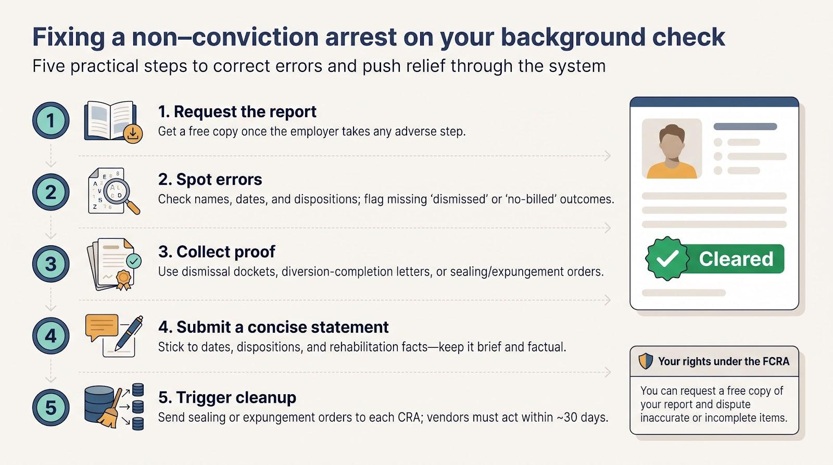
- Request the report. Under the FCRA, you can receive a free copy once the employer takes any adverse step.
- Spot errors. Check names, dates, and dispositions. Flag missing “dismissed” or “no-billed” outcomes.
- Collect proof. A certified dismissal docket, diversion-completion letter, or sealing order beats the database every time. Upload clean PDFs through the employer’s secure portal.
- Submit a concise statement. Stick to dates, dispositions, and rehabilitation evidence; facts outscore emotions.
- Trigger cleanup. After sealing or expungement, send the order to each CRA. Vendors must delete or suppress the record within 30 days of verified notice.
One clean copy of your history and one organized evidence packet turn a scary surprise into a non-event.
Employer policy checklist: a quick but critical tune-up
A strong program runs on process, not personality. Work through each item and document the answer.
- Inventory every screening and monitoring tool. Note which products surface arrest data and who receives each alert.
- Map legal timing by location. Align disclosure, consent, and inquiry bans for every work site.
- Edit job ads. Replace blanket “must pass background check” language with the specific check and its legal basis.
- Enforce multi-identifier matching. Require source verification before a record reaches a hiring manager.
- Add a pause button. Configure ATS/IAM workflows so no automated rejection fires without human review.
- Automate notices. Build FCRA pre-adverse and adverse-action steps into the workflow. Never rely on ad-hoc email.
- Restrict visibility. Limit raw criminal details to HR and counsel; interviewers see status only.
- Track relief SLAs. Monitor sealing, expungement, and vendor-deletion deadlines; aim for relief propagation within 30 days of notice.
- Log every decision. A two-sentence rationale today can save thousands in discovery tomorrow.
- Review annually. Re-audit policies each year, especially through 2027, as clean-slate rollouts and EEOC priorities evolve.
Finish all ten and turn background screening from a compliance worry into a transparent, defensible process that builds trust with candidates, employees, and regulators.
Conclusion
An arrest is a signal, not a verdict. Whether it appears in a background report or pings your security dashboard, treat it like any risk input: verify the facts, check the law, weigh the role, and document the call.
Keep that discipline every time and you protect people and systems without trading fairness for speed. You keep skilled talent in the pipeline, avoid the hidden cost of churn, and sidestep legal landmines that come with snap decisions. Most important, you show candidates, employees, and auditors that trust at your organization rests on process, not prejudice.
Quick FAQs
Do arrests without convictions show up on background checks?
Yes. County courts, jail-booking feeds, and fingerprint repositories can surface them, though visibility and lawful use vary by location and salary level.
Can an employer deny a job based only on an arrest?
Often no. Jurisdictions such as Washington State, Philadelphia, and Minneapolis restrict or bar reliance on non-conviction arrests unless a charge is pending or a statute says otherwise.
How long can a non-conviction arrest stay on a commercial report?
Under the FCRA, up to seven years, unless the role pays $75,000 or more (15 U.S.C. § 1681c).
Does the FCRA apply if we search court dockets ourselves?
No. Self-conducted searches fall outside the statute, but state and local fair-chance laws still control timing and use.
Can continuous monitoring include arrest records?
Yes, with written consent that covers post-hire pulls and the same pre-adverse and dispute steps used for applicants.
Will a sealed or expunged arrest appear on a clearance check?
It can. Law-enforcement repositories may retain sealed data for limited-access suitability or clearance reviews.
These quick answers do not replace the full playbook above, but they point you to the right chapter when time is short.