
What Is Used to Test for Hydrogen Gas? Methods for Detecting and Measuring H in Industry

Image Source: depositphotos.com
Hydrogen is colourless and odourless, burns with a pale flame that is almost invisible in daylight, and forms flammable mixtures with air over a wide concentration range of roughly 4 to 75 vol.%. Its presence cannot be noticed without an instrument, so the question "is there hydrogen in the system, and how much?" is always answered by measurement.
The right instrument depends on the task. In a school laboratory, a burning-splint test can serve as a simple qualitative demonstration. To monitor a room for leaks, a fixed detector with an alarm threshold is installed. When H₂ flows through a process line under pressure, in a humid stream and mixed with another gas, a hydrogen gas analyzer can be used for continuous measurement directly in the process.
This article reviews the main methods: the physical effect each one relies on, the conditions it is designed for, and where its limits lie.
Three Different Tasks Behind One Question
In practice, "testing for hydrogen" covers three tasks, each with its own requirements for the measurement method.
Detection. The aim is to find out whether H₂ has appeared where it should not be: in room air, at a flange joint or in a ventilation duct. Readings may be expressed as hydrogen concentration or as a percentage of the lower flammability limit (LFL), depending on the detector and application. The key requirement for the sensor is to raise the alarm in time.
Process concentration measurement. Here the quantitative value matters: how much hydrogen is contained in a mixture with nitrogen, oxygen, methane or another gas. The range can extend from a few ppm to 100 vol.%, and the measurement runs continuously.
Purity monitoring. In applications where high-purity hydrogen is required, concentrations may approach 100 vol.%. Small deviations can amount to fractions of a percent, so zero stability, drift and repeatability become important parameters.
A method suited to one of these tasks is often of no use for another. Comparing sensors "in general" is therefore meaningless; a comparison only makes sense in relation to a specific task.
The Laboratory Test: the Squeaky Pop
The best-known method comes from school chemistry: a burning splint is held to the mouth of a test tube, and the hydrogen ignites with a characteristic squeaky pop. This is a qualitative test. It confirms that the tube contains enough hydrogen to ignite, but it provides neither a concentration value nor a continuous signal, and it requires an open flame. This qualitative test is unsuitable for industrial hydrogen monitoring and must not be used as a substitute for certified detection or measurement equipment, particularly in hazardous areas.
Which Properties of Hydrogen Instruments Rely On
Every instrumental method is based on one physical or chemical property of H₂:
-
flammability: hydrogen oxidises on a catalyst and releases heat;
-
electrochemical activity: hydrogen oxidises at an electrode and generates a current;
-
reducing properties: hydrogen changes the conductivity of metal oxide films;
-
low molecular mass: 2 atomic mass units, which makes it easy to separate in a mass spectrum;
-
high thermal conductivity: significantly higher than that of most common gases.
What hydrogen lacks is just as telling. The H₂ molecule consists of two identical atoms and has no dipole moment, so it practically does not absorb infrared radiation. Conventional non-dispersive infrared (NDIR) sensors, widely used for gases such as CO₂ and hydrocarbons, cannot directly measure molecular hydrogen.
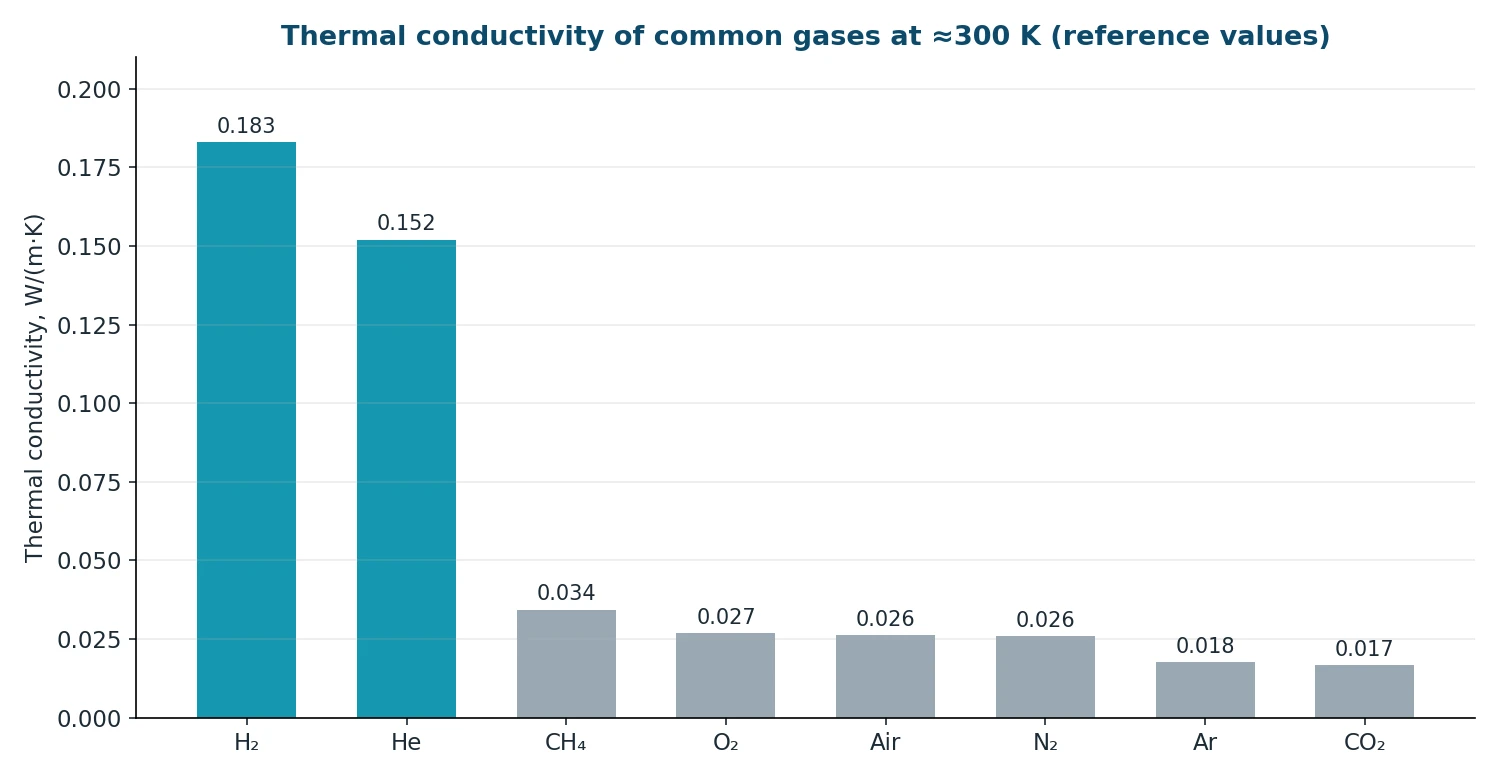
Fig. 1. The thermal conductivity of hydrogen is roughly seven times that of air and nitrogen. The TCD method is built on this difference. Reference values at ≈300 K.
Main Methods for Detecting and Measuring Hydrogen
Catalytic Sensors
The sensing element is coated with a catalyst on which combustible gas oxidises. The released heat raises the element's temperature and changes its resistance, and a bridge circuit converts this change into a signal. The method is designed to monitor combustible gases in air in the range up to the LFL.
Its limitations follow from the principle. The reaction needs oxygen, so the sensor does not work in an inert atmosphere or in pure hydrogen. The catalyst loses activity when exposed to silicon compounds, sulphur compounds and a number of other substances. In addition, the sensor responds to any combustible gas and cannot distinguish hydrogen from methane.
Electrochemical Sensors
Inside the cell, hydrogen oxidises at the working electrode, and the resulting current is proportional to the concentration. These sensors are well suited to the ppm range in air and are used in portable and fixed leak detectors.
The electrolyte and electrodes are consumed over time, so the cell has to be replaced periodically. Readings depend on temperature and humidity, and cross-sensitivity to other gases, such as carbon monoxide, is possible. The method is not intended for high concentrations or for pressurised process lines.
Metal Oxide Semiconductor Sensors
A heated metal oxide film changes its conductivity when a reducing gas is adsorbed on its surface. These sensors are compact and sensitive but have poor selectivity: they respond to many gases and depend noticeably on humidity and temperature. They are used mainly to indicate leaks rather than for quantitative measurement.
Gas Chromatography
The sample is separated into its components in a column, and each component is detected individually. A properly configured gas chromatograph can separate and quantify multiple components of a gas mixture and is widely used for detailed laboratory analysis. The trade-off is sampling, a carrier gas and a discrete analysis cycle: results arrive after tens of seconds or minutes rather than continuously. Notably, gas chromatographs often use a thermal conductivity detector to determine hydrogen, which is the same physical principle as in industrial TCD analyzers.
Mass Spectrometry
Molecules are ionised and separated by their mass-to-charge ratio. The method is selective and sensitive. It is used in laboratories and in leak testing, where a hydrogen-containing mixture serves as the tracer gas. A mass spectrometer requires a vacuum system and gas sampling, which makes it poorly suited to continuous monitoring directly in a process line.
Thermal Conductivity Detector (TCD)
Thermal Conductivity Detection measures how effectively a gas mixture carries heat away from a heated element. No reaction with the gas takes place, no oxygen is required, and the sensing element is not consumed. Because hydrogen differs sharply in thermal conductivity from most background gases, the method produces a strong measuring effect. Depending on the sensor design, gas pair and calibration, TCD analyzers can cover measurement tasks ranging from low hydrogen concentrations to 100 vol.%, which makes them suitable both for concentration measurement and for purity monitoring.
The method has one fundamental limitation: TCD measures a property of the mixture as a whole. It is therefore intended for binary and quasi-binary mixtures. A binary mixture consists of two gases, for example H₂ in N₂. A quasi-binary mixture contains more components, but the background gases are present in stable, low concentrations or have similar thermal conductivity. If the background composition varies arbitrarily, the method cannot be applied without additional measures.
Comparison of Methods
|
Method |
Physical principle |
Typical task |
Key limitation |
|
Catalytic |
oxidation on a catalyst |
combustible gases in air, up to LFL |
requires oxygen, catalyst poisoning, not selective |
|
Electrochemical |
oxidation at an electrode |
leaks, ppm levels in air |
consumable cell, cross-sensitivity |
|
Metal oxide |
change in film conductivity |
leak indication |
low selectivity, humidity influence |
|
Gas chromatography |
separation in a column |
detailed multi-component analysis, laboratory |
sampling, discrete cycle |
|
Mass spectrometry |
separation by ion mass |
laboratory, leak testing |
vacuum, sampling |
|
TCD |
thermal conductivity of the mixture |
H₂ concentration and purity in the process, up to 100 vol.% |
binary and quasi-binary mixtures only |
How Thermal Conductivity Measurement Works
The measuring cell contains a heated element. The electronics keep its temperature constant while the surrounding gas continuously draws heat away. The more hydrogen the mixture contains, the more intense the heat dissipation and the more power the element needs. The electronics convert this power into a concentration using a calibration curve established for the specific gas pair.
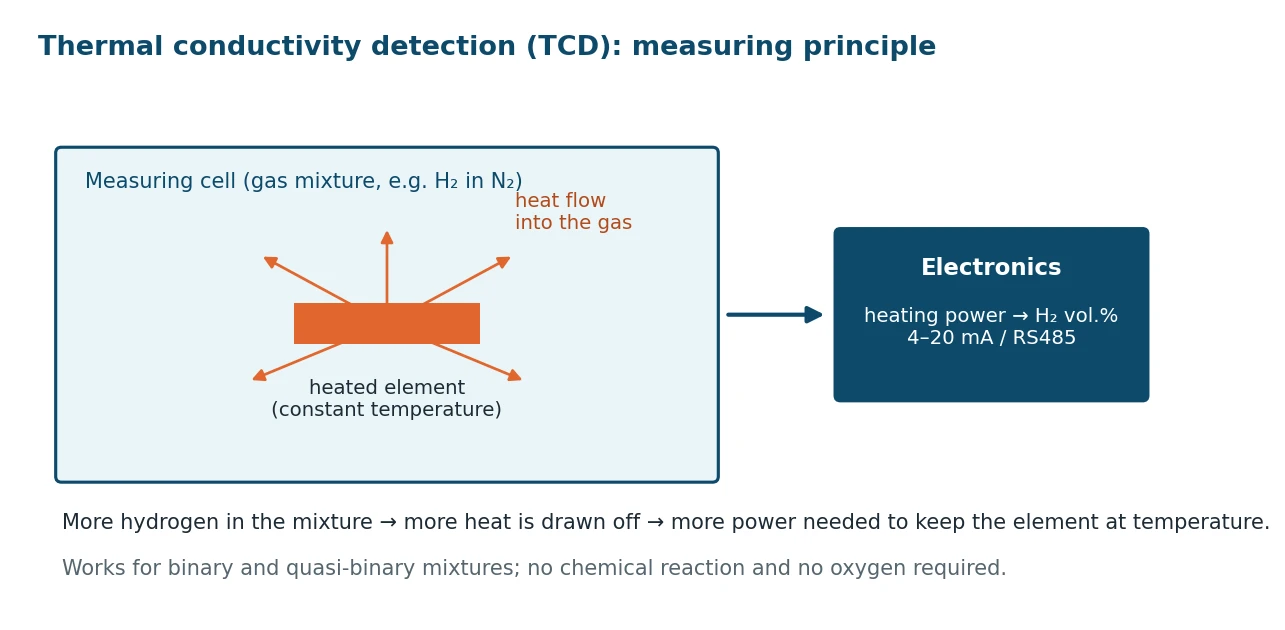
Fig. 2. TCD principle: the hydrogen concentration is derived from the power needed to keep the heated element at a constant temperature.
The principle has several practical consequences.
Calibration for a gas pair. The curve for H₂ in N₂ differs from the curve for H₂ in O₂ or H₂ in CH₄. The analyzer is therefore calibrated for a specific mixture, and the smallest measuring range depends on the background gas.
Pressure, temperature and flow effects. These parameters affect heat dissipation. Well-documented analyzer specifications list their influence as separate items, and these are the figures worth checking when selecting an instrument.
Speed. Heat exchange involves no chemical reaction and no diffusion through a membrane, so response speed is determined mainly by the cell design. In compact sensors, this makes response times in the millisecond range achievable.
Extractive Sampling or Direct Inline Measurement
The second key decision concerns not the method but how the analyzer is connected to the process.
Extractive configuration. Gas is drawn off through a sample probe, transported through a heated line where necessary, cleaned by filters, reduced in pressure by a regulator and stabilised in flow before it reaches the analyzer. After measurement, the gas is vented to a flare or returned to the process. This arrangement allows the use of instruments that are not rated for line conditions, but it adds transport delay, a risk of condensation and multiple additional components that require maintenance.
Inline configuration. The sensor is screwed into the process line, so the sensing element sits directly in the process gas. The gas remains inside the closed system, and the signal reflects the composition at the installation point without any sample transport delay. There is one condition: pressure, temperature, humidity and wetted materials must all be within the sensor's specification. For maintenance, the measuring point is usually fitted with isolation valves and a port for calibration gas.
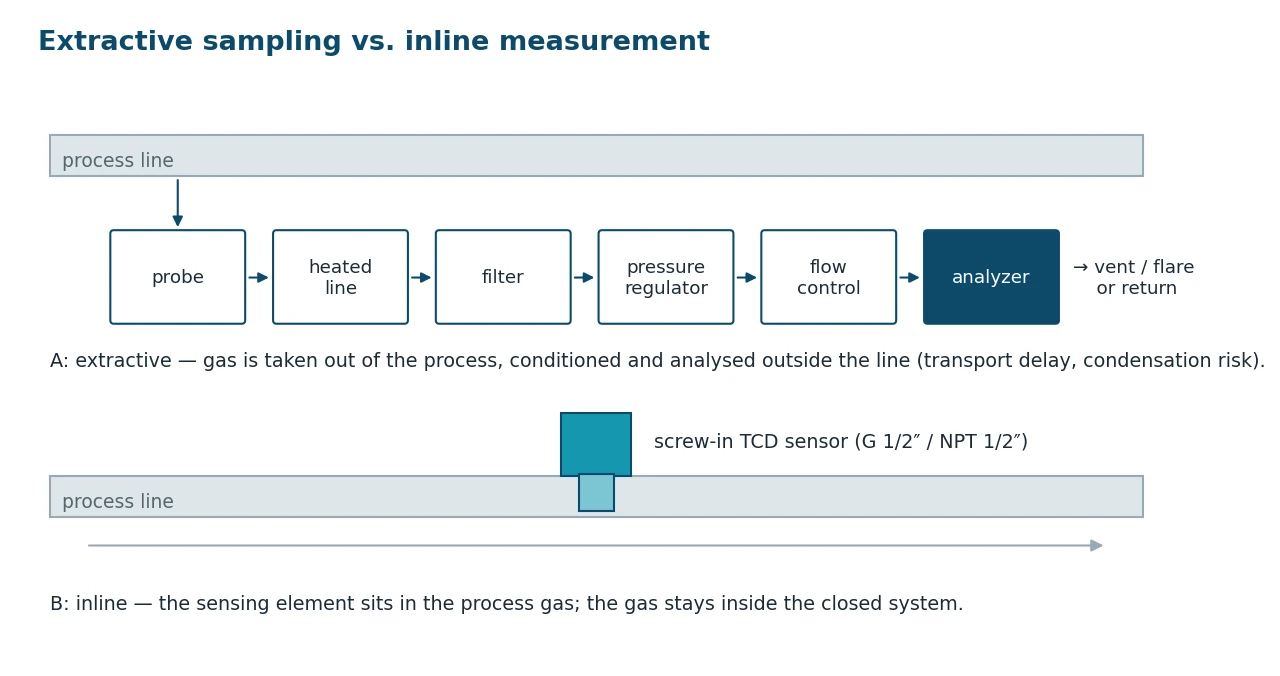
Fig. 3. Extractive configuration with a sample conditioning system (A) and a screw-in sensor installed directly in the process line (B).
Where Hydrogen Monitoring Is Required
Typical measurement tasks for TCD analyzers are listed below. Each entry names the gas pair on which the calibration depends.
-
Electrolysis. H₂ in O₂ on the oxygen side to monitor the LFL under high humidity; O₂ in H₂ on the hydrogen side to monitor the upper flammability limit (UFL).
-
Fuel cells. H₂ in air in the exhaust gas to monitor the LFL at very high water content.
-
Hydrogen injection into the gas grid. H₂ in natural gas across 0–100 vol.% for blending control.
-
Ammonia synthesis and decomposition. H₂ in a mixture of N₂ and NH₃ for process control.
-
Hydrogen-cooled turbogenerators. H₂ in air and H₂ in CO₂ during filling and purging of the generator housing.
-
Protective atmospheres. H₂ in N₂, for example 0–10 vol.%, in forming gas production systems.
-
Safety monitoring in defined gas environments. H₂ in air where the background composition is known and the TCD analyzer is configured for the required range.
How to Choose a Method: Questions to Answer Before Selecting an Instrument
Before requesting a quotation, it helps to answer a few questions. The answers determine not only the method but also the instrument version.
-
What is the task: detection, concentration measurement or purity monitoring? Leak alarms in a room and measurement in a process line call for different instruments.
-
What is the background gas, and is its composition stable? For TCD, this is the decisive question: is the mixture binary or quasi-binary?
-
What concentration range is needed? Fractions of a percent, tens of percent or the region close to 100 vol.%.
-
What are the pressure, temperature and humidity at the measuring point? These determine whether inline installation is possible or sample conditioning will be required.
-
Is the installation site a hazardous area? If so, an instrument with appropriate certification, such as ATEX and IECEx, is required.
-
How fast must the response be? For safety functions and dynamic processes, the difference between milliseconds and tens of seconds is significant.
-
How will the signal reach the control system? Via a 4–20 mA analog output, an RS485 digital interface, or both.
-
How will calibration be performed? Is a service visit required, or can the procedure be carried out on site with calibration gas?
Frequently Asked Questions
Does a hydrogen sensor need oxygen to work?
It depends on the measurement principle. Catalytic sensors require oxygen for hydrogen oxidation and therefore cannot operate on the same principle in an inert atmosphere. A thermal conductivity detector does not require oxygen because it measures a physical property of the gas mixture.
Can one sensor monitor both hydrogen and a nitrogen purge?
Yes, if the analyzer supports several stored calibrations. Some industrial TCD analyzers can hold multiple measuring ranges and gas pairs, for example H₂ in air and N₂ in O₂, and switch between them via software.
How often does a TCD analyzer need calibration?
The interval is specified by the manufacturer and depends on the measuring range, process stability and accuracy requirements. For TCD analyzers, calibration is typically carried out with calibration gases that match the configured gas pair, and in many cases the procedure can be performed on site.
Why does a specification refer to a particular measuring range, such as 0.5 vol.% H₂ in N₂?
Noise, drift and repeatability depend on the gas pair and the width of the range. They are stated for defined conditions so that the values can be compared and verified.
Can hydrogen be measured in a mixture where several components change at the same time?
A single TCD sensor measures binary and quasi-binary mixtures correctly. If the background is multi-component and unstable, the task should be discussed with the manufacturer on the basis of the actual gas composition.
Conclusion
A burning splint confirms hydrogen in a test tube, but industrial applications need an instrument chosen for the task. Catalytic, electrochemical and metal oxide sensors are used to indicate leaks in air. The full composition of a mixture is determined in the laboratory by chromatography and mass spectrometry. For continuous measurement of H₂ concentration and purity in suitable binary or quasi-binary process gas mixtures, TCD is particularly well suited to inline applications, including measurements under pressure and at high humidity. Before making a choice, it is important to define the background gas, the range, the conditions at the measuring point and the explosion protection requirements: these parameters determine both the method and the instrument version.