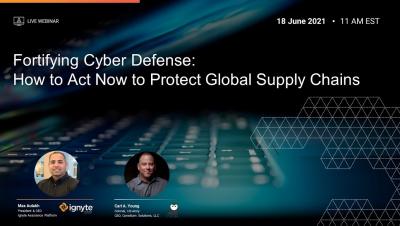
Engaging with third-party vendors for the provision of goods and services isn't new. The level of digital transformation, paired with the number of third-party relationships and business partners the average organization has is. Third-party risk management programs need to evolve the manage this ever evolving type of risk exposure. Enterprise-wide organizations rely on third and fourth-party vendors. And many of them have access to sensitive data.
Globalization and increasing regulatory pressure means more organizations need to examine their third-party vendors, service providers and supply chain in order to assess the level of risk, inform decisions and comply with laws. Failure to adequately assess third-party and fourth-party risk exposes organizations to reputational risk, operational risk, cyber risk, government inquiry, monetary penalties and criminal liability, Ignorance is no longer a valid defense.
You’ve seen the high-level stats on the cybersecurity skills gap, but I’ll remind you of some of the main ones from the (ISC)2 Cybersecurity Workforce Study: As the gap persists, Tripwire continues to keep a pulse on how the skills gap issue is actually being felt by the security experts who are responsible for defending their organizations from cyber attacks every day.
What is cyber resilience? If you search the definition within the Oxford Dictionary, resilience alone is defined as “the capacity to recover quickly from difficulties; toughness.” If you narrow the definition down to cyber resilience, it shifts to maintaining vs recovery. As noted on Wikipedia, it becomes “the ability to provide and maintain an acceptable level of service in the face of faults and challenges to normal operation.”
Cybersecurity threats are evolving and the IT industry is on high alert. Modern cyber threats are more sophisticated and fast such as malware, phishing, cryptojacking, and IoT threats. The major cyber-attacks in 2019 witnessed that cybersecurity defenses were inefficient to prevent cyber threats altogether. The situation will even prevail in 2020. However, mitigation strategies can help to minimize the chances of data breaches.
Companies are facing increased and complex cybersecurity challenges in today’s interconnected digital economy. The cyber threats have become more sophisticated and may harm a company via innovative new forms of malware, through the compromise of global supply chains or by criminal and hostile state actors. The hard truth is that it is difficult to counter the ever-expanding cyber-criminal economy.
A few years ago, I myself was vished, or ‘phished,’ over the phone. The caller was someone, likely offshore in a call center, who had done a little bit of research online to find my name, my phone number, my wireless phone carrier and a few other details that they used to build rapport with me on the phone. Spoofing the customer service phone number of my wireless service provider, they called me and claimed that a credit was being added to my bill.