Security | Threat Detection | Cyberattacks | DevSecOps | Compliance

Turn Unstructured Content Into Searchable Intelligence With Bulk Extraction

“Enterprises that don’t have a metadata-driven approach to modernization could end up spending as much as 40% more on data management.” – Gartner That finding highlights a challenge many organizations underestimate: managing content is easy, but understanding what’s inside is much harder. Files get uploaded, folders multiply, and before long, your content repository looks like a digital attic—full of things that might be valuable, but impossible to sort.

Taming the Unstructured Data Beast: Why Life Sciences Needs a New Playbook

In the world of life sciences, data is the lifeblood of discovery. But today, that lifeblood is more like a tidal wave. We’ve moved far beyond simple spreadsheets—there’s now an explosion of unstructured data with variety, velocity, and volume that’s daunting, even for large companies. According to some estimates, unstructured data now accounts for nearly 80% of all data generated by organizations.

Connecting the Office and Field: A Better Approach to Construction Data Management

Construction projects depend on timely decisions. When a superintendent needs the latest drawing set, a project engineer must review submittals, or a project manager wants to reference lessons learned from a past project, access to accurate information directly impacts project outcomes. Yet many construction firms still struggle with information scattered across jobsite photos, RFIs, specifications, BIM models, emails, and project management systems.

Latency Lessons From Building a ReAct AI Agent for Agentic Search

Egnyte AI surfaces insights from an organization's documents for regulated industries—life sciences, financial services, architecture, engineering, and construction—and does that within existing permissions and compliance controls. Our AI Assistant is the conversational front door. Ask a question about your documents in plain language, summarise a contract, find the latest version, pull a compliance clause, and get an answer grounded only in the files you're permitted to see.

Build Agents, Automate Workflows, and Unlock Your Content-All in One Platform

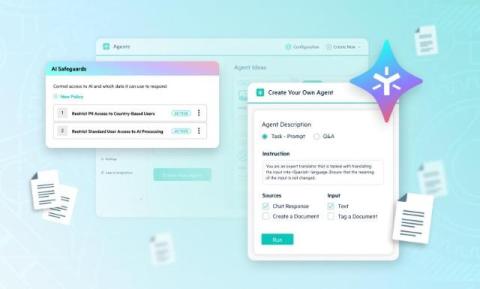
88% of organizations are running AI in at least one workflow, yet nearly two-thirds report more rework than savings. The model is rarely the bottleneck. Everyone has access to the same frontier models now. The difference is what sits underneath: content that's unstructured, ungoverned, and disconnected from the workflows that need it. Fixing the content problem usually means giving AI broad access to content, and that's where governance breaks down.

June Release Rollup: Building Code Analyst, AI Assistant, and More

June's release brings a range of updates across Egnyte's platform, with the most notable addition being the Building Code Analyst, an AI-powered tool that helps AEC teams quickly surface relevant code requirements across jurisdictions. The release also includes Adaptive Block Caching (now generally available), expanded AI Assistant capabilities like agent mode and multi-file spreadsheet analysis, and several mobile improvements across iOS and Android.

6 Key Elements of a Responsible AI Usage Policy

Recently, I had the pleasure of presenting an AI governance-focused webinar with my colleague Neil Jones at Egnyte. In the session, we discussed many ways to improve AI governance, and you can watch and share the complete session replay here. During the session, we discussed the importance of respo nsible AI usage policies. However, my experience is that many organisations struggle to create policies aligned with their business requirements and the technological solutions that they use.

Building for AEC: 3 Takeaways From the Egnyte AEC Summit 2026

One month ago, architecture, engineering, and construction (AEC) leaders gathered for the Egnyte AEC Summit 2026. By the end of the summit, the message was clear: AEC is moving past AI experimentation and into operational change. Three takeaways defined the day.

Getting API Credentials Just Got A Lot Simpler

If you've built an integration with Egnyte, you know the process: register at developers.egnyte.com, create an account, wait for approval, and get your credentials. It works, but for admins who simply want to start making API calls against their own domain, the process isn’t simple or fast enough. Starting today, that changes. Egnyte admins can now generate Collaborate API credentials directly from the Egnyte App Store—no external registration, no approval wait, no context-switching.