Cloud Security Posture Management (CSPM) aims to automate the identification and remediation of risks across your entire cloud infrastructure. A core requirement of the CSPM framework is the need to enforce a principle of least privilege. There are certain overlaps with Cloud Infrastructure Entitlement Management (CIEM) solutions. CIEM is a newer categorization that came after CSPM.
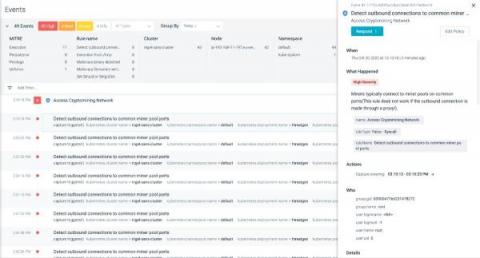
Cryptomining attacks are becoming more notable in-line with the rise of blockchain and cryptocurrencies, so detecting cryptomining has become a high priority. Security researchers have found data breaches related to various cryptominer binaries running within victims’ infrastructures. The default openness of Kubernetes clusters and the availability of the extensive compute power required for mining makes Kubernetes clusters a perfect target for cryptomining attacks.
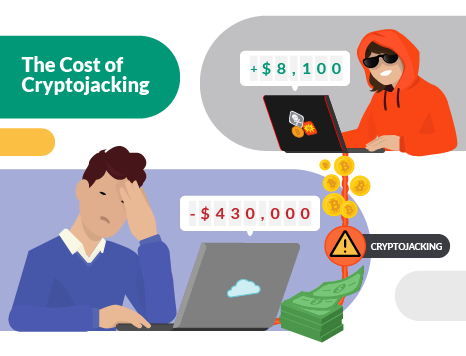
TeamTNT is a notorious cloud-targeting threat actor, who generates the majority of their criminal profits through cryptojacking. Sysdig TRT attributed more than $8,100 worth of cryptocurrency to TeamTNT, which was mined on stolen cloud infrastructure, costing the victims more than $430,000. The full impact of TeamTNT and similar entities is unknowable, but at $1 of profit for every $53 the victim is billed, the damage to cloud users is extensive.
Helm is being used broadly to deploy Kubernetes applications as it is an easy way to publish and consume them via a couple of commands, as well as integrate them in your GitOps pipeline. But is Helm secure enough? Can you trust it blindly? This post explains the benefits of using Helm, the pitfalls, and offers a few recommendations for how to secure it. Let’s get started!
Cyber attacks are an unfortunate reality in our interconnected world. The art of keeping up with malicious actors is challenging, but even more so with the move to cloud-native technologies. As a result, security is evolving. Developers, DevOps, and cloud teams must now learn a new set of best practices that balance shift-left and shield-right security approaches to reduce risk. There has never been a more critical time to revisit your cybersecurity strategy.
Many of the benefits of running Kubernetes come from the efficiencies that you get when you share the cluster – and thus the underlying compute and network resources it manages – between multiple services and teams within your organization. Each of these major services or teams that share the cluster are tenants of the cluster – and thus this approach is referred to as multi-tenancy.
The awaited OpenSSL 3.0.7 patch was released on Nov. 1. The OpenSSL Project team announced two HIGH severity vulnerabilities (CVE-2022-3602, CVE-2022-3786), which affect all OpenSSL v3 versions up to 3.0.6. These vulnerabilities are remediated in version 3.0.7, which was released Nov. 1. The vulnerabilities fixed include two stack-based buffer overflows in the name constraint checking portion of X.509 certificate verification.