Security | Threat Detection | Cyberattacks | DevSecOps | Compliance

91% Reported an OT Cybersecurity Incident. Are Your Critical Systems Protected?

91% of respondents in the energy and utilities sector reported a significant OT cybersecurity incident in the past year. That figure comes from Honeywell’s 2026 OT Security Benchmark. In operational technology (OT), an incident can mean more than compromised data. It can interrupt production, delay maintenance, affect essential services, and put safety and uptime at risk.

Is Your OT Jump Server Giving Vendors More Access Than They Need?

A vendor can bypass MFA and sign in with an individual account while still being able to reach industrial systems unrelated to the job. Before replacing your current setup, follow one real service request from approval through completion. The exercise can reveal outdated permissions, unnecessary network connectivity, shared credentials, or records that are difficult to retrieve when you need them.

OT: The Other Technology Evolution

Written by Bill Moore, CEO & Founder TL;DR In Part 1 of this series, I looked at how computing and telecommunications gradually became what we now call Enterprise IT. That change did not happen because someone decided to merge two departments. It happened because the technologies, the systems, and the work they supported became too interconnected to describe separately.

The Dawn of Enterprise IT: Part 1 of the Enterprise OIT Series

There was a time when “Information Technology” wasn’t a department, an industry, or even a common business term. In the 1970s and 1980s, computing and telecommunications were largely separate disciplines. Computers processed information. Telecommunications moved information. Most systems operated independently, often serving specific departments or business functions. Then those worlds began to converge. Organizations started connecting computers through networks.

CMMC Scope Reduction Strategy: A Control Map for Third-Party Engineering Access

Every defense contractor preparing for CMMC has the same expensive surprise: the third-party engineering firm with VPN access into one file server just doubled the size of their assessment. CMMC, the Cybersecurity Maturity Model Certification that DoD will require on covered solicitations starting November 10, 2026, is scored against the systems that touch Controlled Unclassified Information, or CUI.

4 steps teams can take to mitigate Iranian cyberattacks on critical infrastructure

COMMENTARY: When the United States and Israel launched coordinated strikes against Iran on February 28, the security community mobilized around the visible response. I’ve watched that response for two weeks: teams tracking hacktivist DDoS campaigns, incident counts climbing, news coverage following close behind.

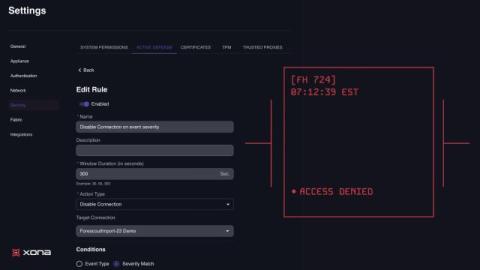
Introducing Active Defense: Automated Session Enforcement for OT Remote Access

Remote access into OT and ICS environments has always carried risk. But the nature of that risk has changed. Threat detections now happen in seconds. Sensors identify anomalous behavior in real time. Identity platforms continuously evaluate trust. SIEM and OT security tools generate rich, contextual alerts instantly. Yet in most environments, access enforcement is still manual. A detection triggers a ticket. A human reviews. A decision is made. Minutes—or hours—pass before action is taken.

Xona Platform v5.5 is Now Available

TL;DR Xona Platform v5.5 strengthens remote access across distributed OT environments. It introduces session resilience to maintain continuity during network interruptions, expands centralized governance for more consistent access control, and enhances support for constrained or disconnected deployments. In critical infrastructure environments, remote access is not abstract. It supports maintenance windows, emergency response, vendor coordination, and day-to-day operations across distributed sites.


Top 6 Takeaways from the 2025 KuppingerCole Leadership Compass for Secure Remote Access in OT/ICS

Secure remote access (SRA) is no longer a stopgap or an IT workaround; it’s become foundational to industrial cybersecurity. According to KuppingerCole, demand for SRA in OT and ICS environments is accelerating due to the convergence of IT and OT networks, rising cyber threats, and mounting regulatory pressure. Traditionally, remote access in industrial environments was limited, heavily manual, and often avoided due to risk.