Security | Threat Detection | Cyberattacks | DevSecOps | Compliance

Security Policy Self-Service for Developers and DevOps Teams

In today’s economy, digital assets (applications, data, and processes) determine business success. Cloud-native applications are designed to iterate rapidly, creating rapid time-to-value for businesses. Organizations that are able to rapidly build and deploy their applications have significant competitive advantage.
How to Secure the network of your GKE Cluster

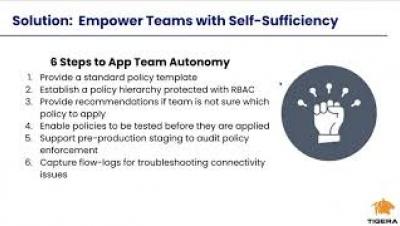
By default, pods are non-isolated; they accept traffic from any source. The Google GKE solution to this security concern is Network Security Policy that lets developers control network access to their services. Google GKE comes configured with Network Security Policy using Project Calico which can be used to secure your clusters. This class will describe a few use cases for network security policy and a live demo implementing each use case.

How to Secure the network of your GKE Cluster

By default, pods are non-isolated; they accept traffic from any source. The Google GKE solution to this security concern is Network Security Policy that lets developers control network access to their services. Google GKE comes configured with Network Security Policy using Project Calico which can be used to secure your clusters. This class will describe a few use cases for network security policy and a live demo implementing each use case.

How to Implement Network Policy in Amazon EKS to Secure Your Cluster

By default, pods are non-isolated; they accept traffic from any source. The Amazon EKS solution to this security concern is Network Policy that lets developers control network access to their services. Amazon EKS comes configured with Network Policy using Project Calico which can be used to secure your clusters. This class will describe a few use cases for network policy and a live demo implementing each use case.

Enforcing Enterprise Security Controls in Kubernetes using Calico Enterprise

Hybrid cloud infrastructures run critical business resources and are subject to some of the strictest network security controls. Irrespective of the industry and resource types, these controls broadly fall into three categories. Workloads (pods) running on Kubernetes are ephemeral in nature, and IP-based controls are no longer effective. The challenge is to enforce the organizational security controls on the workloads and Kubernetes nodes themselves.

Calico Enterprise Multi Cluster Management - Federated Identity and Services

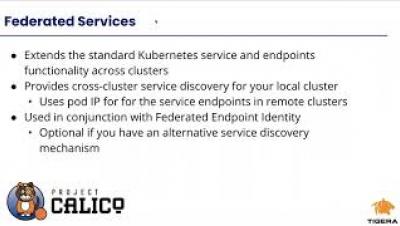
Learn how to simplify deployment and ongoing operations for more than one cluster running Calico Enterprise. What is Calico Enterprise Multi-Cluster Management How is Calico Enterprise Multi-Cluster architected How to set up Calico Enterprise Multi-Cluster Management How to enable Federated Endpoint Identity and Services for Multi-Cluster use cases A Calico Enterprise trial is available after this session and you will be able to practice these use cases on your own within a hosted lab.

Enterprise Security Controls for Kubernetes

In this talk, we will explore how to meet common enterprise security control needs when running Kubernetes. Specifically, we will look at a range of common enterprise security needs and how you can meet these with standard Kubernetes primitives and open source projects such as Calico, or take it a step further with the additional features of Calico Enterprise.

Now GA: Data-in-Transit Encryption in Calico v3.15

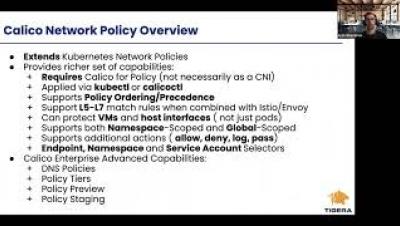
We’re excited to announce that the latest release of Calico includes encryption for data-in-transit. Calico is the open source networking and network security solution for containers, virtual machines, and host-based workloads, offering connectivity and security for container workloads. One of Calico’s best-known security features is its implementation of Kubernetes Network Policy, providing a way to secure container workloads by restricting traffic to and from trusted sources.