Security | Threat Detection | Cyberattacks | DevSecOps | Compliance

Meta Muse in the Enterprise: Data Security for Personal Autonomous Agents

The deployment of personal AI agents like Meta's Muse represents a structural shift in enterprise data loss prevention. Unlike conversational web chatbots where data movement is limited to manual user prompts, autonomous personal agents operate in cloud virtual machines, run continuous background tasks, and connect directly to enterprise SaaS platforms through OAuth integrations.
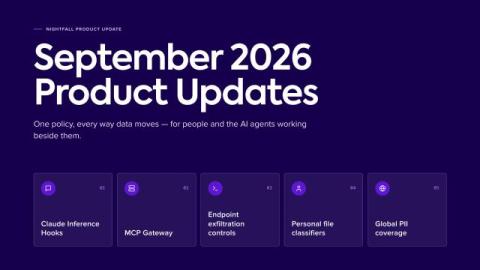
September 2026 Product Updates

September was the month Nightfall's control layer reached inside the model call. Five releases shipped: Claude Inference Hooks, MCP Gateway, expanded endpoint exfiltration controls, personal file classifiers, and PII coverage across 30 countries. Together they close the gap between what security teams can control when a person moves data and what they can control when an AI agent does.

AI Agent Security Explained: Agents, MCP, Prompt Injection, and the AI Harness

AI Agent Security is quickly becoming one of the most important areas in cybersecurity. Terms like "agent," "harness," "MCP," "tool calls," "tool responses," "instruction hijacking," "indirect prompt injection," "prompt exfiltration," and "tool misuse" are appearing in conference talks, vendor announcements, podcasts, and industry discussions, often without clear explanations.

Nightfall's integration with Claude's Compliance API is now live

What this milestone means for enterprise AI security - and why we built it. AI adoption inside the enterprise didn't slow down and wait for security to catch up. It accelerated. And nowhere is that more visible than in the rapid deployment of large language models like Claude across enterprise workflows. Customer support teams use it to summarize tickets. Legal teams use it to review contracts. Engineers use it to write and review code. Finance teams use it to draft reports.

Securing Your AI Agents: Today's New Data Threat

AI agents are already inside your company - reading files, calling APIs, executing code. Most of them were never approved by security. In this session, Nightfall AI walks through exactly how agents become an attack surface: prompt injection, malicious MCP servers, credential exfiltration, and more.

Why MCP Breaks the Financial Services Security Stack

A relationship manager asks the firm's AI assistant to "summarize my top wealth clients by AUM and flag anyone with a pending transfer over $500K." The agent calls a CRM MCP server, then a core banking MCP server, then a market data MCP server, and returns a clean answer in twelve seconds. Names, balances, account numbers, pending wire details, all rendered in plain text inside the chat window. No file moved. No email left the network. No DLP channel triggered.

CISA's GitHub Leak Is a Preview of the MCP Security Problem Every CISO Is About to Inherit

America's cybersecurity agency left its production credentials sitting in a public GitHub repo for six months. The same failure pattern is now being automated by AI agents in every enterprise running Cursor, Claude Desktop, or Copilot.

What Is MCP Security? 9 Things Every CISO Needs to Know

Your AI agents had a productive day. Nobody can tell you what data they touched. A developer opens Cursor and connects it to a GitHub MCP server and a Postgres MCP server. The agent reads the repo to understand a schema change, finds an AWS access key in a config file, and uses it to run a migration against staging. The key now lives in the agent's context, in the Postgres query log, in the chat history, and in whatever artifact the developer copies out. No alert fired. No policy triggered.

How to Monitor MCP Usage: A 10-Step Security Checklist for 2026

What you need to know: MCP can evade traditional DLP, IAM, and SIEM controls because agent traffic looks like authorized API calls, sensitive data is semantically transformed before it leaves the perimeter, and exfiltration happens through tool invocations rather than file transfers.