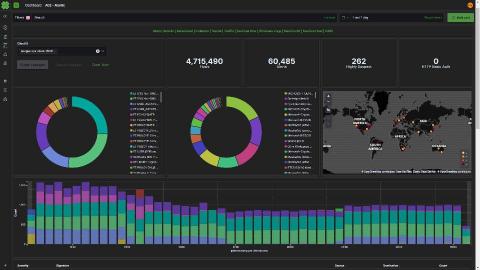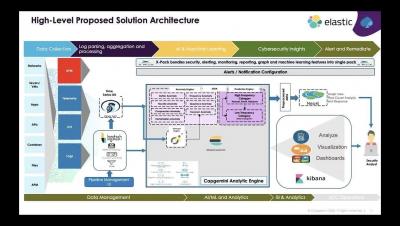
Léargas Security (Léargas is Gaelic for “insight”) provides clients with actionable insights into anomalous or abstract behaviors through the correlation of data gathered from converged security controls: cyber and physical.
What I love about our free and open Elastic SIEM is how easy it is to add new data sources. I’ve learned how to do this firsthand, and thought it’d be helpful to share my experience getting started. Last October, I joined Elastic Security when Elastic and Endgame combined forces. Working with our awesome security community, I’ve had the opportunity to add new data sources for our users to complement our growing catalog of integrations.
If you want to skip ahead to see the MITRE ATT&CK eval round 2 results visualized in an easy-to-configure Kibana dashboard, check it out here.
Six months ago we celebrated the joining of forces between Endgame and Elastic under the banner of Elastic Security and announced the elimination of per endpoint pricing. Simultaneously, while the newest members of Elastic Security were getting acquainted with the Elastic SIEM team, a few of our analysts were locked away in an office at MITRE HQ for round 2 of MITRE’s APT emulation.
Confession: I am a security practitioner. I am also a mom. What I am not is a homeschool teacher. Earlier this year, I spoke to the 5th- and 6th-grade classes at my son’s Innovation Day about cybersecurity. I discussed what it means to be a cybersecurity practitioner and how the practice of cybersecurity affects everyday life.
Many mature security teams look to the MITRE ATT&CK® matrix to help improve their understanding of attacker tactics, techniques, and procedures (TTPs) and to better understand their own capabilities relative to these common adversarial approaches. With the release of Elastic Security 7.6, Elastic SIEM saw 92 detection rules for threat hunting and security analytics aligned to ATT&CK.