The healthcare industry has rapidly embraced digital technologies to enhance patient care, streamline operations, and improve communication. However, this digital transformation brings with it a significant challenge: protecting patient data. One often overlooked risk comes from tracking pixels, which can lead to (accidental) data leakage and privacy breaches.
In the ever-evolving landscape of cybersecurity, staying ahead of threats and ensuring the safety of sensitive customer data is paramount. For organizations that handle payment card information, complying with industry standards like PCI DSS (Payment Card Industry Data Security Standard) is not only a best practice, but a compliance requirement that can result in hefty fines upwards of $100,000 a month.
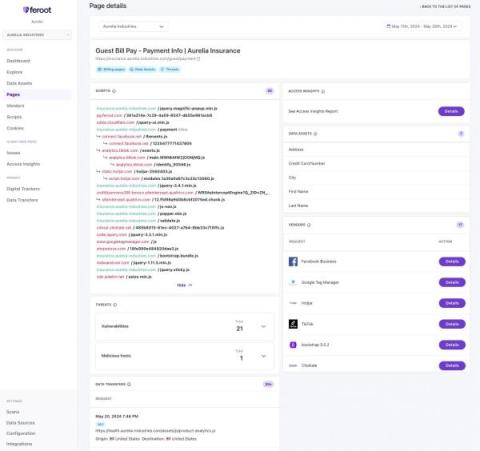
By analyzing over 3,000 websites and over 100,000 associated webpages (using the client-side security scanning feature of Feroot Inspector) across 6 sectors, it was determined that pixels/Trackers transfer data to almost 100 countries around the globe. Table 1 shows the top 40 destinations of data being transferred by pixels/trackers collecting data from the analyzed websites – all of which were US-based.
In an analysis of over 3,000 websites and over 100,000 associated webpages (using the client-side security scanning feature of Feroot Inspector) found pixels/trackers on 95% of their websites. Each website in the study corresponds to an unique organization (company, non-profit, or government agency). The high 95% reflects the extent of data harvesting that is done by marketing, advertising, and performance platforms today.
Analysis on 3,000 websites and over 100,000 associated webpages (using the client-side security scanning feature of Feroot Inspector) revealed that pixels/trackers are collecting and/or transferring data prior to the explicit consent (e.g., cookie acceptance) of a website user. (While some do not require actual consent for one reason or another, the consent is not explicitly made.) Table 1 shows the degree to which some pixels/trackers were present on the analyzed websites.
In an analysis of over 3,000 websites and over 100,000 associated webpages (using the client-side security scanning feature of Feroot Inspector) across 6 sectors, it was discovered that TikTok pixels/trackers were present on 7.41% of the analyzed websites (shown in Table 1). Here, TikTok pixels/trackers were within the code of the web pages that load into a user’s browser from those websites.