Security | Threat Detection | Cyberattacks | DevSecOps | Compliance

Types of AI Guardrails and When to Use Them (2026)

The types of AI guardrails are input guardrails, output guardrails, security guardrails, ethical guardrails, and operational guardrails, each positioned at a different failure point across an inference pipeline. Gartner’s research found that 30% of generative AI projects don’t survive past the proof-of-concept stage, with weak risk controls cited as the leading reason. Most of those projects weren’t badly built. The models worked. The gaps were in what sat around them.

What Is AI Context Security?

Every enterprise wants to use AI on its most valuable data — customer records, financial documents, clinical notes, legal files, engineering IP. The problem is simple: the moment that data enters an AI workflow, traditional security stops working. Firewalls protect the network. Encryption protects data at rest. Access controls protect the database. But none of them protect what happens when an AI agent retrieves five documents, synthesizes an answer, and delivers it to a user.

How to Secure AI Agents Accessing Enterprise Data: A Complete Guide

Artificial intelligence is changing how a business handles its operations, and that too very rapidly. AI agents can easily read, analyze, and act on enterprise data in real time. This ease also brings serious risk. If not managed well, these systems can expose sensitive information, break compliance rules, or even make harmful decisions. Did you know that on average, the overall cost of a data breach reached $4.45 million in 2023?

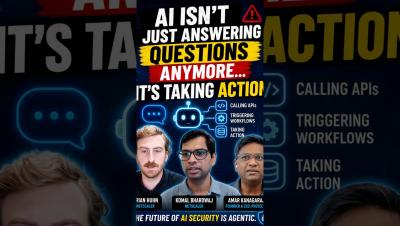
Why Your Security Tools Are Useless Against AI?#short #ai

Most companies believe their security tools—WAF, EDR, API gateways—are enough to stop cyber attacks. But AI has changed the game. AI-powered attacks: –Learn your security patterns–Adapt in real-time–Bypass traditional defenses These tools were built for a predictable world. AI attackers are non-stop, intelligent, and evolving. That’s why even the best security systems are failing against modern AI threats.

7 Generative AI Security Risks and How to Defend Your Organization

Generative AI creates new attack surfaces that traditional security tools were not designed to address. The biggest generative AI security risks include prompt injection, data leakage, shadow AI, compliance exposure, model poisoning, insecure RAG pipelines, and broken access control. Each one requires a specific defense, not a generic firewall or DLP rule.

3 Reasons Your Security Can't Stop AI Attacks #shorts #ai

Is your SOC ready for the 10-minute attack? In 2026, traditional Security Operations Centers are failing to stop Agentic AI Attacks. Why? Because agents don't follow the rules of legacy software. In this Short, we break down the three reasons your current defense is obsolete. The 3 Reasons Your SOC is Too Slow.

Real-Time AI Security: Securing Autonomous Agents in 2026

Is your security stack ready for the agentic revolution? As we move into 2026, Real-Time AI Security has become the new frontier for enterprise protection. In this episode of AI on the Edge, Amar (CEO of Protecto) sits down with security veteran and investor Anand Tangiraja to discuss why traditional "shift left" strategies and legacy tools are failing in the face of autonomous agents.

What is the NIST AI Risk Management Framework?

The NIST AI Risk Management Framework is a guide that helps organizations spot and reduce risks in AI systems. This framework was released in January 2023 by the U.S. National Institute of Standards and Technology. The framework is built around four key steps, namely: Govern, Map, Measure, and Manage, and is meant to help teams responsibly use AI. It doesn’t matter which industry you work in or which AI you use; this framework works everywhere.

NVIDIA Just Made AI Agents Production-Ready #ai #shorts

AI agents just became production-ready overnight. With NVIDIA’s new NeMo Guardrails / NemoClaw-style agent control systems, AI agents can now operate in controlled environments with policies, sandboxing, and guardrails. Sounds safe… but there’s a catch. Agent safety protects what the AI does. But it doesn’t secure what the AI knows. And that’s where the real enterprise risk appears. In this video we break down the difference between.