Security | Threat Detection | Cyberattacks | DevSecOps | Compliance

Visibility Is Not Enough: The Case for Control at the Endpoint

Most security programs have more visibility than ever. Dashboards are full. Alerts are firing. And incidents are still happening. That contradiction is not a coincidence. It reflects something most security vendors have quietly avoided saying out loud: Visibility and control are not the same thing, and for a long time, the industry has been selling one while calling it the other.

Endpoint AI Agents: The New Security Blind Spot

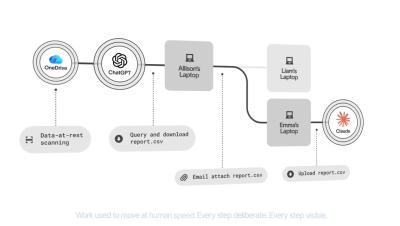
Security teams that have invested in AI governance programs over the past two years face a problem that those programs were not designed to solve. The controls built to manage generative AI, network proxies, browser monitoring, and SSO enforcement work when data moves through defined channels. Endpoint AI agents do not move through those channels. They run locally, operate at the OS level, and access data through pathways that exist entirely outside your current visibility.

How to Build an Agentic AI Governance Framework

AI agents are already running inside your organization. They are accessing files, calling APIs, and executing multi-step workflows with no human reviewing each action. Most governance programs were not designed for this. They were built around policies for human users, controls for known data channels, and audits that happen after the fact. None of those structures were designed to govern systems that act at machine speed across every environment where data lives.

Cyberhaven Analyst Plugin: AI-Assisted Security Investigation in Claude Code and Codex

Security teams have a data problem. Not a shortage of data, but instead there is a growing data surfacing problem. The signals are there, the incidents are logged, and the classifications exist. But, getting from raw data to a prioritized action plan still requires close to an hour of manual querying, tab-switching, and context reconstruction, every single time. The Cyberhaven Analyst Plugin changes that.

Agentic AI Security: Visibility and Control for AI Agents at Work

Security teams have spent years tracking what employees do with data. The harder problem now is tracking what agents do on their behalf. AI agents, whether running in an IDE, installed locally on a laptop, or connected to internal data through a model context protocol (MCP) server, operate with the permissions of the user who deployed them. They read files, query databases, call external APIs, and generate outputs. And in most enterprise environments, security teams have no reliable way to see any of it.

What Your Data Loss Prevention Tool Misses Every Single Day

In this video, you will learn why legacy DLP tools go blind when sensitive data is copy-pasted into generative AI tools, how Data Lineage fingerprints information at its origin to track it across transformation within an environment, and how operating system-level monitoring eliminates the encryption blindness that limits browsers and firewalls. You will also see how to build context-aware paste policies that allow productive AI use while blocking high-risk data flows from sources like source code repositories, Salesforce, and internal wikis.

Standalone Browser Extension: Data Security Without the Endpoint Agent

Most enterprise data security tools are built for a world where IT owns and manages every device. That world no longer exists. Contractors work from personal laptops. Entire teams run ChromeOS. Frontline workers access corporate systems through shared or unmanaged devices. And every one of those browser sessions can involve uploads, downloads, copy-paste, and form inputs touching sensitive data.

The Fastest-Growing AI Categories in the Enterprise Are Also the Riskiest

Security teams often focus governance efforts on the most popular AI tools. But the real risk question isn't which tools employees use most. It's which tools are growing fastest and what data those tools can reach. New data from Cyberhaven Labs shows that the AI categories posting the largest year-over-year growth numbers are the same categories with privileged access to source code, credentials, customer contracts, and internal architecture.

Best Tools for Data Discovery and Classification in 2026

Data discovery has fundamentally changed over the last two years. The question is no longer just "Where is our sensitive data?" Organizations that stop there have a map but no enforcement. The tools that actually reduce risk answer a harder set of questions: Where did the data come from? Where is it going? Who touched it? And can we stop it before it causes damage?

How to Deploy DSPM Across Multiple Cloud Environments

Most enterprises are not running on a single cloud. The vast majority of organizations now operate in hybrid or multi-cloud environments and sensitive data follows wherever workloads go. Regulated files end up in S3 buckets. PII lands in BigQuery development tables. Source code copies into Azure Data Lake repositories that no policy anticipated. The problem is not that organizations chose to spread data across clouds. The problem is that most security programs were not built to track it.