Security | Threat Detection | Cyberattacks | DevSecOps | Compliance

SecOps Automation: How Lean Teams Can Achieve Enterprise-Level Security

The modern threat landscape doesn’t scale down just because your team is lean. Whether you’re a two-person SecOps crew or a full-blown SOC, attackers don’t discriminate — and the alerts don’t stop. Small security teams face the same phishing, ransomware, and insider threats as the world’s largest enterprises — only with fewer hands on deck and less time to respond. To level the playing field, teams are turning to SecOps automation.

The AI SOC Analyst That Offloads 90%+ of Tier-1 Cases - Meet Socrates

Security Operations Centers (SOCs) continue to struggle in 2025. The perfect storm of growing alert volume, consistent talent shortage, and the well-documented limitations of legacy SOAR solutions have brought many SOC teams to a breaking point. At the same time, bad actors continue to innovate, and cybercriminals have become more sophisticated in their tactics and techniques, including using AI to launch attacks at scale.

The Multi-Agent System: A New Era for SecOps

Security teams face mounting pressure to defend against sophisticated cyber threats. Traditional automation strategies are often rigid, reactive, and lack the ability to scale effectively. Many SOCs already have access to generative AI to assist with simple tasks and now Torq has brought agentic AI into the mix — which thinks, acts, and learns autonomously to handle security risks. What’s next?

Three SOC Threats Solved in Minutes with Torq Hyperautomation

Your SOC exists for one core reason: to rapidly reduce the mean time to detect, investigate, and respond to threats. The more efficiently your team operates, the faster you reduce essential KPIs like MTTR, MTTD, MTTI, and what we call ‘MTTx’ (mean time to anything). Ask our Field CISO, Patrick Orzechowski (PO), and he’ll tell you straight: If your SOC isn’t relentlessly focused on reducing risk through speed, you’re falling behind. Talking about efficiency is easy.

CISOs' Unconventional Criteria for Evaluating AI SOC Analysts

Noam Cohen is a serial entrepreneur building seriously cool data and AI companies since 2018. Noam’s insights are informed by a unique combination of data, product, and AI expertise — with a background that includes winning the Israel Defense Prize for his work in leveraging data to predict terror attacks. As the Head of Artificial Intelligence at Torq, Noam is helping build truly next-gen AI capabilities into Torq’s autonomous SOC platform.

The Future of Retail Cybersecurity: SOC Automation

Retail companies are high-value targets for cybercriminals. With sprawling infrastructures, complex supply chains, and large amounts of customer data, retailers are a goldmine for bad actors. In 2024, the retail sector accounted for 24% of all cyberattacks — more than any other industry. The average cost of a data breach in retail rose to $3.28 million.

AI-Powered SOCs, Explained

Security Operations Centers (SOCs) are the command center of an organization’s frontline cybersecurity defenses — responsible for monitoring threats, prioritizing alerts, and orchestrating remediation. However, today’s SOCs are facing an existential crisis: an overwhelming volume of increasingly complex and sophisticated threats combined with a shortage of skilled analysts.

Torq HyperSOC is the first Autonomous SOC Platform with Native Model-Context Protocol (MCP) Support

Innovation in cybersecurity technology, particularly in security operations, is advancing at an incredible pace. The past few months have seen a surge in announcements of Agentic AI solutions and SOC Analyst AI Agents, transforming the landscape rapidly. At BlackHat USA 2023, Torq pioneered this space by introducing Socrates, the first AI Agent SOC Analyst. This highlights the remarkable acceleration of AI adoption in cybersecurity and the significant advancements made in a relatively short period.

HyperSOC-2o: The Game-Changing, Analyst-Validated Autonomous SOC

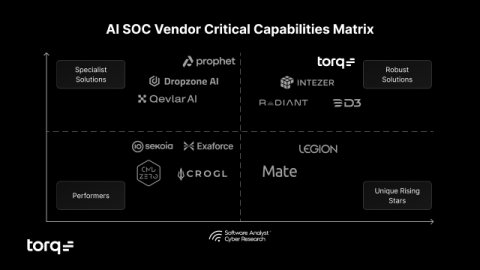
IDC, Gartner, and Cyber Research Analyst Francis Odum validate Torq HyperSOC-2o for establishing the important building blocks for achieving the autonomous SOC. The autonomous SOC is here. It is no longer a distant reality, it’s not a pipe dream, and it’s certainly not just another cybersecurity buzzword.

All Gas, No Brakes: The Autonomous SOC Revolution is Here

The era of static playbooks and reactive security is over. A new generation of AI-driven security operations is emerging — one that combines cloud-native scale with intelligent, agentic automation to redefine how Security Operations Centers (SOCs) work. As CEO of Torq, I’ve had a front-row seat to this transformation. In speaking with countless CISOs and analysts, one theme rings loud and clear: We can’t fight modern threats with yesterday’s tools.