Security | Threat Detection | Cyberattacks | DevSecOps | Compliance

The Best Proactive Cybersecurity Tools for SMEs (and Where They Fall Short)

Most proactive cybersecurity tools for SMEs are designed to stop attacks before damage occurs. That sounds sufficient. It isn’t. In practice, most attacks don’t succeed before defenses activate or after alerts are triggered. They succeed during a narrow window where users are actively interacting with malicious environments and unknowingly handing over valid credentials. This is where most security stacks lose visibility. For SMEs, it is where most account takeovers (ATO) actually happen.

The Scattered Spider Playbook: Why Airline Loyalty Accounts Are Prime Targets for ATO

Scattered Spider–style attacks increasingly target airline loyalty accounts, where stolen credentials can be used to hijack frequent flyer accounts and redeem miles for fraud. Investigations associated with the Scattered Spider ecosystem show how attackers manipulate impersonation campaigns, phishing infrastructure, and account recovery workflows to gain control of customer accounts. For airline security teams, the lesson is not limited to one threat group.

How to Detect Account Takeover Attempts in the First 5 Minutes

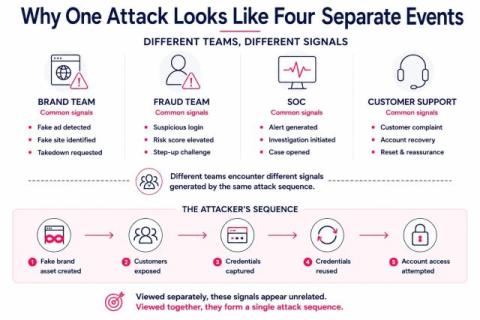
Most ATO detection tools are watching the wrong moment. Attackers don’t start at your login page – they start days earlier, registering lookalike domains, cloning your site, and harvesting credentials before your stack sees a single signal. Knowing how to detect account takeover means moving detection upstream: to the reconnaissance stage, the cloning event, and the live harvesting window. That’s where the attack is stoppable.

Effective Account Takeover Mitigation Playbook: Real-Time ATO Response Framework

Account takeover mitigation is the process of detecting, containing, and preventing unauthorized access to user accounts before financial or reputational damage occurs. Effective mitigation depends on real-time detection, rapid response, and automated playbooks. Modern account takeover attacks execute in minutes. Credentials are harvested in real time through phishing, reverse proxy phishing, and man-in-the-middle techniques. Attackers often attempt login seconds after a user submits credentials.

How LAPSUS$ Bypassed MFA and How to Prevent Similar Identity Attacks

LAPSUS$-linked breaches did not break multi-factor authentication (MFA) cryptographically. Attackers obtained valid authentication outcomes through techniques commonly described as MFA fatigue attacks or MFA bypass attacks, including push-prompt abuse, SIM swapping, social engineering, and session token replay. Understanding how these attacks succeed helps explain where modern identity defenses must evolve.

Enterprise Account Takeover Solutions: How to Operationalize Protection After Go-Live

Enterprise account takeover solutions often look strong during procurement. The real test begins after go-live. Integration completes. Alerts begin flowing. Fraud, SOC, and digital leaders see new data. Now the question shifts from deployment to operationalization. How do enterprises turn early ATO visibility into measurable fraud reduction, faster investigations, and stronger regulatory posture?

RFP Essentials for Account Takeover Fraud Solutions: A Procurement Guide

The digital landscape is currently witnessing an industrialization of fraud. Legacy defenses, once considered standard, are now struggling to keep pace with sophisticated attackers who operate with the speed of AI. For enterprises, the Request for Proposal (RFP) process is no longer just a bureaucratic hurdle. It is a critical opportunity to filter out reactive “band-aid” fixes and identify account takeover (ATO) fraud solutions that provide preemptive protection.

Preemptive Defense Is No Longer Optional: Why Frost & Sullivan Is Calling for Earlier Fraud Intervention

Preemptive cybersecurity defense refers to the ability to detect and disrupt fraud and account takeover attempts before credentials are misused and damage occurs. According to a 2026 analyst brief from Frost & Sullivan, most enterprise fraud and cybersecurity controls still activate too late in the attack lifecycle to prevent loss.

Shift Left Security: Compress Time-to-Detect and Reclaim Hours for High-Impact Work

Imagine this: a customer clicks a paid search ad that looks exactly like you. Same logo. Same layout. Same tone. They enter credentials. They hand everything to a scammer. Your team finds out later. When the fraud case lands. When the customer complains. When a suspicious login alert finally fires. That’s not a tooling problem. It’s a timing problem. Shift-left security is how you get the time back.