Security | Threat Detection | Cyberattacks | DevSecOps | Compliance

The latest News and Information on Security Incident and Event Management.

NEW Elastic Security 8.16: Elastic AI Assistant knowledge, cloud detection and response, and agentless integrations

Elastic Security 8.16 is now available, advancing our mission to streamline security workflows with enhanced data accessibility and AI-driven analytics. Key updates include agentless onboarding for faster cloud security posture management (CSPM) and asset discovery; expanded integrations with Wiz, AWS Security Hub, and Falco for contextualized threat detection; custom knowledge sources for Elastic AI Assistant; and improved support for locally hosted large language models (LLMs).
Threat intelligence feeds: essential arsenal in cybersecurity

Cyber threats are relentless, sophisticated, and growing. To stay ahead, you can no longer treat threat intelligence as an optional tool—it’s the backbone of a proactive, defense-ready strategy. Threat intelligence feeds bring crucial insights to security teams, from high-level trends to detailed indicators of compromise (IoCs). But no single feed can capture every potential threat. Threat landscapes evolve rapidly and adversaries employ diverse techniques and targets.

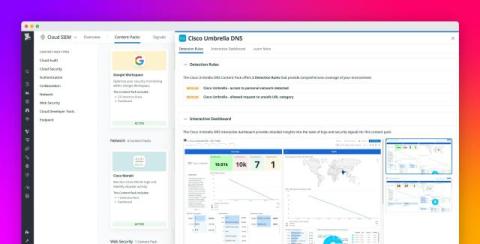
Monitor your Cisco Umbrella network logs with Datadog Cloud SIEM

Cisco Umbrella is a platform for monitoring and maintaining the DNS-layer security across your network. It monitors network activity and detects behavior like DNS hijacking, spoofing, and other attacks. It can then reroute or block potentially malicious requests before they reach endpoints. However, while Umbrella’s DNS-layer security blocks malicious domains, the sheer volume of DNS and proxy logs it generates can overwhelm security teams.

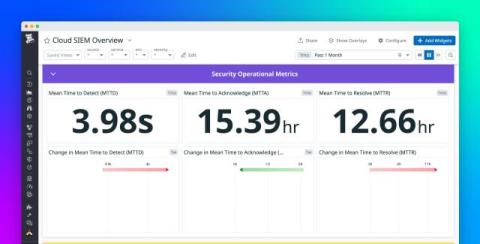
Measure and optimize security team efficiency with Cloud SIEM security operational metrics

Many organizations lack clear visibility into the efficiency of their security processes, making it difficult to accurately assess their security teams’ performance. Without insight into key factors like alert response speed, investigation thoroughness, and the accuracy of detection rules, teams risk operating without a clear view. This can lead to missed threats, inefficient use of resources, and an inability to improve security outcomes.

Best Practices for Writing an IT Security Incident Report

Everyone remembers that one required writing class they needed to take. If you’re like a lot of other security analysts, you assumed that your job would focus on using technology, not writing research papers. However, in today’s business environment, cyber incidents are critical business events, especially as governments and agencies create more reporting requirements.

SOAR in Seconds - Playbook Building with Natively Integrated SIEM and SOAR

In Splunk SOAR 6.3, SOAR features now come fully integrated with Splunk Enterprise Security 8.0. In this demo, see how to easily create a Splunk SOAR playbook in the context of your SIEM workflows. Playbooks and actions are now directly integrated within the Splunk Enterprise Security analyst queue. You can run playbooks and see the results without leaving the Splunk Enterprise Security interface. Both a Splunk SOAR and Splunk Enterprise Security license is required.

Cross-Site Request Forgery Cheat Sheet

“Aren’t you a little short for a Stormtrooper?” In this iconic Star Wars moment, Princess Leia lazily responds to Luke Skywalker, disguised as one of her Stormtrooper captors and using authentication information to open her cell. In other words, Star Wars acts as an analogy for a cross-site request forgery (CSRF) attack. In a CSRF attack, malicious actors use social engineering so that end-users will give them a way to “hide” in their authenticated session.

What is a Cross-Site Scripting Attack

Cross-site scripting attacks are the digital version of the mystery trope where people inject IV lines with hazardous material. In the murder mystery genre, these crimes often focus on someone who looks legitimate, sneaking malicious material into someone’s medicine to harm the patient. Similarly, a cross-site scripting attack is when a threat actor sneaks malicious code into someone’s application to harm end users.