Security | Threat Detection | Cyberattacks | DevSecOps | Compliance

5 Steps for Building an Agile Identity and Access Management Strategy

Traditional identity and access management (IAM) implementation methods can’t provide enough flexibility, responsiveness, and efficiency. Indeed, many organizations struggle with developing a mature IAM program according to the State of Enterprise Identity report by the Ponemon Institute. Among the key reasons for this challenge cited by respondents in the report are a lack of employee awareness, an insufficient budget, and ineffective planning.

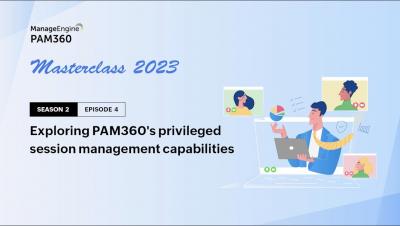
[PAM Masterclass] Episode 4: Simplifying privileged session management

In this episode of PAM masterclass, you will learn how to launch privileged sessions by configuring remote access pathways. You will also gain insights into how admins can monitor and record live sessions and suspend malicious user activities using ManageEngine's flagship PAM suite, PAM360.

How Web3 and IAM are changing the way we use the Internet

IAM (identity access management) involves numerous IT practices to enforce identity authentication and verification. But Web3 could change how we use the internet by simplifying data protection and IAM procedures. Two factors contribute to the need for authentication practices that are both fast and accurate. One, rising cyber threat activity, and two, infrastructure changes and complexity. Now, IT teams need new ways to authorize identity credentials to adapt to an evolving environment.

The Complete Guide to Identity and Access Management (IAM)

With the rising trend of digitization, major companies like Airbnb, Microsoft and Twitter are staying out of the office, moving processes online and allowing employees the option to work from home. Organizations are adopting remote and hybrid working models. As a result, many people are spending more than double the amount of time online as they did pre-pandemic.

The Role of IAM in Maintaining Cloud Security

Cloud computing is an effective solution for large and small companies across every industry. There has been rapid adoption due in large part to its accessibility, flexibility, and reliability. The cloud environment brings a significant amount of benefits, but at the same time, it can expose businesses to various alarming cybersecurity risks. A study conducted by Thales and 451 Research revealed that 40% of respondents have experienced a data breach within their cloud environments.

What is MFA (Multi-Factor Authentication)? Learn How it Works

Multi-factor authentication (MFA) is an authentication method that requires at least two forms of verification of the user’s identity to gain access to an account, application, or data set. Instead of needing just a username and password to log in, MFA adds additional layers of security by requiring users to verify their identity. Each additional verification method can prevent unauthorized access from cybercriminals or hackers from executing a successful cyber attack.

Is Credential Sharing the Weakest Link in Your Security Strategy?

You might think that the majority of cybersecurity breaches result from carefully planned and executed attacks. You may imagine hackers expertly crafting phishing emails to con employees into giving away access to critical systems, for example, or planting state-of-the-art malware on victims' servers. The reality – as Zenity co-founder and CTO Michael Bargury explains in his most recent Dark Reading column – is less interesting, and perhaps more worrying.

[PAM Masterclass] Episode 3: Mastering remote password management

In this latest episode of the PAM masterclass, we'll explore the remote password management capabilities of ManageEngine's PAM suite. We will also learn to generate strong and unique passwords that comply with built-in and custom policies, and automatically reset passwords of your remote resources. Key takeaways.

How to create a continuous lifecycle for your IT Policy Management

If your organization is having trouble creating policies, I hope that this blog post will help you set a clear path. We’ll discuss setting up your organization up for success by ensuring that you do not treat your policies as a “do once and forget” project. Many organizations I have worked with have done that, but later realized good policy lifecycle is required, and a pillar of good governance.

Using Rego as a generic policy language

Policies have a vital role in every organization, but can mean a lot of different things depending on the context. For our purposes, a policy refers to the principles or ideas that an organization uses to make decisions. In this post, we’ll discuss Open Policy Agent (OPA) and its rule language, Rego, highlighting how we can use them to write a simple policy for a payroll microservice.