Security | Threat Detection | Cyberattacks | DevSecOps | Compliance

This Month in Datadog: State of DevSecOps report, Event Management, Container Image Trends, and more

Datadog is constantly elevating the approach to cloud monitoring and security. This Month in Datadog updates you on our newest product features, announcements, resources, and events. To learn more about Datadog and start a free 14-day trial, visit Cloud Monitoring as a Service | Datadog. This month, we put the Spotlight on Datadog’s State of DevSecOps report.


Key learnings from the State of DevSecOps study

We recently released the State of DevSecOps study, in which we analyzed tens of thousands of applications and cloud environments to assess adoption of best practices that are at the core of DevSecOps today. In particular, we found that: In this post, we provide key recommendations based on these findings, and we explain how you can leverage Datadog Application Security Management (ASM) and Cloud Security Management (CSM) to improve your security posture.

Datadog Code Security achieves 100 percent accuracy in OWASP Benchmark by using an IAST approach

As application architectures shift to the cloud and the velocity of software delivery accelerates, organizations are seeking more powerful capabilities to identify security vulnerabilities within their production applications. Traditional static application security testing (SAST) tools, by themselves, are insufficient.

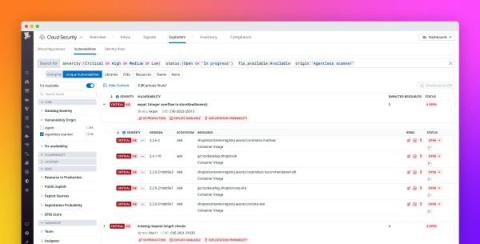
Detect vulnerabilities in minutes with Agentless Scanning for Cloud Security Management

Security teams require complete visibility into their hosts, containers, and functions in order to detect, prioritize, and remediate their most pressing security risks. The Datadog Agent helps you achieve this visibility by collecting deep insights in your environment through logs, distributed traces, infrastructure metrics, and other key telemetry.

Prioritize vulnerability remediation with Datadog SCA

Software Composition Analysis (SCA) is the practice of identifying the open source libraries your code depends on. By using SCA, you can analyze these dependencies and determine whether they are affected by any known vulnerabilities, contain malicious code, introduce licensing risk, or are poorly maintained. SCA helps teams understand their software’s dependencies and the security implications of using them so that they can safely build on and innovate with open source code.

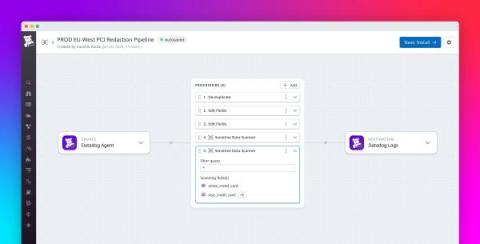
Redact sensitive data from your logs on-prem by using Observability Pipelines

As your business evolves to serve more users, your applications and infrastructure will generate an increasing volume of logs, which may contain sensitive data such as credit card numbers, IP addresses, and tokens. When you collect sensitive data, you may be subject to laws such as GDPR—which restricts the transfer of personal data across borders, and you may face legal consequences if this data is exposed outside your infrastructure.