Security | Threat Detection | Cyberattacks | DevSecOps | Compliance

Agentic First Security -- Customer Brown Bag - August 20th, 2026

Join Jeremy Powell, CISO of Sumo Logic, to learn how AI-powered agents are reshaping modern security operations. Discover the key principles, governance, and best practices for building an agentic security program that enhances analyst productivity, accelerates threat response, and strengthens organizational resilience.

Think like a criminal: How to land your first security role

On this episode of Masters of Data, we tackle breaking into cybersecurity. David shares his journey from welder to AppSec manager, proving that career pivots are tough but doable. We explore entry points like SOC analyst, GRC, and application security roles, noting that penetration testing gigs are fiercely competitive. AI is reshaping the landscape, making technical skills more accessible while amplifying the need for critical thinking. Networking beats degrees. Side projects and hands-on certifications matter more than credentials.

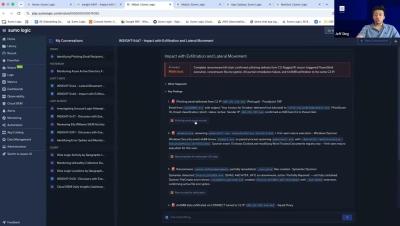
Mobot: Sumo Logic's natural language AI for SOC investigations

Mobot is Sumo Logic's conversational interface designed to streamline investigations for SOC analysts and observability users. Ask a question in plain English and get a full SOC analyst-style investigation without writing a query. Inside an Insight, Mobot pulls context like the C2IP, ransomware hash, host, and exfiltration data automatically. A six-word question, "anyone else hit by the campaign?", triggers a full investigation across every mailbox and endpoint tied to that attack, with a link to the raw query behind every answer.

Sumo Logic's SOC Analyst Agent: Automated triage for every tier one alert

Sumo Logic's SOC Analyst Agent automatically triages every insight within the SIEM, replacing the manual work that used to fall to a tier-one analyst. Using Sumo Logic's own SOC as customer zero, we found that 100% of tier-one alerts are triaged end-to-end by the agent, resulting in a 89% reduction in median time to triage, from 28 minutes to 3 minutes. In this demo, you’ll see.

Black Hat FOMO? Dojo AI Demo

On this episode of Masters of Data, we take you inside the Dojo AI demo we're bringing to the show floor at Black Hat. We walk through the SOC Analyst Agent, Mobot, and MCP back to back. SOC Analyst Agent triages every tier one alert down to the one that actually matters, and Mobot picks up from there, running the investigation in plain English to track down other phishing victims and lateral movement. We also show how MCP pulls that same insight into Claude or Slack. SOC leads tired of alert fatigue and analyst burnout will want the numbers here: 100% of tier one alerts triaged automatically, and 25 hours a week back per person.

Called it (mostly): Checking in on 2026 predictions so far

On this episode of Masters of Data, we revisit the predictions Adam White, Zoe Hawkins, and David Girvin made at the end of last year, checking our own scorecard halfway through 2026. The hits: agents running amok and deleting databases, MCP becoming the backbone for tracking what agents actually do, growing security gaps around personal data, and a collective rejection of low-quality AI content. The misses: we underestimated how fast companies would cut staff for AI, then quietly start rehiring once the agents couldn't cover the work, and we're still arguing about whether token burn is a cost problem or a coming attack vector.

Everything you need to know for a career in cybersecurity

So, you want to be a cybersecurity analyst. With the rise in high-profile data breaches, privacy concerns and rapid technological advancements, there’s a greater demand for cybersecurity analysts now. And the demand for cybersecurity analysts is only expected to grow. But before you get too far into pursuing this job, let’s look into the basics of this profession. Below, we answer the most frequently asked questions about becoming a cybersecurity analyst.

AI across the security lifecycle

For nearly a decade, the security industry has used machine learning to solve detection. By feeding it enough logs and determining abnormal behaviors, it found the threats that rules-based systems miss. This delivered sharper anomaly detection, fewer false positives, and UEBA is now essential. In fact, threat detection and analytics account for close to 44% of total SIEM spend, the single largest use case by far. Using machine learning for detection was only the start.