Security | Threat Detection | Cyberattacks | DevSecOps | Compliance

AI Agent Governance Part 2 - What Good Looks Like: Governing AI Agents in Practice

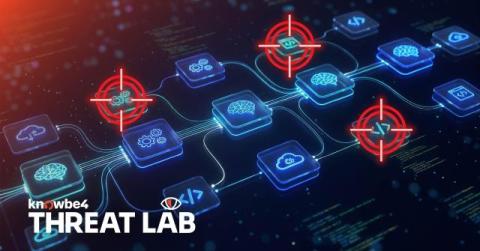
If AI agents are becoming organizational actors, then governance needs to move beyond principles and into operational structure. In Camille Stewart Gloster’s upcoming book The Insider You Build, she explains that governance is not defined by policies or structures, but by whether it can actually influence system behavior at runtime. In an agentic environment, governance only exists where it can shape, constrain, and intervene in decisions as they happen.

8 Ways to Reduce False Positives in Email Security

False positives can disrupt inbound email security as much as missed threats by slowing business workflows and eroding trust in security controls. As phishing attacks become more convincing, many systems respond by tightening filtering thresholds. But without enough context, this can lead to overblocking, where everyday business communication is misclassified as suspicious. Reducing false positives requires more than adjusting filters.

Ransomware Attacks Drive a Surge in Cyber Insurance Claims

Cyber insurance claims surged by 40% over the past eighteen months, while ransomware payments have dropped by 44%, according to a new report from Cowbell Cyber. The three most common incident types were data breaches, cybercrime (including phishing and business email compromise), and extortion attacks (including ransomware).

Free Gift Fallacy: How Attackers Harvest Credit Cards via Fake Surveys

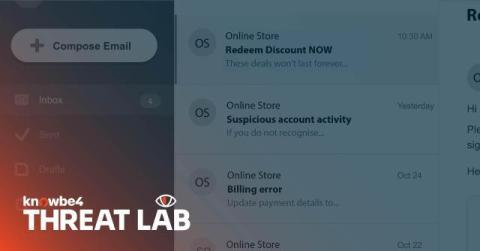
The classic 'survey reward' scam is back and hitting harder than ever. KnowBe4 Threat Labs is tracking a massive, high-volume campaign that is not only impersonating a wide array of trusted global brands across retail, logistics, and healthcare, but is using hundreds of newly registered domains (NRDs) and sophisticated psychological priming to fly past traditional security defenses.

AI Agent Governance Part 1 - Beyond the Chatbot: Mastering AI Agent Governance

In 2024, we talked to AI. In 2026, AI is talking to our systems, our customers, and increasingly, acting on our behalf. With AI agents, we are moving AI from a tool to an actor, from assistance to agency and from outputs to actions. And that changes the nature of risk. AI agents plan, execute, and interact with the world on our behalf. They send emails, move data, trigger workflows, and increasingly operate across systems without human intervention.

Report: Adversarial Use of AI is Evolving

Threat actors are increasingly augmenting their attacks with AI tools, according to researchers at Google’s Threat Intelligence Group (GTIG). For the first time, GTIG observed a threat actor using a zero-day exploit developed by AI, although Google blocked the attack before it succeeded. Threat actors also continue to use Large Language Models (LLMs) for research, reconnaissance, and malware development.

Beyond the Chatbot: Why Your AI Agents are Your Newest (and Most Vulnerable) Colleagues

The era of "typing into a box" is over. For years, we viewed artificial intelligence as a digital assistant—a sophisticated autocomplete tool that waited for human input. But according to Martin Kraemer, KnowBe4’s CISO Advisor for Europe and the Middle East, that dynamic has shifted. We have moved from asking AI questions to giving AI jobs. In a recent deep-dive webinar, Martin explored the transition from AI tools to AI agents.