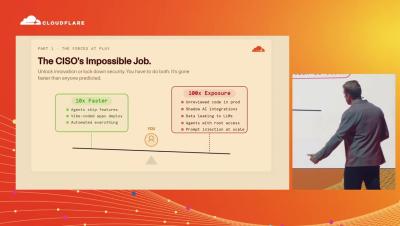
Jose Dores of Cloudflare explains how programmable SASE gives organizations the fastest path to adopting AI safely, with security built for what comes next.
Michael Gustafsson of Cloudflare shows how to ship AI agents on Cloudflare that are secure by default, so teams can build and deploy agents with confidence.
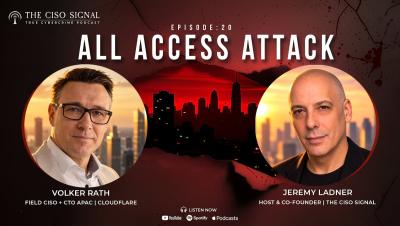
It was just a little chat window in the corner of the screen. But behind it was a web of trusted connections reaching deep inside the enterprise. Here’s how attackers turned a trusted integration into a massive supply chain breach. Expand for more details and resources In August 2025, attackers tracked as UNC6395 compromised OAuth tokens associated with Salesloft’s Drift integration. This turned trusted connections to Salesforce environments into an attack path reaching hundreds of companies, including top-tier cybersecurity organizations.
Twelve years ago, during Birthday Week 2014, we turned on Universal SSL and nearly doubled the number of encrypted sites on the web overnight, giving free TLS to every site behind Cloudflare, including the ones that never paid us a cent. Encryption stopped being an expensive, time-intensive undertaking and instead became the default. For Birthday Week this year, we are taking the next step on that path.
In 2023, Cloudflare declared itself free from CAPTCHAs with the launch of Turnstile, our privacy-first client-side challenge. Turnstile is free to use, works on any site (no need to proxy traffic through Cloudflare), and never asks a visitor to solve a puzzle. Now, we are launching Turnstile Spin, an agent-mediated end-to-end implementation of Turnstile.
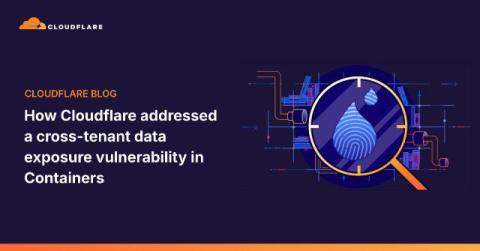
On September 4, 2026, Oren Yomtov, a security researcher from Accomplish, responsibly reported a vulnerability affecting Cloudflare Containers and Cloudflare Sandboxes (which is built on Containers), through Cloudflare’s bug bounty program. Cloudflare has fully remediated the vulnerability, and we have no evidence that customer data has been compromised.
A modern storefront can look perfectly healthy while malicious JavaScript works underneath: siphoning affiliate revenue, hijacking searches and clicks, tampering with analytics, or asking a remote server what to execute next. Pages load, products appear, and checkout works — yet the browser may be quietly doing something the site owner never authorized. That is the blind spot our Client-Side Security machine learning (ML) model is built to expose.
Today, we’re making Cloudflare CASB more powerful than ever by introducing automatic remediation policies. This means security teams can now design event-driven logic to revoke risky file shares and dispatch custom webhooks, without manual intervention. When we launched Cloudflare CASB, a cloud access security broker, we wanted to provide security teams complete visibility into the posture of their SaaS applications before misconfigurations became incidents.
1.1.1.1 now validates DNSSEC signatures made with ML-DSA-44, a post-quantum signature algorithm standardized by the National Institute of Standards and Technology (NIST). This is a first step toward preparing DNSSEC for a future in which today’s signature algorithms are no longer secure. Cloudflare plans to achieve full post-quantum security by 2029. Much of the work so far has focused on TLS, but public-key cryptography is used in many other systems, including DNSSEC.