
Security | Threat Detection | Cyberattacks | DevSecOps | Compliance

Preventing Data Breaches: Essential Steps Your Business Needs Today

The average total cost of a data breach is now $3.86 million, making prevention a top priority for businesses of every size. Yet most organizations still struggle to stay ahead. Studies reveal that it takes nearly 280 days on average to identify and contain a breach, and the shift to remote work has only made matters worse. More than three quarters of companies report longer detection and containment times, adding an estimated $137,000 to the cost of each incident.
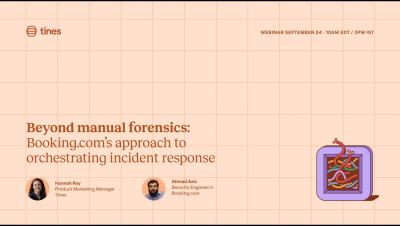

Beyond manual forensics: Booking.com's approach to orchestrating incident response

Browser history can play a critical role in incident response, from helping analysts reconstruct user activity and validating alerts, to uncovering malicious behavior. But retrieving raw artifacts from endpoints is often slow, manual, and inconsistent. In this technical session, Ahmad Aziz, Security Engineer II at Booking.com, will share his winning entry from the 2024 “You Did WHAT?! With Tines” (YDWWT) competition: a fully automated workflow that pulls raw browser history artifacts from devices using CrowdStrike and prepares them for offline forensic analysis.

The Value Of Log Management For Building Reliable IT Infrastructures

Reliability is a non-negotiable requirement. Organizations of all sizes depend on stable systems to deliver services, protect data, and maintain customer trust. Behind the seamless performance of applications and networks lies a wealth of activity recorded in system logs. These logs, often overlooked, provide crucial insights into operations, performance, and security. Effective log management, such as collecting, analyzing, and monitoring these records, is fundamental to building and maintaining a resilient IT infrastructure.

Aligning SRE and security for better incident response

In this series, we looked at why we combined our SRE and security teams into one cohesive group, and how we made that happen. With this combined approach, we set out to build our internal platform and customer-facing products with a security-first mindset, while still drawing upon the deep expertise of our existing SRE practices. Combining the teams improved the way we build tools for both our engineers and customers and strengthened our ability to mitigate risks.

Why DFIR: A Guide to Digital Forensics and Incident Response Services and Retainers

No organization likes to contemplate being successfully hit with a cyberattack, but turning a blind eye to the possibility is the exact wrong thing to do. Digital Forensics and Incident Response (DFIR) planning and retainers, like car, home, and health insurance, are a necessity in case the unthinkable happens.

Building a Smarter Incident Response Playbook with Deception and Fidelis Elevate

Cybersecurity has become unnecessarily complex. Modern threat actors have refined network infiltration techniques while many organizations continue operating with outdated response methodologies. Traditional security measures are proving insufficient against contemporary attack vectors, particularly advanced persistent threats that operate undetected for extended periods. Security operations centers process thousands of daily alerts, with most representing false positives.

Quantum Incident Response

When the first cryptographically relevant quantum computer (CRQC) arrives, it won’t come with a press release. One day in the not too distant future, a nation-state, organized crime group or unhinged megalomaniac billionaire will quietly spin up the capability, and in eight hours or less, your TLS (Transport Layer Security) RSA-2048 encryption is gone. Like a hot knife through butter.

Understanding the Role of Incident Response in Cybersecurity

The consequences of a successful cyber attack can be stark. Organizations often face significant financial damage due to lost revenue due to downtime, plus compliance, legal, and regulatory costs, and legal fees arising from potential lawsuits, not to mention reputational damage. These costs can quickly blow the average out of the water, with many organizations facing seven-figure costs to restore their operations and fully remediate a breach. The numbers tell the story.