Security | Threat Detection | Cyberattacks | DevSecOps | Compliance

Cyber Risk in 2026: Top Threats, AI Risks & What Security Leaders Must Do Next

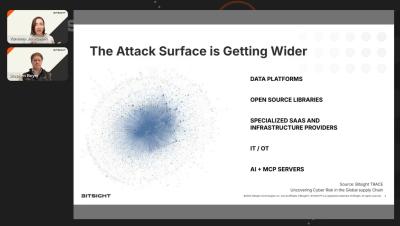
Cyber risk is evolving fast—and 2026 will demand more from security leaders than ever before. In this forward-looking webinar, Bitsight Co-Founder Stephen Boyer and SVP Vanessa Jankowski break down the biggest cyber threats shaping the year ahead, from AI-driven attacks and expanding attack surfaces to third-party and cloud risk.


First 72 Hours of a Cyber Incident: How GRC & Security Teams Must Respond Together

When a critical vulnerability is exploited, the first 72 hours of a cyber incident can determine the outcome. In this scenario-driven webinar, Bitsight experts break down how security, GRC, and threat intelligence teams must work together—fast—to detect risk, prioritize action, and communicate clearly under pressure.

Productivity at a Price: The Rising Cost of AI Convenience

Humans have always sought to streamline productivity through the most convenient solutions available, prioritizing speed to stay ahead and gain an edge over the competition. From the assembly line to the cloud, the goal remains the same: do more with less friction. Today, that convenience is synonymous with AI. While these tools have revolutionized how we work, the reality remains that rapid innovation always comes with a hidden cost.

Practical Tips for Tracking Vulnerability Remediation Progress

When vulnerability remediation succeeds at enterprise scale, it’s very rarely because the vulnerability management team is finding more vulnerabilities. It’s because the program was built around the idea of turning messy findings into steady, measurable risk reduction. That’s not an easy task. It’s easier to make it a numbers game, pointing to vulnerability volumes and how many findings were addressed, rather than accurately depicting how much real risk was eliminated.

The Top 5 Vulnerabilities Attackers Are Using Against Your Vendors (And What It Says About Third-Party Risk)

When threat actors target your vendors, they’re not just looking to exploit a system for a single attack. They’re looking for every opportunity to scale up their operations. This means seeking ways to push their compromises as far downstream into the supply chain as they can go.

The CEO's Take: Bridging the Cybersecurity Divide To Address Cyber Risk

“150 companies account for 90% of the technology products and services across the global attack surface. 41% of those companies had evidence of at least one compromised device in the past year.” With organizations as interconnected as they are, even organizations who “have” good cybersecurity are only as good as their weakest link.

How Organizations Should Prioritize AI Security Risks

‍ ‍Artificial intelligence (AI) systems and GenAI tools are no longer merely being experimented with in the market. Instead, they are being embedded into the organizational infrastructure at large, shaping how enterprises process data, automate decisions, and provide core services to customers. Unfortunately, while this integration increases efficiency, it simultaneously increases exposure to a dramatic extent.

The Strengths and Shortcomings of AI Control Tower

This is why platforms like ServiceNow AI Control Tower are showing up in governance roadmaps. Control Tower helps organizations standardize how AI systems are requested, reviewed, cataloged, and managed across their lifecycle. It can bring order to chaos. But there’s a second, equally important reality: the strongest governance workflow in the world can’t govern what it can’t see.

Safeguarding Transactions Outside Traditional Banking Channels

Compliance teams often focus on banks, yet value can move through many routes that never touch a branch or a core banking platform. In safeguarding transactions outside traditional banking channels, the hardest part is defining the perimeter: nonbank payment providers, prepaid instruments, merchant networks, and informal value transfer systems that rely on trust, netting, or cash settlement.

Cyber Resilience in 2026: Why Supply Chains Are the New Front Line

"When cyber risk is treated as an internal problem, governments miss where most modern attacks actually begin: in their vendors, their service providers, digital dependencies that sit outside their direct control." SecurityScorecard's Head of Public Policy Michael Centrella shares his key takeaways and insights from the latest World Economic Forum’s Global Cybersecurity Outlook 2026 which states a simple, clear truth: cyber risk no longer lives inside the firewall.

The Hidden Security Risk of Enterprise Documents and Why AI Amplifies It

For years, enterprise security strategies have evolved around visible and measurable threats: network intrusions, endpoint compromise, identity misuse, and cloud misconfigurations. These domains are well understood, heavily monitored, and continuously audited. Yet one of the most critical security risk surfaces in modern enterprises remains largely under-governed: documents and unstructured data.

Inside the Rise of Clone Phishing and CAPTCHA-Based Social Engineering

In our previous two posts, The ABC’s of Ishing and From Lure to Breach, we broke down the foundational tactics used by cybercriminals to deceive users and gain unauthorized access. This follow-up report expands on that foundation by exploring three evolving phishing threats that go beyond traditional email lures: clone phishing, deepfake phishing, and Captcha phishing.

Breaking Silos with SCDR: How SOCs & TPRM Teams Drive Integrated Cyber Strategies

Too often, vendor risk management operates in a silo, focused on compliance checkboxes, while the SOC team is on the frontlines of threat intelligence and response. These two groups should be allies, but instead, they’re often working in isolation. That’s a problem because cyber risk isn’t just a compliance issue… it’s a threat issue. Join Steve Cobb for this talk on: SecurityScorecard monitors and scores over 12 million companies worldwide.

Custom Risk Scoring Is the Missing Link Between Disconnected Findings and Real Exposure Management

Most large organizations rely on multiple vulnerability and exposure scanning tools out of necessity. Infrastructure scanners, cloud security platforms, application security testing tools, container scanners, and attack surface management solutions all play a role. Each one is designed to answer a specific question. But when it comes to understanding the risk of the vulnerabilities and exposures they detect, each tool has its own approach to quantifying it.

The Philanthropist's Take: Bolstering Cyber Civil Defense

“Doing well by doing good” – there’s something to be said for that. Join Aleksandr Yampolskiy (CEO & Co-Founder, SecurityScorecard) and Craig Newmark (Founder, craigslist, Craig Newmark Philanthropies) for this discussion on: SecurityScorecard monitors and scores over 12 million companies worldwide. Find your company's security score for free at SecurityScorecard.com Follow our CEO Dr. Aleksandr Yampolskiy.

Securing AI Where It Acts: Why Agents Now Define AI Risk

In the first round of the AI gold rush, most conversations about AI security centered on models: large language models, training data, hallucinations, and prompt safety. That focus made sense when AI was largely confined to generating text, images, or recommendations. But that era is already giving way to something far more consequential.

Ensuring Institutional AI Ownership With the AI Compliance Officer

‍Artificial intelligence (AI) systems and generative AI (GenAI) tools have already been embedded across enterprise operations in a myriad of ways that trigger compliance obligations, both in terms of AI-specific regulations and other reporting mandates. In many cases, this adoption is occurring informally, through employee-driven tools or AI features embedded within third-party platforms, without centralized visibility or approval.

Emerging Risks: Typosquatting in the MCP Ecosystem

Model Context Protocol (MCP) servers facilitate the integration of third-party services with AI applications, but these benefits come with significant risks. If a trusted MCP server is hijacked or spoofed by an attacker, it becomes a dangerous vector for prompt injection and other malicious activities. One way attackers infiltrate software supply chains is through brand impersonation, also known as typosquatting—creating malicious resources that closely resemble trusted ones.
Featured Post

Security's Next Turning Point Is the Workforce

Cybersecurity is entering a turning point. It has less to do with new tools than a new reality: the workforce has changed. For years, security programs assumed risk lived in systems, controls, and configurations. People were the variable managed through policies, training, and best-effort awareness. That model was already under strain. Now it is being outpaced.

Understanding Open-Source License Risk in Modern Software

Open source is one of the best things to ever happen to software development. It is also one of the easiest ways to accidentally ship legal obligations you did not sign up for. Most teams know they rely heavily on open-source dependencies. Fewer teams know exactly what licenses those dependencies use, what obligations come with them, or how those licenses travel through transitive dependencies and container images. That gap is what we call open-source license risk.

4 Predictions Our Researchers Say Could Break (or Break Through) in 2026

As we step into 2026, Bitsight researchers are closely watching key developments across the cyber risk landscape. Their insights reveal a dynamic tension between rising threats and new opportunities to strengthen defenses. Here's what they predict for the year ahead, and what security teams should be prepared to navigate.

The Data Scientist's Take: Making AI Work for the Enterprise

In retrospect, it’s a lot easier to determine whether or not something has been overhyped. But for the moment? We’re bullish on agentic systems – and their adoption. Is your enterprise ready for the age of autonomous AI? Join Aleksandr Yampolskiy (CEO & Co-Founder, SecurityScorecard) and Ilya Mezyin (SVP, Head of Data Science, Dun & Bradstreet) for this discussion on: SecurityScorecard monitors and scores over 12 million companies worldwide. Find your company's security score for free at SecurityScorecard.com.

Meet GitGuardian's Machine Learning-Powered Risk Scoring

The GitGuardian Platform now automatically ranks every secrets incident with a risk score from 0–100, turning alert floods into a prioritized, trustworthy work queue. Scores are computed from incident context (like validity, exposure, where it was found, and exploitability) and build on existing ML capabilities like Secret Enricher and our False-Positive Remover, which cuts false positives by 80%+.

2026 Study from Panorays: 85% of CISOs Can't See Third-Party Threats Amid Increasing Supply Chain Attacks

Panorays, a leading provider of third-party security risk management software, has released the 2026 edition of its annual CISO Survey for Third-Party Cyber Risk Management. The survey highlights third-party cyber risk as one of the most critical challenges facing security leaders today, driven largely by a lack of visibility. While 60% of CISOs report an increase in third-party security incidents, only 15% say they have full visibility into those risks.

A Day Without ICS: The Overlooked ICS Risks That Could Bring Operations to a Halt

Have you ever watched AMC’s The Walking Dead? Before the walkers, before the chaos, there is a quieter moment that often goes unnoticed. The power is out. Roads are empty. Hospitals are running on borrowed time. The world has not fallen apart yet, but it is no longer working. That is what a day without ICS and OT would look like. Industrial control systems (ICS) and operational technology (OT) are the systems that run the physical world.

How to choose the best risk management software for your organization

Fast-paced changes in technologies, regulations, and growth expectations can quickly shift your risk environment. Without a structured approach to managing these risks, even the most innovative organizations can face costly disruptions, security incidents, and compliance missteps.

Why Your Attack Surface Is Bigger Than Your SOC Can See | Financial Cyber Risk Explained

Your organization’s attack surface doesn’t stop at the network—and in financial services, that reality can’t be ignored. In this clip, Dov Lerner explains why even companies with strong internal security programs remain vulnerable when attackers target customers through phishing and account takeover schemes.

Inside the Deep & Dark Web Marketplace Fueling Financial Cyber Attacks

The deep and dark web isn’t chaos—it’s a fully functioning marketplace. In this clip from Exposed: Cyber Risk in the Financial Sector and its Supply Chain, Dov Lerner explains how aspiring attackers can purchase phishing kits, stolen bank credentials, initial network access, and even cash-out services—often without technical expertise.

The CEO's Take: The Human Element of Security

“Human error contributes to 95% of data breaches.” From unsecured collaboration channels to poor password hygiene, the attack surface of an organization extends across both its vendor ecosystem as well as all of the employees within it. Join Aleksandr Yampolskiy (CEO & Co-Founder, SecurityScorecard) and Marc van Zadelhoff (CEO, Mimecast) for this discussion on: SecurityScorecard monitors and scores over 12 million companies worldwide. Find your company's security score for free at SecurityScorecard.com.

YOLO Mode: Hidden Risks in Claude Code Permissions

What permissions are developers granting to Claude Code, and could those permissions pose a risk if the coding agent were exposed to malicious inputs? To answer this question, we turned to GitHub, the website where developers go to share their private configuration files. From Github we collected a dataset of 18,470.claude/settings.local.json files, each containing the permissions that a user granted to Claude Code for a software project.

Quantified Cyber Risk Through an ERM Lens in NIST IR 8286 Rev. 1

Lack of data has rarely been a challenge that cybersecurity leaders in the enterprise setting have faced. In fact, cyber risk data is usually in abundance. The obstacle, thus, is instead twofold. Teams must first make sense of all of that information, and leadership must then be able to communicate what it means in a language that supports high-level decision-making. That gap between information and deeper understanding is where many cyber risk programs flounder.

GRC impact: Challenges to opportunities of remote work

As organizations worldwide recalibrate their operations in the wake of unprecedented change, remote work has emerged not simply as a fleeting trend but as a mainstay of modern business. For compliance experts and leaders alike, this shift has introduced a complex interplay of governance, risk management, and compliance (GRC) challenges and opportunities.

Why Transparency Is Critical to Cyber Resilience in the Financial Sector

Transparency isn’t optional—it’s foundational to cyber resilience. In this clip from the Exposed: Cyber Risk in the Financial Sector and its Supply Chain webinar, Roland Cloutier, Global CSO and Digital Business Enablement Executive (TikTok, ADP, EMC), explains why visibility across the financial ecosystem is essential for managing third-party risk and preventing cascading cyber attacks.

AI 2026: A Look Ahead

2026, the perfect time to reflect on how far technology has come and what lies ahead. Without a doubt, Artificial intelligence has gone from a niche to an omnipresent force, reshaping how we work, build, and defend. While organisations have speed-ran the adoption of AI and machine learning, cybercriminals have been just as fast to exploit them, and AI now powers business decisions, customer interactions, and – predictably – cyberattacks.

The Media Mogul's Take: Cyber & Storytelling in the Age of AI

Despite the connection with Robert De Niro, we won’t be spoiling Zero Day for you yet. But there is a large intersection between the future of media, cybersecurity, and AI, and we’re excited to jump into it! Join Aleksandr Yampolskiy (CEO & Co-Founder, SecurityScorecard) and Sandy Climan (President, Entertainment Media Ventures, Inc.) in this webinar, where they chat about: SecurityScorecard monitors and scores over 12 million companies worldwide.

Cloud and Platform Migration: Cost, Risks, and Best Practices for Enterprises

In today's fast-evolving digital economy, staying competitive has nothing to do with relying on legacy systems. Even if your aging solution seems to be reliable because you're so accustomed to it, you'll definitely face blockers while trying to scale or innovate. Without modernized software.
Featured Post

From Spend to Impact: Fixing the Disconnect in U.K. Supply Chain Security

In today's hyperconnected economy, supply chains are no longer just operational backbones; they are strategic lifelines, shaping resilience, competitiveness, and innovation across industries. Yet for many U.K. organisations, these lifelines are becoming increasingly fragile. The most recent iteration of our global supply chain defence research indicates that - despite pouring significant resources into third party risk management (TPRM) programs and embracing new technologies to shore up their supply chain defences - U.K. businesses continue to face a high rate of supply chain breaches.

Cyber Threat Intelligence Report: Top 4 Malware Targeting Finance

The finance sector continues to face sustained and evolving cyber threats driven by the high value of financial data, credentials, and transactional access. Malware remains one of the most common and effective mechanisms used to compromise financial institutions, payment platforms, and end users, enabling fraud, data theft, and operational disruption.

A Practical Approach to Continuous Threat Exposure Management

Organizations face a complex cybersecurity conundrum. Attack surfaces are expanding faster than SOC teams can scan. All of which is leading to a never-ending cycle of swivel-chair security, context-free lists, increased alert fatigue, and slow remediation. The strategic pivot needed to combat this is Continuous Threat Exposure Management (CTEM). A structured and essential alternative that moves teams away from reactive scanning to proactive, ongoing validation and prioritization.

Leveraging Cyber Threat Intelligence to Empower SOC Teams

Security Operations Centers (SOCs) are overwhelmed by alerts, often reacting to threats as they appear rather than anticipating them. Bitsight Threat Intelligence (TI) transforms SOC operations by providing external visibility, context, and correlation with real adversary behavior. By mapping incidents to MITRE ATT&CK techniques and monitoring the deep and dark web for emerging risks, Bitsight TI enables SOC and CTI teams to detect, understand, and prevent threats before they cause impact.

6 Cyber Risk Quantification (CRQ) Trends That Will Define 2026

‍Cyber risk quantification (CRQ), the process of modeling cyber threats and forecasting loss outcomes, is becoming foundational to how organizations govern and respond to cyber exposure. What began as a specialized function is now shaping the priorities of security operations and enterprise risk management as a whole.

Crypto Trading Patterns Every Beginner Investor Should Know

The world of cryptocurrency is both exciting and volatile, attracting investors from all walks of life. While the potential for substantial returns is alluring, the market's unpredictability can make it intimidating for beginners. Understanding crypto trading patterns is an essential step for any investor looking to navigate the complexities of this digital asset space successfully. By recognizing these patterns, beginners can make informed decisions, reduce risks, and develop a strategic approach to trading.

Why 2025 Marked a Turning Point for Exposure Management and for Nucleus

For years, the cybersecurity industry has told itself that vulnerability management has been improving. This story is centered around “more”: more scanners, more data, more dashboards. Despite this abundance, by 2025 the gap between activity and outcomes became impossible to ignore. Security teams were doing more work than ever but struggled to show that risk was actually going down.

The CEO's Take: Making Security Work

“In 2024, at least 35.5% of all data breaches originated from third-party compromises.” Join Aleksandr Yampolskiy (CEO & Co-Founder, SecurityScorecard) and Nick Schneider (President & CEO, Arctic Wolf) for this discussion on: SecurityScorecard monitors and scores over 12 million companies worldwide.