Security | Threat Detection | Cyberattacks | DevSecOps | Compliance


The latest News and Information on Data Security including privacy, protection, and encryption.

3 Reasons Why Data Security Helps Ensure Cyber Recovery
Are you still relying on legacy backup systems to protect your business from cyber attacks? If so, you might want to think twice. Cyber attacks have become so common that 98% of security and IT leaders reported that they dealt with at least one in the last year. Relying on legacy backups as a defense against cyber attacks is not only ineffective but also obsolete in today's rapidly evolving threat landscape.

archTIS NC Encrypt Integrates with Thales CipherTrust Manager to Secure Business Critical Content in Microsoft Applications
New Content Preview Feature Results in up to 90% Productivity Increase
The Nightfall platform is lauded by customers for its high accuracy detection of sensitive data across a variety of cloud environments. This helps users save time by only surfacing the most relevant and most critical instances of sensitive data exposure. We’re always looking for ways to continue to build value in this area, and many of our feature updates like our new PHI detector and enhanced secrets detection releases accomplish this.
archTIS is a Microsoft Security Excellence Awards Privacy and Compliance Trailblazer Finalist
Nightfall AI Rightway Case Study Part 1
Nightfall AI Rightway Case Study Part 2
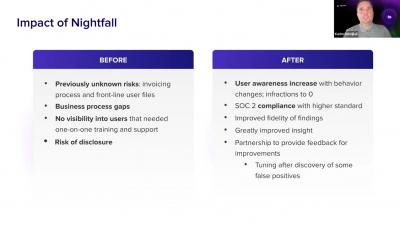
Nightfall AI Rightway Case Study Part 3 - Rightway Before & After Nightfall

Data Lifecycle Management
Data lifecycle management (DLM) is the process of safeguarding data appropriately throughout its existence. The basic data lifecycle stages are creation, storage, data usage, sharing and destruction: Figure 1. The 6 basic data lifecycle management stages The goal of DLM is to ensure data security and regulatory compliance during all stages without throttling business productivity. Achieving this goal requires different processes and policies at various times during the data lifecycle.
A Data Leak Detection Guide for the Tech Industry in 2023
In February 2021, UpGuard researchers discovered that 51% of analyzed Fortune 500 companies were leaking information in the metadata of public documents hosted on their websites. This discovery is a window into a broader overlooked cyber threat category, increasing the risk of data breaches in the tech industry - data leaks. Data leaks (often confused with data breaches) help hackers compress the data breach attack pathway, increasing the speed, severity, and frequency of these events.