Security | Threat Detection | Cyberattacks | DevSecOps | Compliance

Buying an AI SOC Isn't Like Anything You've Bought Before

John White is the Field CISO for EMEA at Torq. A respected security executive with more than 20 years of leadership experience, John previously served as CISO at Virgin Atlantic, where he led a multi-year transformation deploying the Torq AI SOC Platform to modernize cyber operations. Prior to Virgin Atlantic, he built and transformed security functions for global organizations, including ASOS, Liberty Global, AEG Europe, and KPMG.
How Security Orchestration Protects DevOps Environments at Scale

DevOps moves fast by design. Continuous integration, automated deployments, and infrastructure-as-code let development teams ship features in hours rather than weeks. Security teams have a real opportunity here: when they build workflows that integrate directly into the development process, they gain coverage and response speed that manual, disconnected approaches leave on the table.

Cybersecurity ROI Calculator: Measure Your Investment

Security teams have always had to justify their budgets, and the bar for that justification keeps rising. Boards and CFOs want proof that security spending delivers measurable business value: reduced risk translated into financial language. That pressure has made cybersecurity ROI calculators a standard part of the security leader’s toolkit, a way to convert threat prevention, automation efficiency, and incident response improvements into the numbers executives understand.

What We Learned Testing Jev on Security Alert Triage

Yaniv Zimmer is an AI researcher at Torq, focusing on cybersecurity research at the crossroads of artificial intelligence, deep learning, and defensive operations. Drawing on extensive experience within Unit 8200 alongside industry and academic AI research roles, his work centers on advancing SOC AI architectures and threat detection capabilities Like a lot of people, we were excited when Jev launched. The premise is genuinely useful in production: an intelligent language model built for classification.

From Agreement to Action: What's Actually Stopping Us?

Over the course of this series, I’ve laid out the case for a fundamentally different security operating model — one built around Outcome, Judgment, and Execution layers, where AI handles the execution at machine speed, and humans focus on the decisions that actually need them. I’ve argued that the CISO’s role is changing, that human-centric security no longer scales, and that the org chart needs to reflect where AI fits on the team.

How CISOs Should Brief the Board on AI in the SOC

John White is the Field CISO for EMEA at Torq. A respected security executive with more than 20 years of leadership experience, John previously served as CISO at Virgin Atlantic, where he led a multi-year transformation deploying the Torq AI SOC Platform to modernize cyber operations. Prior to that, he built and transformed security functions for global organizations, including ASOS, Liberty Global, AEG Europe, and KPMG.
More Tools Never Fixed the SOC: The Bottleneck Was Never Visibility

Odysseus left Troy with a fleet and reached Ithaca with nothing, having lost every ship to the sea. While the war was won by force, the journey home was won by wits, and ultimately the fleet barely mattered. Most security operations centers are still running their SecOps voyage the way Odysseus ran the war: more tools, more force, more signal. It is the wrong instinct, because the SOC bottleneck was never how much you can see. It is how fast you can decide.

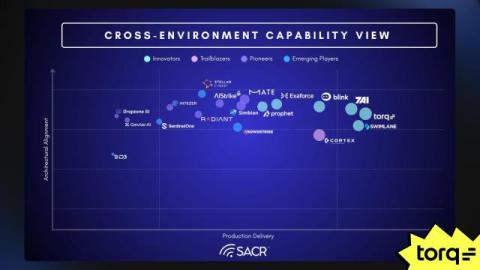
Torq Named a Leading Innovator in SACR 2026 AI SOC Market Report

Software Analyst Cyber Research (SACR) just published its 2026 AI SOC Market Report, offering an independent assessment of vendors competing in what has rapidly become the most consequential category in enterprise security. Torq features prominently, and the report’s framing is worth unpacking because it illuminates what makes the AI SOC category hard to evaluate and why Torq’s approach is consequential.

Torq SOC Brain: The AI SOC That Learns, Not Just Remembers

Back in June, I wrote a blog making the case that agentic triage alone isn’t an AI SOC. The way I see it, that’s like saying triage is the only responsibility of a SOC team. But as we know, the SOC’s responsibilities extend far beyond that, and these triage-only solutions don’t investigate threats, contain them, or close cases. That work is still left to the SOC team; the bottleneck is just shifting.