
Security | Threat Detection | Cyberattacks | DevSecOps | Compliance

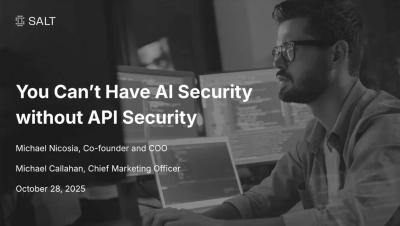
You Can't Have AI Security Without API Security: The Agentic Action Layer

AI agents run on APIs, and that is where most security programs have a gap. Salt Security Co-Founder and COO Michael Nicosia and CMO Michael Callahan explain why you cannot secure AI without securing the APIs underneath it. An AI agent uses an LLM to reason and an MCP server to broker calls out to other systems, and every one of those calls is an API interaction. Deploy one agent and the traffic multiplies. Deploy hundreds, and the internal east-west traffic climbs to several times what a pre-AI environment carried.
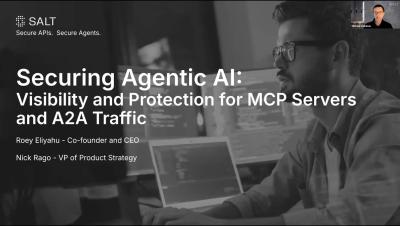
Securing AI Agents: How to See MCP Servers and A2A Traffic with Salt Security

AI agents have moved past conversation into action. They book transactions, pull sensitive data, and chain tools together through the Model Context Protocol (MCP) and Agent-to-Agent (A2A) traffic. Every one of those actions runs on APIs, and that connective tissue is where the risk sits. Salt Security Co-Founder and CEO Roey Eliyahu and VP of Product Strategy Nick Rago walk through the risks in the agentic action layer and show what Salt does about them.

When Al Agents go Rogue: What you're Missing in your MCP Security

No Fluff, Just Real-World Threats This isn’t your typical marketing webinar. We cover what Agentic AI actually looks like in production, how MCP servers work to broker instructions, and what kind of new threats are emerging. Agentic AI isn’t coming. It’s already here. Autonomous agents are now operating in production environments, reasoning, remembering, and taking real actions across your systems. They’re not just generating content. They’re triggering workflows, modifying records, and making decisions. And they’re doing it over APIs.

How Salt Security & AWS Simplify API Security

See your Blind Spots in Minutes, not Months: How Salt Security & AWS Simplify API Security AI agents and cloud-native architectures have unleashed a wave of APIs and with them, new attack surfaces. Most security teams are struggling to keep up, especially in dynamic AWS environments where shadow and zombie APIs can easily go undetected. This Salt Security and AWS webinar explores a better approach to API discovery and security in AWS without the burden of in-line traffic collection or sensor deployments.

Ep 9 - Inside Volt Typhoon: Defending Against Chinese State-Sponsored Cyber Threats

In this podcast, we uncover the tactics behind Volt Typhoon, a Chinese state-sponsored operation targeting critical national infrastructure. Learn how this group is moving from espionage to disruption, using stealthy, “living off the land” techniques and exploiting legitimate system tools to hide in plain sight.

The Real Remediation Bottleneck

Most teams think vulnerability scanning equals progress. But scanning without effective remediation is just expensive noise. Two things block real fixes: Meanwhile, our own research shows as much as 30% of vulnerabilities in transitive dependencies remain unresolved, simply because upgrades break production. That means most organizations aren’t “secure”. They’re sitting on unfixed issues their scanners excluded.

What are you doing to stay safe from supply chain attacks?

Automatic updates were supposed to make us safer. Instead, they’ve become one of the easiest entry points for supply-chain attacks. When a public repository is compromised, an attacker uploads a malicious version and waits, for 30 minutes to a few hours, before the community detects and removes it. During that window, automated tools like Dependabot can pull that version straight into production. That small window of time is enough to compromise thousands of systems.

Close the "Unfixable" Vulnerability Gap

30% of open source vulnerabilities are marked “unfixable”. Not because they can’t be fixed but because traditional tools stop there. Your customers don’t care. They just see unresolved CVEs. And they won’t sign off on software that fails a scan. That’s where the real business risk lies. In mid-size software companies, “unfixable” means delayed deals, failed audits, and lost revenue. Seal Security was built to close that 30% gap.

Deepfake Candidates Are Getting Hired - Here's How

Hiring in 2025: Is the person you hired even real? Deepfakes resumes. Outsourced interviews. Candidates landing jobs they never intended to do. We've moved from KYC to KYE, and organizations haven't caught up yet. In the latest episode of The Connectivity Cloud Podcast, we explore how attackers are weaponizing the job market with Vladimir Krupnov and Blake Darché. For anyone in hiring, HR tech, or security leadership, this is a must-listen.