Security | Threat Detection | Cyberattacks | DevSecOps | Compliance

Sysdig integration with Backstage

Developers are frequently tasked with working with multiple tools in the cloud-native era. Each of these tools plays a crucial role in the application life cycle, from development to deployment and operations. However, the sheer variety and diversity of these tools can increase the likelihood of errors or the accidental inclusion of critical vulnerabilities and misconfigurations.
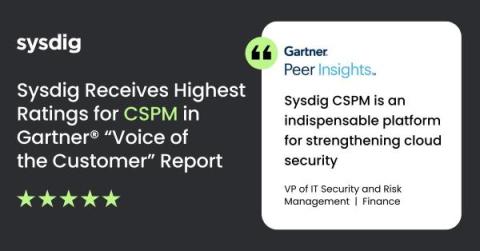
Customers Rate Sysdig 5 Out of 5 in Gartner Voice of the Customer for Cloud Security Posture Management Tools

As more and more workloads move to the cloud, the attack surface security teams need to secure has grown exponentially. To guard the massive perimeter of the cloud, you need to position your cloud infrastructure to be as safe as possible by default.

The Future of Kubernetes Network Policy

In the ever-changing world of Kubernetes security, it’s crucial to stay ahead of threats while maintaining operational efficiency. That’s why we’re excited to introduce our latest feature: Auto-Generated Kubernetes Network Policy, based on application runtime behavior, powered by eBPF (extended Berkeley Packet Filter) technology. With this addition, organizations can easily apply native Kubernetes network rules without worrying about disrupting their production systems.

Kubernetes Hardening Guide

Kubernetes, also referred to as k8s or “kubes,” stands as a portable, extensible, open-source container orchestration platform designed for managing containerized workloads and services. Initially developed by Google based on its internal systems Borg and later Omega, Kubernetes was introduced as an open-source project in 2014 and subsequently donated to the Cloud Native Computing Foundation (CNCF).

Falcon Cloud Security Supports GKE Autopilot to Secure More GCP Workloads

In the ever-evolving landscape of cloud security, staying ahead of the curve is paramount. Today, we are announcing an exciting enhancement: CrowdStrike Falcon® Cloud Security now supports Google Kubernetes Engine (GKE) Autopilot. This integration marks an important milestone in our commitment to providing cutting-edge DevSecOps-focused security and solutions for modern cloud environments.

K8s Backup Automation: Tools & Best Practices

Kubernetes (K8s) is a key platform for deploying and managing containerized applications. As more and more businesses use Kubernetes, it’s clear that there’s a need for robust data protection strategies. A crucial element of these strategies is the automation of procedures to backup K8s to prevent data loss, which could otherwise result in significant operational disruptions and financial consequences.

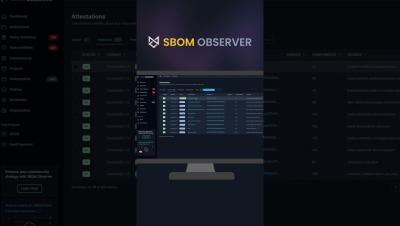
Quick Kubernetes SBOM Integration: Secure Your Cluster with SBOM Observer in a few seconds

Discover the fastest way to enhance your Kubernetes security and compliance! With SBOM Observer's new Kubernetes integration, you can generate and upload SBOMs for your entire cluster in just a few seconds using our CLI. This approach offers a holistic SBOM-centric overview, enabling vulnerability detection and management across environments. Level up your cybersecurity strategy today and ensure your environments remain compliant.

The Kubernetes network policies you need today

In the dynamic world of Kubernetes, container orchestration is just the tip of the iceberg. In this sophisticated ecosystem, you must prioritize security efficiency. Kubernetes’ robust, open-source platform has been revolutionary in automating the deployment, scaling, and management of application containers. Yet, such capability comes with significant responsibility, particularly in network security. Here, the role of network policies becomes crucial.

What is the difference between an SCA scan and a container scan?

Are Software composition analysis (SCA) scans and container scans the same thing? The short answer is yes… and no. A comprehensive container image scan applies SCA specifically to containers in combination with other analyses particular to containers, such as how they’re configured to deploy and the presence of secrets. Read on to learn the key differences.