Security | Threat Detection | Cyberattacks | DevSecOps | Compliance

Datadog Cloud Security Management Demo

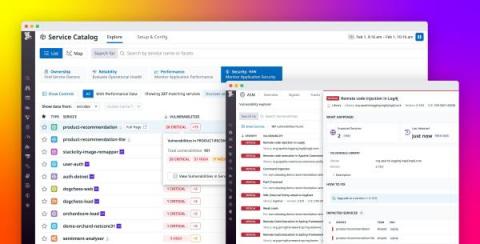
Datadog Cloud Security Management provides security context for your observability data to help you quickly identify threats and misconfigurations across your infrastructure. In this demo, we show you how Cloud Security Management allows you to remediate threats, collaborate with other teams, and declare incidents for further investigation, giving you complete cloud-native application protection.

Dash Panel Discussion: Foundations of Security and Leadership at Scale

As businesses have modernized and migrated their tech stacks from on-prem to the cloud and broken down monoliths into microservices, security teams have had to evolve. This evolution has led to new tools and new practices to avoid incidents. In this panel moderated by Datadog’s Andrew Krug, we chat with security engineering leaders about the processes they’ve adopted or created to keep modern, distributed systems safe. We also discuss what organizations can do to keep ahead of threats as our systems keep advancing.

Add security context to observability data with Datadog Cloud Security Management

Organizations are rapidly migrating their infrastructure to the cloud, enabling them to modernize their applications and deliver more value to their customers. But this transition creates significant security risks that they may be unable to keep pace with. For example, cyber attacks on cloud resources are becoming more sophisticated and prevalent. Additionally, organizations often rely on legacy, disjointed security tools that don’t integrate well with cloud-native infrastructure.

The State of AWS Security

In the cloud, securing identities and workloads is both paramount and complex. Inventories of AWS customer security breaches help us learn from publicly disclosed incidents—but until now, not much concrete data has been shared around the usage of security mechanisms that could have helped prevent these incidents. For this report, we examined real-world data from a sample of more than 600 organizations and thousands of AWS accounts that use the Datadog Cloud Security Platform.

Best practices for securely configuring Amazon VPC

Amazon Virtual Private Cloud (Amazon VPC) is an AWS service that enables you to launch AWS resources within your own virtual network. Because you can deploy VPCs in separate regions and other VPC components themselves are deployable across different Availability Zones, VPC-hosted environments tend to be highly available and more secure.

Datadog on Web Security Standards

Modern web applications are incredibly complex. Frameworks, javascript, and dependency management have made understanding and maintaining a baseline security standard maximum difficulty. With attack vectors like those listed in the OWASP Top 10 it can be incredibly difficult to know where to start and what the metrics for success are. Every web browser today supports a variety of "secure headers". These headers can be served as part of each response from the web server stack and can prevent a variety of common attacks. Perhaps the most impactful among these is content security policy headers or CSP.

Identify security vulnerabilities with DNS-based threat detection

The Domain Name System (DNS) is responsible for mapping client-facing domain names to their corresponding IP addresses, making it a fundamental element of the internet. DNS-level events provide valuable information about network traffic that can be used to identify malicious activity. For instance, monitoring DNS lookups can help you see whether a host on your network attempted to connect to a site known to contain malware.