Security | Threat Detection | Cyberattacks | DevSecOps | Compliance

Navigating the Agentic AI Era: Forward's Perspective from Cisco Live EMEA

Cisco Live EMEA 2026 Amsterdam has officially wrapped up, and the path forward is clear: we have entered the Agentic AI Era. The event was centered around an industry shift towards a unified platform where AI agents don't just respond; they act. At Forward Networks, we aren’t just watching this shift happen; we are providing the foundation required to make it a reality.

Using NQE to Consistently Validate DNS Configuration During Network Changes

DNS is foundational to almost every application, yet it is often treated as background configuration rather than a critical dependency. During network changes, DNS settings are easy to overlook. A single device pointing to the wrong resolver, missing a required DNS entry, or retaining a legacy configuration can cause application failures that appear unrelated to the original change.

Modernizing Mission-Critical Networks Through Accurate, Non-Intrusive Surveys

Modern network surveys provide a structured, repeatable way to uncover the true state of complex environments without intrusive installs or prolonged approvals. This blog explains how Forward Enterprise enables fast, accurate baselining and why understanding actual network behavior is foundational to modernization and mission assurance.

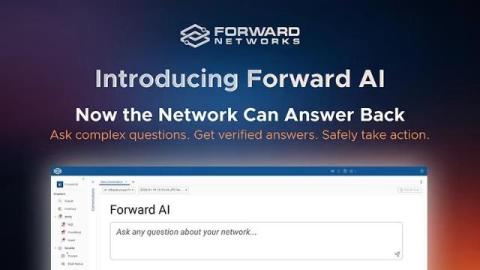
Introducing Forward AI

As enterprises move toward agentic operations, speed without data accuracy becomes a liability. At Forward Networks, we recognized this challenge and set out to deliver a solution: speed backed by mathematical accuracy. In networking, acting on incomplete or approximate data is not an inconvenience, it is a cause of outages, security exposure, and operational risk.

Introducing Forward AI

The Network is Complex. Operating It Shouldn't Be. Forward AI transforms network operations by reducing manual analysis, expert dependency, and guesswork. By combining conversational interaction with a mathematically accurate digital twin, teams can validate intent, understand actual network behavior, and act with confidence across even the most complex environments.

A New Security-Focused Path Search View for Faster, Clearer Analysis

Security teams frequently investigate whether traffic is allowed, denied, or translated along a path, but traditional visualization methods create unnecessary complexity. A standard Path Search view includes every L2 and L3 hop—switches, routers, and intermediary devices that participate in forwarding but apply no security policy. While this depth is helpful for network troubleshooting, it overwhelms analysts focused specifically on enforcement points.

How Permit-All Mode Simplifies Troubleshooting Across Routing and Firewalls

When application traffic fails to reach its destination, teams must determine whether the problem lies in routing, firewall rules, NAT behavior, or a combination of all three. In many environments, these components overlap in ways that make traditional troubleshooting slow and error-prone. Engineers often have to run repeated tests, stage changes, or temporarily disable rules to understand why a flow is being blocked.

New Configuration Change History in Forward Enterprise

Modern networks change constantly as teams modify interfaces, adjust routing, enable features, or deploy security controls. Over time, these individual updates create a complex configuration history that is rarely documented comprehensively. Without access to historical configuration data, engineers face significant challenges determining when changes occurred, whether they align with approved change windows, or how they influenced network behavior.