Security | Threat Detection | Cyberattacks | DevSecOps | Compliance

Governance That Ships: Embedding Policy as Code Into Your System of Record

Proving compliance is a necessity, but in a world of tightening regulations, the path to compliance is currently paved with spreadsheets, screenshots, and manual attestations. We call this the “Audit Tax”, the millions of dollars and thousands of people hours spent not just integrating security, but on proving you are handling security.

AI Models Won't Pick Sides in the Security War. Governance and Policy Will.

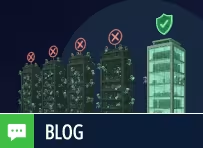
Two significant software supply chain cybersecurity attacks, seven days apart, with one hundred and eighty million weekly downloads between them. The chaos from development teams to the boardroom is real. And the pace is only going to get faster. Much, much faster…

Accelerating Secure Software Delivery in Southeast Asia: Why the "Surge of Binaries" Demands a Unified Strategy

For years, the conversation around digital transformation in Southeast Asia focused on “getting to the cloud.” Today, that conversation has shifted. Our region is no longer just adopting the cloud; we are leapfrogging traditional development cycles by integrating AI and cloud-native architectures at a staggering pace. However, this acceleration has created a byproduct that many organizations are struggling to contain.

From Shai-Hulud to LiteLLM: Supply Chain Attackers Are Coming for Your Agents

The LiteLLM supply chain compromise of March 24, 2026, is not an isolated incident. It is the latest and perhaps most dangerous chapter in an evolving attacker playbook that JFrog Security Research has been tracking for years. The target has shifted from developers to the AI agents that developers now rely on to build software.

Stop Policies From Breaking Your Builds

Security policies exist to protect your software supply chain. So why do they keep breaking your builds? This is the unspoken frustration inside most DevOps and security teams today. Supply chain attacks drove 30% of external breaches in 2025. So your security team did the right thing. They added policies to flag packages that are too new, unproven, or missing from the organization’s approved package list.

9 New Innovations. One Trust Layer.

The software supply chain is no longer just about shipping code, it is about managing intelligence and risk. As DevOps, DevSecOps, DevGovOps and AI/ML practices converge into a single AI-driven and increasingly agentic delivery pipeline, the demands on development and security teams have reached a new level. The platform that once managed packages and artifacts now governs models, agents, and skills at enterprise scale, speed, and accountability.

From Agentic Risk to Agentic Confidence: The JFrog MCP Registry is GA

In an AI-native world where Model Context Protocol (MCP) is the universal standard for AI connectivity, the security and governance stakes have never been higher. AI’s ability to take autonomous action through MCPs means that a single breach of an MCP server can grant attackers control over mission-critical enterprise systems, putting enterprises in an immediate and escalating state of agentic risk that cannot be ignored.

Survive the AI Code Blizzard: Introducing Snippet Detection

In 2026, software development speed is an AI-solved problem. Yet, as AI-generated code volumes surge, organizations face a new kind of risk visibility gap. Developers are increasingly copying third-party snippets into their codebases—from both AI prompts and open-source software components—creating large security and compliance blind spots that lead to significant risks.

Agent Skills are the New Packages of AI: It's Time to Manage Them Securely

Let’s talk about agent skills. As the AI agent ecosystem matures, we’re seeing a major shift in how users equip agents to run automated workflows. While robust protocols such as MCP exist to handle complex system integrations and authentication, skills have emerged as the go-to, low-friction way to shape an agent’s day-to-day behavior. Skills are extremely easy to adopt. In many cases, they are simply lightweight files that orchestrate scripts and commands.

Webinar Recap: The Context Engine - Why Consolidation is the Natural Future of AppSec

As the software development lifecycle continues to evolve, the rise of AI is introducing both unprecedented productivity and unprecedented risk. In a recent webinar hosted by JFrog, Jens Eckels sat down with Forrester Senior Analyst Janet Worthington to discuss the state of application security (AppSec), the explosive growth of agentic software development, and why consolidating security tools is no longer a luxury, but a necessity.