


|
By The JFrog Team
At JFrog’s swampUP 2026 conference in New York, security leaders gathered to tackle the rapidly evolving landscape of software supply chain security and AI-driven development. In this exclusive sit-down interview from the event, former SolarWinds CISO TIM (now CISO in Residence at Team8) sits with JFrog CISO Paul Davis and reflects on the historic 2020 Sunburst breach that reshaped the cybersecurity industry. This conversation has been edited for length and clarity.

|
By Carmit Hershman
The way software gets built has changed faster than the standards that govern it. AI agents now create pull requests, select dependencies, refactor codebases, interpret test failures, and execute infrastructure changes across the entire Software Development Life Cycle (SDLC). AI agents are autonomous team members, but unlike human engineers, they are ephemeral: their reasoning, decisions, and tool calls vanish the moment the session ends. You can’t hold an ephemeral process accountable.

|
By Paul Davis
As we enter the AI era, few among us have found themselves so entrenched in the throes of the shifting landscape as CISOs. With the threat landscape shifting, they are up against increasing rates of vulnerabilities and exploits alongside rapidly scaling demands for ever more secure environments. As CISOs, with our role as the protectors of an organization, we are expected to deliver guidance and security visibility. This is not a vision of the future, it’s today’s reality.
|
By Shachar Menashe
TL;DR: Frontier AI has collapsed the vulnerability exploit window from weeks to mere hours. Attackers now use advanced AI models to reverse-engineer published fixes and generate working exploits faster than human security teams can deploy updates. In the AI era, publishing a patch creates a blueprint for attackers. Surviving this threat requires vendors to tier sensitive disclosures and customers to treat patch application speed as a critical security metric.
|
By Yuval Moravchick
Your Mac runs a vulnerable version of Parallels Desktop. A malicious package, compromised CI job, or other unprivileged process is already running on it. No admin access. No Parallels-signed client. One appliance-install request later, attacker-controlled code runs as root. While testing Desktop 26.4.0 (build 57513) on Apple silicon, we found that an unprivileged local user could execute code as root through prl_disp_service.
|
By Ronny Belenitsky
Every compliance audit starts the same way: Someone flags a deadline, the team scrambles to pull evidence, map controls, and prove that the policies running in production actually match what the framework requires. They make it through. They exhale. Six months later, a new framework arrives, and the fire drill starts all over again. Most teams walk away from an audit believing they are compliant.

|
By The JFrog Team
Every developer on your team now runs multiple agents. None of them are waiting for human sign-off to act. That’s exactly the gap we discussed and closed at swampUP 2026. JFrog unveiled new capabilities that extend the JFrog Platform as not only the Single Source of Truth for OSS and heritage software, but now the Agentic Software Supply Chain. Here’s everything we announced, and why it matters.
|
By Yonatan Philip
Most organizations spent years hardening their software supply chain. The model is familiar: dependencies flow through a controlled repository, policies determine what is allowed, scanning catches what slips through, and every action is logged for auditability. It works because human developers operate within environments that enforce these rules. AI coding agents break that assumption entirely.

|
By Jacqueline Basil
For twenty years, the software security playbook has worked the same way. You find the vulnerability, score it, open a ticket, assign it to a human, wait for the fix, ship the patch, and prove it happened. Every step in that sequence assumes humans can review each fix individually and still keep up. Frontier AI broke that assumption. The exploit window has collapsed from weeks to hours. Attackers reason across your codebase, chain their findings, and ship exploits before a CVE is even published.

|
By Ohad Shalev
The riskiest thing an AI agent does all day isn’t writing code. It’s shopping. Every few minutes, it reaches out for a package, an AI asset, or a tool, and pulls it in with no real way to check what’s inside. We think the fix is agent immunization: security that lives inside what an agent consumes, builds, and ships, not a wall built around it.
|
By JFrog
Governance, Risk, and Compliance — better known as — is an integrated approach that helps organizations align their objectives, manage risks, and meet regulatory requirements, all at the same time. In this quick explainer, we break down: Whether you're new to GRC or looking for a simple way to explain it to your team, this short video gives you the essentials without the jargon.
|
By JFrog
Is there an unlocked window in your code? A software vulnerability is more than just a "bug". It's a security gap that can lead to data breaches, system crashes, and lost customer trust. In this episode of EveryOps in 1 Minute, we break down: The definition of a software. Why they happen (from coding slips to complex architecture). Real-world examples like Log4j. How to "shift left" to catch flaws before they reach production.
|
By JFrog
In today's complex business world, staying organized and secure is more important than ever. This video breaks down GRC (Governance, Risk, and Compliance)—an integrated approach that helps organizations manage their goals, threats, and regulatory requirements in one unified way.
|
By JFrog
How do AI models go from a cool idea to a reliable app feature? One answer:. It's the "#DevOps for" that helps teams build, deploy, and monitor models without breaking things.

|
By JFrog
In software, speed is great, but safety is critical. How do you get both? That's the "Sec" in. It’s why has gained popularity: moving from the end of the line to the very beginning. Instead of a final check, it becomes a "shared responsibility" for Dev, Sec, and Ops teams at every stage of software development and delivery.
|
By JFrog
Only secure, verified, compliant software should reach production. Full stop. With increasing pressure on modern development teams to deliver across security and compliance requirements, a fully-secured, attestable pipeline demands complete visibility and control across the entire release lifecycle in a single solution.
|
By JFrog
Only secure, verified, compliant software should reach production. Full stop. With increasing pressure on modern development teams to deliver across security and compliance requirements, a fully-secured, attestable pipeline demands complete visibility and control across the entire release lifecycle in a single solution.
|
By JFrog
How can you ensure your software supply chain is resilient and prepared for the challenges ahead? In this exclusive session, we’ll reflect on key lessons from 2024 and showcase how JFrog is leading the way in securing DevOps pipelines for 2025 and beyond. Join us for an engaging conversation with industry experts as we uncover real-world insights, explore actionable strategies, and demonstrate innovations designed to safeguard your software delivery lifecycle in an evolving threat landscape.
|
By JFrog
DSSE, or Dead Simple Signing Envelope, is a standard JSON format for signing arbitrary data, widely accepted for attesting software supply chain security, particularly for SLSA provenance and attestations verification.
|
By JFrog
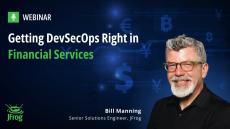
Some of the largest financial services organizations in the world - including the top 5 banks in the US - all use JFrog to deliver applications faster, and more securely. Working closely with these top banks, trading and insurance companies has taught us a thing or two about getting DevSecOps right in these highly regulated, complex environments.
|
By JFrog
Cloud DevOps tools offer greater flexibility, rapid deployment, cloud automation, reduced IT costs, and low upfront costs with subscription pricing. Setting up your environment with Artifactory on the cloud on your choice provides unlimited scalability allowing you to grow according to your needs and is easily achieved by using cloud storage providers (Amazon AWS, Google GCP or Microsoft Azure) in your environment with Artifactory.
|
By JFrog
Software businesses of every industry and all sizes, from small startups to large enterprises, are looking for ways to accelerate their software development process in the race to innovate and deliver their offerings to their customers ahead of their competition.
|
By JFrog
Today, we live in a very connected world, where our devices, homes and cars all communicate with each other, and every company with a product or service has the need to develop software. It is one of the primary mediums by which they strive to provide better products, services and solutions, and has become paramount to a company's success. To continuously improve their software, companies must have sound DevOps or DevSecOps practices in place.
|
By JFrog
In today's enterprises, software is your company's everyday face, whether through the desktop, the cloud, or a mobile device, to all parts of the globe. Cars are computers on wheels. Thermostats are data terminals. Banks live in your phone. In this new world, software updates serve customer's demands. Each one you deliver is your opportunity to renew - or, if botched, destroy - their trust. How can you make every update top-notch at top speed?
|
By JFrog
Over the last several years, software development has evolved from deploying products periodically to building them on an ongoing basis using CI servers. A company's end product may be built on a daily or even hourly basis. This means that DevOps must support the continual flow of code from the individual developer's machine to the organization's production environment.
|
By JFrog
Two numbers are shaking the foundations of business. What do these two figures mean to your business? They mean that, odds are your competitive landscape is irrevocably changed - already. To start, expectations for delivery speed for new products, services, and everything are faster. The new table stakes in the DevOps world have raised the bar on collaboration, cross-organizational visibility, efficiency, even company culture. Another thing these two simple stats mean is that most businesses are already there, or heading there now.
- October 2026 (3)
- September 2026 (4)
- August 2026 (9)
- July 2026 (7)
- June 2026 (14)
- May 2026 (3)
- April 2026 (8)
- March 2026 (12)
- February 2026 (9)
- January 2026 (4)
- December 2025 (6)
- November 2025 (4)
- October 2025 (10)
- September 2025 (12)
- August 2025 (3)
- July 2025 (5)
- May 2025 (1)
- April 2025 (3)
- March 2025 (4)
- February 2025 (3)
- January 2025 (4)
- December 2024 (2)
- November 2024 (4)
- October 2024 (5)
- September 2024 (5)
- August 2024 (6)
- July 2024 (3)
- June 2024 (2)
- May 2024 (8)
- April 2024 (2)
- March 2024 (4)
- February 2024 (5)
- January 2024 (9)
- December 2023 (10)
- November 2023 (7)
- October 2023 (5)
- September 2023 (12)
- August 2023 (5)
- July 2023 (3)
- June 2023 (6)
- May 2023 (5)
- April 2023 (6)
- March 2023 (6)
- February 2023 (5)
- January 2023 (2)
- December 2022 (3)
- November 2022 (8)
- October 2022 (9)
- September 2022 (6)
- August 2022 (11)
- July 2022 (4)
- June 2022 (8)
- May 2022 (15)
- April 2022 (7)
- March 2022 (9)
- February 2022 (10)
- January 2022 (3)
- December 2021 (17)
- November 2021 (3)
- October 2021 (6)
- September 2021 (7)
- August 2021 (4)
- July 2021 (5)
- June 2021 (8)
- May 2021 (4)
- April 2021 (1)
- March 2021 (2)
- February 2021 (5)
- December 2020 (2)
- November 2020 (1)
- October 2020 (4)
- September 2020 (1)
- July 2020 (4)
- June 2020 (1)
- May 2020 (4)
- April 2020 (4)
- March 2020 (1)
- February 2020 (2)
- January 2020 (6)
- December 2019 (2)
- November 2019 (2)
JFrog products seamlessly integrate with practically any development environment on Earth, from legacy code to the most recent containers and micro-services.
JFrog's end-to-end platform provides a fully automated pipeline for distributing trusted software releases. Connecting all developers, DevOps engineers and product owners to end devices, the JFrog Platform ensures software flows quickly and free from interruption.
End-to-End Universal DevOps Platform:
- JFrog Artifactory: The undisputed software repository leader for integrated, universal artifact management at enterprise scale.
- JFrog Container Registry: The world’s most flexible, hybrid container registry, with enterprise-grade resiliency backed by JFrog Artifactory.
- JFrog XRay: Universal security vulnerability & compliance analysis, natively integrated with Artifactory for continuous governance across the DevOps pipeline.
- JFrog Pipelines: Universally orchestrate software releases and master the entire CI/CD pipeline from code to production.
- JFrog Distribution: Secure and validate your software releases, allowing trusted, optimized software distribution on a global scale.
- JFrog Mission Control: A single access point providing a centralized dashboard to oversee your DevOps pipeline.
Universal Artifact Management for DevOps Acceleration.