Security | Threat Detection | Cyberattacks | DevSecOps | Compliance

Deepfakes and AI-based fraud: Strategies to protect your business

For years, fraudsters have used generative AI to bypass identity and liveness checks. Unfortunately, as generative AI models improve and new models are released, fraudsters also improve and expand their ability to spoof identity verification systems. The result? Preventing fraud has never been more challenging.

Strengthening Identity Assurance: Combatting Social Engineering with Duo Identity Verification

Social engineering accounts for 60% of identity-related breaches. By exploiting human trust during helpdesk interactions and remote onboarding, threat actors can use people to attack systems. Traditional MFA alone can’t stop these attacks when they bypass authentication entirely. Watch this discussion with industry experts Landy Naylor (Senior Product Manager at Cisco Duo) and Bobby Baek (Manager, Sales Engineering at Persona). We’ll cover how Duo Identity Verification, powered by Persona, adds high-assurance identity verification to helpdesk and remote onboarding workflows.

Account takeover (ATO) uncovered: multi-signal strategies for marketplaces

Unfortunately, account takeover (ATO) schemes are all too familiar to any marketplace. A bad actor infiltrates a high-value buyer or seller account and commits fraud, causing reputational risk and financial harm. While the tactics haven’t changed, new fraud tools have skyrocketed ATO into a $13 billion problem. To combat this growing threat on your platform or marketplace, you must look beyond point solutions, which only catch the most obvious cases, and adopt a sophisticated, multi-signal approach.

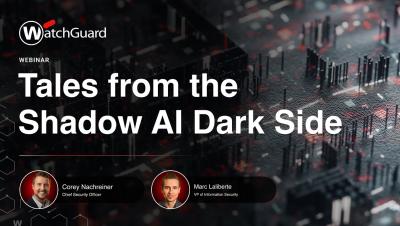
Tales From the Shadow AI | WatchGuard Webinar

Join WatchGuard’s Corey Nachreiner and Marc Laliberte for a deep dive into Shadow AI breaches from 2025 and 2026. You’ll hear about an AI coding agent that wiped a live database during a code freeze and a hiring chatbot whose admin login was 123456. Then they'll show you how to find the same risks across every client you manage with WatchGuard Cloud Detection and Response (CloudDR).

CrowdStrike Expands Falcon Adversary OverWatch Threat Hunting Across AI and Google Cloud

As adversaries broaden their operations across cloud environments, identities, SaaS applications, and AI systems, security teams need threat hunting that can keep up. Suspicious activity in one environment may be part of a larger intrusion spanning multiple domains, making it increasingly important to connect signals across the attack surface. To expand detection coverage across the widening attack surface, CrowdStrike Falcon Adversary OverWatch threat hunting has added two key capabilities.

Build an Intelligence Advantage with Falcon Next-Gen SIEM

Every organization has a different threat profile. Industry, geography, infrastructure, business operations, and the broader technology ecosystem all influence which adversaries and threats matter most. The challenge is putting threat intelligence to work at scale to identify the greatest threats to each business. The intelligence that security teams rely on is as varied as the threats they face.

CrowdStrike Agent Graph Shows How Agents Act on the Endpoint

AI agents don't just answer questions anymore. They open files, use credentials, run code, install software, and run models locally, all at machine speed. Every one of those actions happens on the operating system. This is where attacks land, and where CrowdStrike Falcon Guardian excels: on the endpoint, at runtime.

What is Identity Manager? | One Identity | IGA

What is One Identity Manager? It’s an identity governance and administration (IGA) solution that automates user provisioning, access requests, access certification, and role management across on-premises, hybrid, and cloud environments. Watch this overview to see how Identity Manager helps you enforce least privilege, close compliance gaps, and manage the full identity lifecycle from joiner to mover to leaver. Learn more about identity governance and administration at oneidentity.com.#IGA.

Guide: What Are ODPs in NIST 800-171 Rev 3?

The shift from NIST SP 800-171 revision 2 to revision 3 includes a lot of changes, which we've already covered from a bird's-eye view over in this post. One of the biggest changes in Rev 3 is the introduction of ODPs, or Organization-Defined Parameters. These are very important for compliance with CMMC moving forward, but they're still something of a mystery to some security professionals, and are worth explaining. What are they, how do you define them, and how do you use them for compliance?

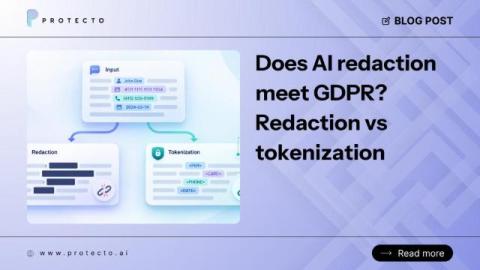
Does AI redaction meet GDPR? Redaction vs tokenization

Short answer: GDPR names pseudonymization as a recommended safeguard, in Article 25 and Article 32, and Recital 28 says pseudonymization reduces risk for data subjects. Redaction deletes the value, so a redacted prompt breaks the model’s ability to reason. Tokenization replaces the value with a consistent token, so the model keeps working. Tokenization is a safeguard, not an exemption. A familiar pattern: a team writes a regex, strips emails from the prompts, and calls it done.