Security | Threat Detection | Cyberattacks | DevSecOps | Compliance

How to Prevent Prompt Injection

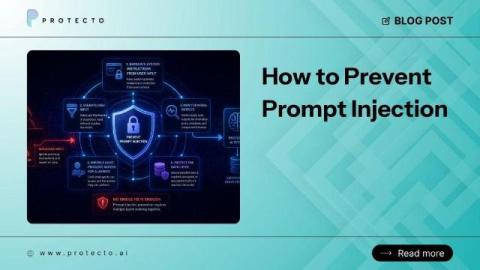
A prompt injection occurs when an attacker manipulates input to your AI system, overriding its instructions. To prevent prompt injection, you need a layered approach: separate system instructions from user input, validate user input before it reaches the model, monitor model outputs for anomalies, enforce least-privilege access for AI agents, and protect the data layer so sensitive information never reaches the model in a readable form. No single fix is enough.

Most Critical Infrastructure is Held Together by Sticky Tape

The fear is not only what advanced AI can do, it is what it can do to brittle systems already running on neglect and compromise. When critical infrastructure is patched together with ageing controls and restricted tools land in a few powerful hands, the imbalance gets worse fast.

If You're Worried About Mythos, Your Security is Broken #infosec #alert

This episode looks at what happens when AI starts finding vulnerabilities at scale, restricted access creates market imbalance, and security teams struggle to keep pace. It covers fragile infrastructure, bug brokers, overloaded analysts, CISO fear, and the growing sense that cyber defence is entering a faster and harsher era.

How a Hacker Used Standard AI to Dismantle a Government

The real shock is not a restricted model with scary branding, it is what standard public AI tools already make possible. A prolonged attack against government systems, tax records and voter data shows the threat comes from scale and persistence, not only from the newest frontier release.

The Adversary's Speed Just Changed - What Mythos Means for Your Security Posture

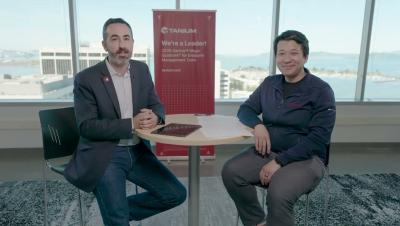
The cybersecurity threat landscape just changed — and most organizations don't know it yet. In this conversation, Tanium's Pedro (CRO) and Mark Liu (VP of Solution Engineering) break down what Anthropic's Mythos really is, why security leaders everywhere are asking about it, and what organizations need to do right now. No marketing pitch — just a straight conversation about a consequential shift that's already underway.

AI SecOps Worskhop Series: Detection Engineering with LimaCharlie and Claude Code

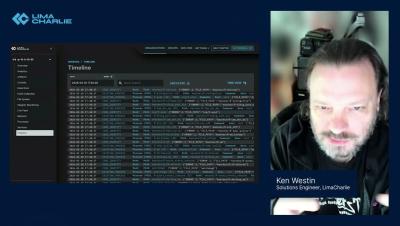
This hands-on workshop is designed for security professionals interested in learning how to integrate advanced AI capabilities into their detection and response workflows. Attendees will receive practical, step-by-step instruction on leveraging the power of Claude Code, a sophisticated AI agent, to significantly enhance security operations within the LimaCharlie platform for detection engineering use cases.

Are we blindly giving AI access to everything?

Users are connecting AI tools without understanding the security implications. In this week's Intel Chat, Chris Luft and Matt Bromiley discuss a security breach at Vercel that originated from a compromised third-party AI tool used by one of its employees. The attacker gained control of the employee's Google Workspace account, which provided access to Vercel's internal environment.

How multi-agent systems work in LimaCharlie

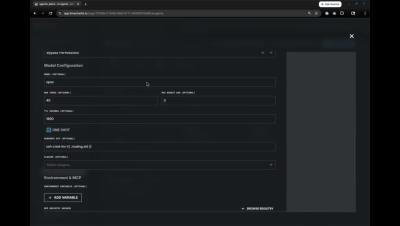
This video walks through how single agents and multi-agent systems are built and run inside the LimaCharlie platform. Agents in LimaCharlie are defined declaratively. Each agent specifies the model it runs, its instructions, the tools it can access, what events trigger it, and the guardrails it operates under. This approach makes agents version controllable, reviewable, and portable across tenants.

SMB Risks, AI, and Regional Realities with Paul Harris - The 443 Podcast - Episode 368

This week on the podcast, Marc and Corey sit down with Paul Harris, CEO of BGLA and Futurity Corp at WatchGuard's Impact Partner Conference in Tulum, to explore the evolving cybersecurity landscape across Latin America. Paul shares his journey from early days in cybersecurity to leading organizations in the region, while breaking down the biggest concerns facing LATAM SMBs today. The conversation also covers how AI is reshaping cybersecurity, the challenges of securing partners across diverse markets, and practical advice for business leaders looking to stay ahead of cyber risk in LATAM.

Detection Engineering with LimaCharlie and Claude Code

Detection engineering is fundamentally a translation problem: rules need to be converted between formats, IOCs need to be converted into detection logic, and noisy alerts need to be converted into precise suppressions. That translation work is what consumes analyst time, and it's what Claude Code handles well.