Security | Threat Detection | Cyberattacks | DevSecOps | Compliance

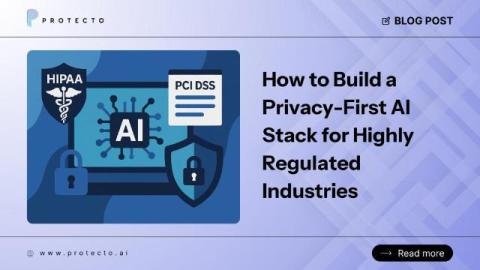
Building a Privacy-First AI Stack for Highly Regulated Industries

In a bid to quickly join the AI race, enterprises are steadily pouring time and money to adopt it. While designing a new AI tool, security and compliance are often an afterthought for developers and product managers. For industries that don’t handle sensitive data, AI adoption does not necessitate embedding strong privacy controls. However, highly regulated sectors like healthcare, finance, or government defence contractors can’t afford to launch without adhering to regulations.

What is shadow AI and what can you do about it?

Organizations across industries are actively investing in AI to streamline operations, boost productivity, and stay ahead in competitive markets. However, most proceed with caution when rolling out new AI solutions internally as they need to meet standards for AI security, compliance, and responsible use through rigorous testing and assessments. ‍ At the same time, teams may occasionally adopt AI solutions outside formal channels to simplify their workload.

Snyk and Cognition partner to enhance security for AI-native development

Today, Snyk is excited to announce a new partnership with Cognition that significantly advances security within the software development lifecycle, validating our "Secure at Inception" model. This collaboration introduces new integrations, Snyk for Devin and Snyk for Windsurf, which directly embed Snyk Studio's security intelligence into Cognition's AI-native developer tools.

A CISO's Guide to the Business Risks of AI Development Platforms

The tools designed to build your next product are now being used to build the perfect attack against it. Generative AI platforms can spin up a pixel-perfect replica of your brand's login page in minutes, launching high-fidelity phishing campaigns at a scale and speed that legacy security models cannot handle. This isn't an emerging threat; it's an industrialized phishing engine that’s already being weaponized against businesses.
Featured Post

Adapting to an AI-Driven Threat Landscape: The Future of Cyber Defence

As cyber threats grow more advanced, with AI becoming a tool for both cyber attack and defence, the challenge facing businesses has never been more complex. Emerging technology is now making watertight cybersecurity practice a core pillar of operational resilience, data integrity, and customer trust. The path forward lies in strategic AI integration, harnessing its potential to automate defence and accelerate detection, while maintaining transparency, governance, and trust.

Sweet Security Named Cloud Security Leader and CADR Leader in Latio Cloud Security Report

Sweet Security, a leader in Runtime Cloud and AI security solutions, today announced that it has been recognized as both a Cloud Security Leader and a Cloud Application Detection & Response (CADR) Leader in the 2025 Cloud Security Report by James Berthoty of 'Latio Tech.'

Securing Agentic AI on Mobile

AI adoption is accelerating at an unprecedented rate. A recent McKinsey survey found nearly 80% of enterprises now regularly use generative AI, outpacing the early adoption of both the personal computer and the public internet. Agentic AI—autonomous agents capable of planning, reasoning, and acting on a user’s behalf—has likewise moved from pilots to production, with 79% of senior executives reporting adoption.

Shadow AI and the New Data Defense Paradigm: Insights from Our Data Defense Forum

Last month, we brought together some of the brightest minds in cybersecurity for our Data Defense Forum event. As someone who's been in the trenches of data security for years, I walked away from these conversations with a renewed sense of urgency and optimism about where we're headed.

API Attack Awareness: When Authentication Fails - Exposing APIs to Risk

Authentication issues seem like low-level attacks. But authentication today – especially API authentication – can be more difficult than people expect. Companies rely on APIs to carry sensitive information every day. If access to those APIs is not properly secured, all the sophisticated security solutions companies use to protect their data elsewhere are completely undermined.