Security | Threat Detection | Cyberattacks | DevSecOps | Compliance

Session on AirGapped AI - Adopt AI Privately and Securely, AI Trends from Around the World at CyBe

In this session at CyBe AI Summit 2026, NIMHANS Convention Centre in Bengaluru, our Founder & CEO Mr. Anirban Mukherji discussed current AI trends, geopolitical and sovereignty risks tied to frontier LLMs, and practical implementations for India. He addressed how AI-driven automation like delivery robots and drones can disrupt jobs, why governments and defense agencies require air-gapped or on-prem solutions, and how cost and restricted access to frontier models create inequity in AI adoption.
Securing autonomous AI agents: regulatory risk and governance for modern AppSec

Autonomous AI agents writing and executing code at machine speed present an urgent compliance challenge for modern software organizations. As global regulations tighten, engineering leaders must establish clear governance layers over agentic workflows, external tool calls, and Model Context Protocol integrations to ensure full accountability. In this session, Mend.io experts Asaf Saar and Ben Goldberg unpack the intersection of AI compliance, software supply chain security, and enterprise risk management. Learn how to bridge the accountability gap without sacrificing development velocity.

When the AI Arrives Inside Software You Already Bought

An application that was AI-free at the last audit may be processing corporate data through a language model today. Nobody procured it, nobody approved it and nobody was asked. A vendor shipped a release. ‍ Third-party AI governance is built almost entirely around procurement. Assess the vendor, negotiate terms, sign a data processing agreement, add the tool to a register. The apparatus requires a purchasing event, and an embedded feature produces none, so the apparatus never engages. ‍

Best Shadow AI Governance Tools for Enterprises: Buyer's Shortlist

Security teams already know employees use generative AI. The harder problem is buying the right platform before unsanctioned apps move sensitive data outside your visibility and control. UpGuard research found 81% of employees and 88% of security leaders use unapproved AI tools, and 45% of workers find a workaround when their employer blocks an app. That last number should shape your buying criteria more than the first two. Demand doesn't disappear when you block it. It moves somewhere you can't see.

The Ultimate API Security Guide: Everything You Need to Know to Protect Your APIs

APIs power modern software. They connect apps, move data, and run agentic AI workflows. But every API is also a door into your systems. Attackers know this. They target APIs more than any other layer today. This guide breaks down API security from the ground up. You will learn what it means, why it matters, and how to protect your APIs against real-world threats. We cover risks, the OWASP API Security Top 10, best practices, tools, and use cases. Let’s get started.

Twitter Brand Impersonation: How Security Teams Detect Fake Accounts and Phishing on X

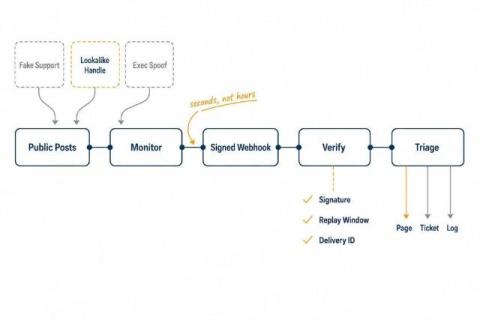
Most brand impersonation starts in public. A lookalike support handle appears, replies to real customers under your official account, and links to a credential-harvesting page. By the time it reaches a takedown vendor's weekly report, the damage window has been open for hours.

How Enterprises Vet Vendors: A Digital Contact Card Case Study

Every large company works with dozens, sometimes hundreds, of outside vendors. From software providers to marketing agencies to hardware suppliers, enterprises depend on a wide network of partners to keep operations running smoothly. But before any vendor gets a seat at the table, they go through a process that can feel like a job interview crossed with a background check. This process is called vendor vetting, and it exists to protect the enterprise from risk, wasted money, and reputational damage.

How AI Phone Calling Is Changing Voice Phishing Defense

Phone scams have been around for decades, but the last few years have brought a sharp shift in how convincing they've become. Voice phishing, often called vishing, used to rely on generic scripts and a scammer's ability to sound believable. Today, the same technology that powers helpful tools like AI phone calling is also being studied and used to fight back against these scams.

Why Sales Commission Data Needs the Same Audit Trail as Any Other Financial Record

An unexpected data integrity question has crept into sales operations: can a company actually reconstruct how a commission payout was calculated months after the fact? For teams still running compensation through spreadsheets, the honest answer is usually no, and that blind spot carries real financial and compliance weight.