Security | Threat Detection | Cyberattacks | DevSecOps | Compliance

How to Track All of Your Fourth-Party Cybersecurity Risks

A lack of direct communication with your fourth-party vendors makes tracking their security risks difficult. Thankfully, there are methods of overcoming this issue to help you remain informed of emerging fourth-party risks to help you easily track emerging fourth-party threats within your Fourth-Party Risk Management program. To learn how UpGuard can help you track your fourth-party risk, click here to request a free trial.


Reduce silos and prevent supply chain threats

We’ve entered the fourth and final week of National Supply Chain Integrity Month, an initiative started by CISA and other government agencies to highlight the importance of securing our nation’s most critical systems and ensuring they stay resilient. I started off the month with a post about maturing your third-party risk management program, and followed that up with two more posts dedicated to securing the small business supply chain and streamlining procurement.

Paws in the Pickle Jar: Risk & Vulnerability in the Model-sharing Ecosystem

Early 2023 has been characterized by an explosion of Artificial Intelligence (AI) breakthroughs. Image generators and large language models (LLMs) have captured global attention and fundamentally changed the Internet and the nature of modern work. But as AI / Machine Learning (ML) systems now support millions of daily users, has our understanding of the relevant security risks kept pace with this wild rate of adoption?

Boosting the Cyber Resilience of our Nation's Institutions

The White House’s ambitious national cyber strategy— which represents a shift away from decades-old voluntary compliance guidelines to a more aggressive regulatory approach of critical infrastructure firms—couldn’t come at a better time. A recent study found that local governments were the organizations least capable of disrupting ransomware attacks, and that they were also among the ransomware victims to pay ransoms most frequently (43% paid a ransom after an incident).

5 Things a Security Manager Should Check Every Morning

As a security manager, you have a wide variety of tasks you need to complete in order to protect your organization — as well as your employee and customer data. Of course, some of these responsibilities are performed on a quarterly or yearly basis, such as gathering information for audits or conducting annual assessments. But there are certain tasks that you should be completing daily in order to maintain the desired security posture and reduce cyber risk across your expanding attack surface.

New high-severity vulnerability (CVE-2023-29552) discovered in the Service Location Protocol (SLP)

Researchers from Bitsight and Curesec have jointly discovered a high-severity vulnerability — tracked as CVE-2023-29552 — in the Service Location Protocol (SLP), a legacy Internet protocol. Attackers exploiting this vulnerability could leverage vulnerable instances to launch massive Denial-of-Service (DoS) amplification attacks with a factor as high as 2200 times, potentially making it one of the largest amplification attacks ever reported.

How to Assess Cyber Risk for Potential Vendors (Complete Guide)

Assessing cyber risk for potential vendors is one of the most important aspects of managing third-party risk for any organization. The vendor risk assessment process helps businesses decide which partners or service providers to work with and, more importantly, who to trust with their most sensitive data.

How Do You Determine Vendor Criticality?

Vendor criticality is the level of risk that vendors are categorized into during the risk assessment phase. Determining vendor criticality is an essential part of the third-party risk management (TPRM) program to help organizations better prioritize their risk remediation goals. As part of the vendor risk assessment and vendor due diligence process, understanding the risk criticality levels of each vendor plays a huge role in preventing data breaches from occurring.

ScorecardX Integrates with OpenAI's GPT-4

As part of SecurityScorecard’s commitment to making the world a safer place, we are now the first and only security ratings platform to integrate with OpenAI’s GPT-4 system. With this natural language processing capability, cybersecurity leaders can find immediate answers and suggested mitigations for high-priority cyber risks.

Oversight of Cyber Risk: The Board's Essential Role in Mitigation and Prevention

Cybersecurity has become a top-of-mind concern for many C-level executives and board members. Data breaches are a daily occurrence and carry a hefty — and growing — price tag averaging $4.35 million worldwide, according to the latest Cost of a Data Breach report. However, this is only one of several potential cybersecurity risks that an organization can face.

5 Common Vulnerabilities Associated With Remote Access

After COVID, enterprise IT security got turned on its head. As the world adjusted to working from home, and continues to, IT teams worked overtime to enable remote access for millions of employees. This transition has gone smoothly for most organizations, but many security gaps still remain years later. The SolarWinds data breach is a worrying example. It shows how vulnerable organizations are to malicious activity in our changing risk environment.

Yes, It's Possible to Complete Vendor Questionnaires Faster

Let's be honest – nobody likes security questionnaires. To vendors, they're irritating workflow interruptions, always seeming to arrive at the most inconvenient times. To businesses, they mark the first stage of a long, drawn-out process where vendors need to be continuously pestered to complete them. In this post, we outline three proven strategies for streamlining the security questionnaire process to eliminate stress for both the businesses that send them and the vendors receiving them.

Are Vendor Security Questionnaires Accurate?

Vendor security questionnaires accurately evaluate a third-party supplier’s attack surface, but only if they’re utilized intelligently. The quality, and therefore, accuracy, of questionnaires rapidly deteriorates when they become excessively lengthy, one-size-fits-all templates bloated with jargon. In this post, we suggest x actions for improving the accuracy of your security questionnaires and the overall efficiency of your security questionnaire process.

Remediate Zero Day Events with Third-Party Vulnerability Detection & Response

When a major security event like SolarWinds or Log4j happens, how do you assess the impact across your third-party supply chain? Most organizations struggle to effectively react to zero day attacks and other critical vulnerabilities at scale, often following manual and cumbersome workflows. But our latest capability is here to change that.

Bitsight Partners with Moody's Analytics-Incorporating Cyber Analytics into Its Leading Integrated Risk Products

A recent study found that financially material cyber attacks are increasing in frequency and that the top 5% of such attacks lead to an average $52M in losses. As these types of cyber attacks become more frequent and more severe, it has become increasingly critical for risk managers outside of enterprise security functions —such as compliance and credit officers—to consider cybersecurity risk in their assessment of customers, suppliers and investments.

Bitsight Updates Ratings Algorithm to Reflect Changes in Attack Dynamics

Today we are announcing updates to the Bitsight ratings algorithm. Bitsight is committed to creating the most meaningful, trustworthy, and actionable security ratings and analytics in the marketplace. As part of this commitment, we periodically make updates to our ratings algorithm based on new data observations and capabilities, internal and external research, and market feedback. For this year’s update, we have made several adjustments, including modifying the weights of several risk vectors.

An Evolved Bitsight Starts Today as We Expand into Integrated Cyber Risk Management

In 2011, Bitsight invented the security ratings industry. As the market leader, we are still the standard in how organizations quantify, manage, and monitor cyber risk. Today, that universal metric is used by entities from national governments to global enterprises to Fortune 500 companies to interpret cyber risk. And now, we’re disrupting the industry once again. Waves of change are constantly disrupting companies of all sizes around the world, particularly when it comes to cybersecurity.

Introducing Bitsight Third-Party Vulnerability Response

Bitsight Third-Party Vulnerability Response empowers organizations to take action on high priority incidents at a moments notice. Learn how to initiate vendor outreach and track responses to critical vulnerabilities through scalable templated questionnaires —with tailored exposure evidence— for more effective remediation. And grow and build trust across your ecosystem without worrying about expanded risk. Vulnerability Response not only facilitates communication with vendors but also allows you to track responses with more precision, coupling automated, bulk outreach with status updates and insights.

Bitsight - Cyber Risk Management as Visionary as You Are

Bitsight is a cyber risk management leader transforming how companies manage exposure, performance, and risk for themselves and their third parties. Companies rely on Bitsight to prioritize their cybersecurity investments, build greater trust within their ecosystem, and reduce their chances of financial loss. Built on over a decade of technological innovation, its integrated solutions deliver value across enterprise security performance, digital supply chains, cyber insurance, and data analysis.

Uplevel your supply chain risk management

We’ve entered Week #3 of National Supply Chain Integrity Month, an initiative that CISA and other government agencies started to highlight the importance of securing our nation’s most critical systems and ensuring they stay resilient. For Weeks #1 and #2, I wrote about maturing your third-party risk management program and securing the small business supply chain.

What is Fourth-Party Risk Management (FPRM)?

Fourth-party risk management is the process of identifying, assessing, and mitigating the cybersecurity risks posed by the vendors of your third-party vendors (your vendor’s vendors). With digital transformation compressing the boundaries between IT ecosystems, any of your vendors could be transformed from trusted suppliers to critical data breach attack vectors if they’re compromised.

How Financial Services Organizations Can Achieve Compliance and Reduce Cyber Risk

The financial services industry is undergoing a sea change in how it does business. Today their customers expect 24×7 access, self-service convenience, apps that eliminate the need to visit brick-and-mortar locations, and always-available customer service accessed via phone, email, and the internet. Making things even more challenging, financial sector leaders are embracing cloud technologies to save costs, support real-time analysis, and offer more personalized customer experiences.

How to Improve Your SOC's Cyber Vulnerability Awareness

The cybersecurity threat landscape is rapidly evolving as cloud computing, the Internet of Things (IoT), mobile devices, and remote work become more widely adopted. As a result, Security Operations Center (SOC) teams are increasingly overwhelmed. In addition to responding to cyber threats, teams must continuously identify emerging vulnerabilities and move quickly to apply and test patches and updates. A failure to do so significantly increases cyber risk. Consider the statistics.

BitSight & RSA 2023: How Security Leaders Are Preparing for the "New Era" of Cybersecurity Disclosure

In response to the growing number of cyber incidents, policymakers and regulators around the world are creating new cybersecurity requirements for companies to comply with, including mandates to disclose cyber risks and incidents. For example, new cyber risk disclosure requirements from the U.S. Securities and Exchange Commission (SEC) are anticipated to be adopted in 2023 and would have a major impact on corporate cybersecurity initiatives.

5 Ways to Evaluate the ROI of Your Cybersecurity Program

Cybersecurity ROI isn't about cost savings. It's about how your cybersecurity program helps you achieve your goals while managing risk to a level that your executive team is comfortable with. So if you shouldn't measure success in cost savings, how do you measure it? BitSight is providing five steps that help CISOs and executive teams evaluate their company's cybersecurity performance.

Creating Trust in an Insecure World: Strategies for Cybersecurity Leaders in the Age of Increasing Vulnerabilities

Are you overwhelmed by the intricacies of your attack surface? Concerned about the rising risk of vulnerabilities in your and your partners' digital ecosystems? New BitSight research finds that the average vulnerability remediation rate across organizations is about 5 percent per month, sparking concern that the status quo of exposure and vulnerability management is broken. Moreover, organizations face significant challenges in managing vulnerabilities in their extended, third-party ecosystem, and most security leaders do not have the tools to address these emerging threats.

Meeting OCC Third-party Risk Requirements [2023 Edition]

The Office of the Comptroller of the Currency (OCC) has outlined its third-party risk management requirements for United States national banks and federal savings associations in the OCC Bulletin 2013-29. These risk management standards don't only apply to third-party vendor relationships; the OCC expects all banks to follow best third-party risk management practices, whether activities occur internally or through service providers.

Can You Adjust Vendor Security Ratings?

Vendor security ratings cannot be adjusted without modifying the criteria for evaluating a vendor’s security posture. Since the ability to make unmitigated adjustments violates the objectivity of security posture measurements, this functionality usually isn’t possible on security rating solutions. However, a workaround is to prevent certain discovered risks from influencing the calculation of a vendor’s security ratings.

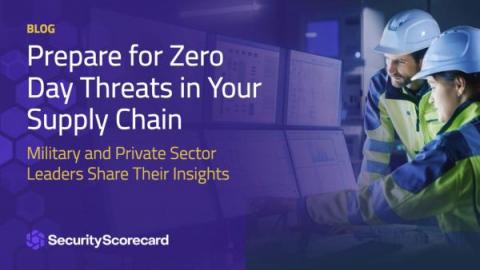
Prepare for Zero-Day Threats in Your Supply Chain

Leading cybersecurity experts Major General John F. Wharton, (US Army ret); Oleg Strizhak, Shell’s Digital Supply Chain Risk Manager; and Sam Curry, the CISO of Zscaler, recently sat down with SecurityScorecard’s President of International Operations Matthew McKenna to discuss how organizations can prepare themselves and their supply chains for zero-day attacks as well as best practices for supply chain risk management.

Secure the Lifeblood of the American Economy

Small and medium-sized businesses account for 4.17 percent of private sector employees and almost half of the United States’ gross domestic product , yet—due to limited finances, resources, and staff—many have difficulties when it comes to supply chain management. Geopolitics, inflation, and worker shortages are just a few variables that can impact supply chains; 86% of SMB supply chains have already been or expect to be impacted by Russia’s war in Ukraine.

EP 25 - Cisco CX Cloud CISO on the Language of Risk

We all accept a certain degree of risk in our lives. So, to varying degrees, we’re all operating – to use cybersecurity parlance – with an assume breach mindset. Meaning, we accept that attacks are inevitable and, as such, we focus time and effort on protecting the assets that matter most. In short, we buckle up for safety.

7 Factors that Drive Cyber Risk: New Research from Marsh McLennan and SecurityScorecard

The expanding attack surface of an increasingly interconnected digital world comes with a high degree of risk due to ransomware, phishing attempts, supply chain attacks, data breaches, and other cyber incidents. And while many organizations recognize the need for cyber insurance, a recent Forrester Research report found that only 55% of organizations in North America have purchased cyber insurance. 1

What is Mobile Application Protection and How To Enforce It

With the rise of remote work and shadow IT, more devices and apps (both sanctioned and unsanctioned) are connecting to your organization’s network. Today, there are approximately five million mobile apps currently in circulation: approximately three million for Android and two million for iOS. That’s great for productivity, but less than ideal when it comes to security.

How resilient is your supply chain?

This week kicks off the 6th annual National Supply Chain Integrity Month, an initiative started by CISA and other government agencies to highlight the importance of securing our nation’s most critical systems. This year’s theme, “Supply Chain Risk Management (SCRM) – The Recipe for Resilience,” is meant to encourage all stakeholders to apply a comprehensive approach in their efforts to strengthen cyber defenses.

The Next Generation of Risk Registers is Here

A risk register is a tool used to manage potential problems or risks within an organization. It helps to identify and prioritize risks, their likelihood of occurrence, and provides ways to mitigate them. Risk registers allow you to play offense and defense – you’re proactively planning for potential challenges and minimizing their impact on your project’s success in the event that the roadmap does veer off course.

OFAC and Vendor Management: What You Need to Know

Are you aware of the risks involved in doing business with parties sanctioned by the Office of Financial Assets Control (OFAC)? How does this impact your vendor management? OFAC stands for Office of Foreign Assets Control within the Treasury Department. As part of the U.S. government measure to enforce anti-money laundering/counter terrorism financing regulations, OFAC oversees economic and trade sanctions. These sanctions are against countries, individuals, or outfits engaged in disreputable actions.

6 Ways To Use SecurityScorecard APIs and Integrations

Optimize your security workflows and deliver intelligence everywhere you work with the largest ecosystem of integrated technology partners in cyber risk ratings. SecurityScorecard provides Application Programming Interface (API) access for all our data allowing you to get more contextual security insights, app integrations, and detailed information about your current or prospective vendors. You can leverage our APIs and Integrations in the following ways.

What is Vulnerability Monitoring? Benefits, Tools, and Best Practices

In today’s ever changing cyber risk landscape, your organization must adopt a vulnerability management framework to control exposure and remediate risks in a timely manner. In an earlier blog, we explained the vulnerability management process. Here, we explore a key part of that process – vulnerability monitoring – in greater depth.

New regulation from the SEC to require companies to report how cyber risk could affect them financially

Against the backdrop of the growing frequency and severity of cyber attacks against enterprises, proposed new regulations from The Securities and Exchange Commission (SEC) are set to require publicly traded companies in the U.S. to analyze how cyber risk could affect financial statements. ‍

8 Dangerous Ransomware Examples

The threat of ransomware has been ever present in 2020, especially within the high-stakes industries like healthcare and those involved in the election. According to Verizon's 2019 Data Breach Investigations Report, 24% of security incidents that involved specific malware functionality exhibited ransomware functionality.

5 Keys to Building a Scalable Vendor Risk Management Program

Traditional vendor risk management programs are not effective at mitigating risk in ever-expanding third-party networks, and yet 69% of businesses still rely on manual processes. It's time to take your program to the next level. How can you centralize, automate, and streamline your process to manage hundreds of vendors as effectively as you manage ten? Scalable VRM continuously detects, monitors, and mitigates risk, going beyond due diligence and initial assessments to constantly reassess and proactively act on vendor risk.

Build Cyber Resilience with BitSight's Advanced Analytics

Stop reacting to cyber risk as it comes. BitSight for Security Performance Management empowers security leaders to strengthen cyber resilience over time with objective, meaningful, and evidence-based metrics. Gain insights, drive decisions, and build confidence with our suite of advanced analytics.