Security | Threat Detection | Cyberattacks | DevSecOps | Compliance

Is your TPRM program an engine or an anchor?

In 2026, a slow assessment is a security risk. Every day spent in manual handoffs is a day of exposure for your organization. Join us at UpGuard Summit to see how our new Risk Automations engine transforms TPRM from a static checklist into an autonomous system. We will show you how to automate everything from vendor follow-ups to instant Jira routing for IT and Legal.


Critical Vulnerability Alert: CVE-2026-41940 in cPanel, WHM, and WP Squared

A critical vulnerability CVE-2026-41940 has been identified in cPanel, WHM, and WP Squared, affecting cPanel & WHM versions after 11.40, as well as WP Squared. These web hosting control panels are commonly used to manage websites, email, databases, and server configurations, making unauthorized access a serious security concern.

How to Protect Your Enterprise from High-Stakes Business Litigation

High-stakes litigation can drain a company's resources and focus. Protecting an enterprise requires a proactive approach to risk. Leaders must look ahead to spot potential legal traps before they cause damage. Safeguarding a brand is about building a wall against future threats. It allows for steady growth without constant fear of lawsuits. Small steps taken today prevent massive headaches tomorrow.

1 in 15 MCP Servers are Lookalikes: Is Your Org at Risk?

Researchers recently analyzed 18,000 Claude Code configuration files pulled from public GitHub repositories. What they found was straightforward and alarming: developers are already installing mistyped, misconfigured, and near-identical MCP server names — often without realizing it. The human-error condition that makes typosquatting work was already present at scale before any attacker needed to exploit it.

The Shadow Supply Chain: A Pivot To Usage-Based Discovery

We’ve established the new forensic reality: a massive 72.9% inventory gap exists between the vendors you monitor and those invisible to your security. We have seen the shortcomings of SSO and its inability to holistically monitor all the vendor applications your users engage with, along with a Shadow AI explosion that is compounding both issues. The era of procurement-only discovery is over. To secure the modern cyber workforce, we must pivot from "buying-based" to usage-based discovery.

MCP: The AI Protocol Quietly Expanding Your Attack Surface

In February 2026, researchers uncovered something that should give every security leader pause. A malware operation called SmartLoader, previously known for targeting consumers who downloaded pirated software, had completely pivoted its infrastructure. SmartLoaders new target was developers, and its new entry point was a protocol most security teams had never heard of. The payload delivered to victims: every saved browser password, every cloud session token, every SSH key on the machine.

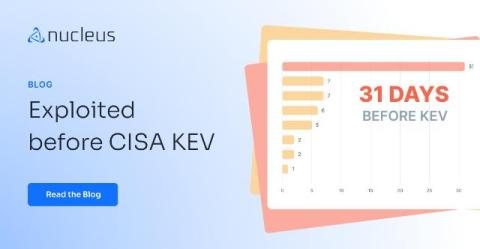
Exploited Before CISA KEV: What 8 Confirmed Cases Reveal

Most vulnerability programs are built to act when risk looks obvious, such as when a vulnerability lands in CISA KEV, a public exploit emerges, or EPSS rises. This approach is rational because it provides a clear, defensible trigger for action. But it often comes with delay: by the time signals are strong enough to drive consensus, the window to get ahead of risk may already be closing.

Beyond Detection: What a National Cyber Drill Reveals About True Cyber Resilience

In today’s threat landscape, cybersecurity is no longer defined by the ability to detect and respond to isolated incidents. It is defined by how organizations perform under pressure, when faced with coordinated, AI-enabled, multi-vector attacks that test not only technology, but leadership, governance, and trust. Recently, Obrela had the opportunity to support a national-level cyber security drill in Qatar, working alongside our partner ecosystem.

Is Your Official Vendor List a Lie?

How many new vendors did your team engage with today? If you’re looking at your official procurement list, the answer might be zero. But if you’re looking at employee behavior, the reality is likely much higher. Find out more about the shadow supply chain in our most recent research report: Interested in finding out more about UpGuard?

Measuring Real Risk Reduction Across Your Security Stack

Garrett Hamilton recently presented at the North Texas ISSA Lunch & Learn in Plano, TX to talk about what risk reduction actually looks like in practice. Reach shows customers exactly which controls they've deployed, the user impact of those changes, and how much risk has been reduced across IAM, EDR, email, firewall, and SASE. Not feature checklists. Targeted, measurable outcomes tied to the business.

An Introduction to the NIST Risk Management Framework (RMF)

While inherently critical to today’s businesses that run on data, implementing and enforcing data security and privacy has never been straightforward. Between collecting different types of sensitive data and deploying unique architectures, organizations cannot adopt a one-size-fits-all solution, meaning that every security architecture is unique.

Top 10 Governance, Risk, and Compliance (GRC) Software Solutions

Governance is breaking. Not because companies care less about risk, but because modern infrastructure moves faster than the controls designed to govern it. In 2026, governance has to keep up with cloud-native architectures, AI adoption, API sprawl, and the explosion of machine identities across production environments.

SecurityScorecard Weekly Brief: The Cyber Risk and Policy Edition - Amanda Smith

In this week’s Weekly Brief: The Cyber Risk and Policy Edition, SecurityScorecard’s Director, Public Sector Channel Amanda Smith breaks down why the U.S. war with Iran is more than just what takes place on the physical battlefront. In 2026, as conflict unfolds in the Middle East, the digital battlefield has a direct impact on the homeland and U.S. critical infrastructure, too. “It's a global digital confrontation that hits a lot closer to home than a lot of people realize.”

How to Use the MITRE ATT&CK Framework as a Shared Language for SOC, CTI, GRC, and Leadership

Picture the first meeting after a serious security event. The Security Operations team is talking about alerts, detections, and lateral movement. Threat Intelligence is talking about adversary tradecraft and known campaigns. Governance and Risk is talking about control gaps, exposure, and business risk. And leadership? They only care about how bad this event is, and what the team is doing about it. Security teams often agree on the mission: deter and stop threat actors at all costs.

Obrela's 2025 Digital Universe Report highlights shift to stealthy, identity-driven cyberattacks

London, 21st April - Obrela has released its Digital Universe Report 2025, revealing a significant shift in the global cyber threat landscape as attackers move away from high-volume attacks toward more targeted, stealth-driven techniques focused on identity, access and persistence.

How Third-Party Development Partners Become Your Biggest Security Liability

Third-party development partners offer real advantages: faster delivery, specialised expertise, and lower costs than building an in-house team. They also expand your attack surface in ways most organisations never fully account for. When an external team builds or modifies your systems, they bring with them their own tools, practices, access levels, and vulnerabilities. The question is not whether that creates risk. It is whether your organisation is managing it deliberately or leaving it to chance.

Penetration Testing as a Tool That Reveals the Real State of Cybersecurity

Most security measures are built on the assumption that if something is configured correctly, it is secure. But there is a big difference between "configured" and "able to withstand an attack" - a gap that cannot be seen without practical testing. Penetration testing is not just another item on a compliance checklist; it is a way to get an honest and realistic answer to the question that truly matters to a business: can an attacker reach what is most important to us?

Navigating the Post-Mythos Landscape with Bitsight

The rise of AI-driven vulnerability discovery using Anthropic's Claude Mythos, as well as similar tools from Google and OpenAI, is completely changing the calculus of cyber risk. The number of vulnerabilities is exploding. The time it takes for exploits to appear is shrinking. The patching cadences and scan intervals, assessments and risk registers that many organizations still rely on are rapidly becoming ineffective.

Why we can't have nice things! ...Or can we?

On 7th April 2026, Anthropic published a system card for an AI model we may never be allowed to use: Claude Mythos. This preview demonstrated a significant leap in capability over Anthropic’s previous Claude Model (Opus 4.6), and their Responsible Scaling Policy (RSP) v3.1 led to them making the decision to withhold it from general availability, serving as a "defensive only" asset.

Analyzing the RondoDox Botnet: A DDoS and Mining Threat

A few weeks ago we published the first part of this series where we described the infrastructure used by the RondoDox threat actors to scan and exploit vulnerable systems. In this second post we’ll take a deep dive into the malware that is deployed into vulnerable systems. Specifically, we’ll look at the initial implant used to fetch the RondoDox binary and the binary itself, detailing its behaviour, how it communicates with the Command and Control (C2), and its malicious capabilities.

The Transformation of Third-Party Risk Management from SecurityScorecard

Ready for the future of Third-Party Risk Management (TPRM)? The supply chain is a growing target, but you can fight back. That world is here with the transformative, threat-informed SecurityScorecard TITAN AI Platform. Imagine a world where you go beyond checking compliance boxes by actively mitigating and eliminating risk with continuous, AI-accelerated, and predictive TPRM that allows you to gain visibility and prioritize threats more effectively. Learn more about the TITAN transformation.

5 Themes From a Candid Discussion

The Eskenzi IT Security Analyst & CISO Forum wasn’t a typical security event. This forum was a gathering of CISOs, analysts, and security leaders speaking candidly under Chatham House Rule about what’s actually breaking, what’s working, and where things are heading. Here are 5 key themes that came through loud and clear. None of them were surprising. But together, they paint a pretty stark picture of where security and AI are right now.

How to Build a Security Compliance Audit Process that Works All Year Round

Security compliance audits can feel intimidating, especially if your team has never been through one before. For many organizations, an audit feels like a high-pressure project with a hard deadline, a long list of evidence requests, and a lot of manual work spread across security, IT, legal, and compliance teams. For vendors and companies in highly regulated industries, audits and risk assessments may already be a routine part of doing business.

What Cybersecurity Risks Does CNC Automation Introduce in 2026?

Manufacturing floors are no longer air-gapped environments. As CNC machines connect to networks for automated loading, real-time monitoring, and remote diagnostics, they become potential entry points for cyber attackers targeting industrial operations. Companies like Gimbel Automation are advancing in-machine CNC automation that reduces manual labor and increases throughput. But every connected system, from spindle grippers to pneumatic workholding, needs cybersecurity planning alongside its mechanical engineering.

EU AI Act Compliance Starts With Operationalizing AI Governance

The European Union's (EU) AI Act is the most consequential regulatory development in enterprise technology in years. For organizations deploying artificial intelligence at scale, which essentially includes all businesses nowadays, it introduces a formal, continuous obligation to demonstrate governance. The regulation has been in the public domain long enough that most organizations have a working understanding of what it requires.

Exposure as a Competency: How Agentic Exposure Management Can Differentiate High-Performing Teams

In today's fast-paced work environment, the factors that distinguish high-performing teams go well beyond technical skills and traditional leadership. Increasingly, organizations are recognizing "exposure" as a critical competency, one that shapes how teams interact with uncertainty, opportunity, and risk. While exposure has historically been viewed through a financial or risk management lens, it is now emerging as a core driver of organizational agility, innovation, and resilience.

What is Shadow IT?

Shadow IT refers to any technology—including hardware, software, cloud services, SaaS applications, or AI tools—used within an organization without the explicit approval of the IT or security department. Shadow IT is rarely malicious. It is usually the result of employees searching for a means of making their workflows more efficient. When sanctioned corporate tools are perceived as too slow, rigid, or complex, users often "self-serve" by adopting unvetted alternatives to meet their deadlines.

A Critical Look at OpenClaw and NemoClaw

Surprise, surprise, agentic AI is advancing very quickly, and security isn’t quite keeping up. While most attention in recent times has focused on improving model capability, we’ve often been left wondering how to actually make these systems safe enough to trust with real-world tasks and limited interaction. This challenge has become particularly evident with the rise of platforms like OpenClaw, where autonomous agents can execute multi-step actions with minimal human oversight.

SecurityScorecard Weekly Brief: The Adversary Insights Edition with Steve Cobb

This is SecurityScorecard's Weekly Brief: The Adversary Insights Edition with SecurityScorecard's CISO Steve Cobb. Critical infrastructure security in the U.S. remains an important element of the ongoing conflict between the U.S. and Iran with Iranian-linked threat actors targeting US-based assets. Iranian threat actors have focused their efforts on the fastest methods of attack by searching for what Cobb calls “low hanging fruit” in critical infrastructure environments where many organizations have exposed systems.

The Future Is Cyber Risk Intelligence

Risk is expanding faster than most organizations can measure it, communicate it, and act on it. The convergence of AI, an ever-expanding attack surface, and deep, often hidden supply chain risks—extending into third-, fourth-, and fifth-party connections—all pose strategic and material risks to companies. Security leaders are ultimately looking for better ways to identify risk, prioritize action, and support stronger risk decisions across the entire business ecosystem.

The NVD Funding Crisis Was Bigger Than Mythos

Everyone is calling Claude Mythos a watershed moment. I’d like to offer a slightly different take. Not because the capability isn’t real, it is. But if Mythos is the moment that finally convinced your organization that rapid vulnerability discovery is an existential threat, you’ve been watching the wrong thing. We saw this coming. Vulnerability Management has been moving in this direction for years, and we built Nucleus with this trajectory in mind. What surprises me is the surprise.

AI Governance and Risk: Expert Insights for Enterprise Leaders

‍ As GenAI tools become embedded in core business operations, the governance programs meant to oversee them are still catching up. Closing that gap requires visibility into where AI operates and the ability to express exposure in financial terms that leadership can act on. The organizations best positioned to manage AI risk are those that have already started treating it as a measurable business variable rather than an abstract operational concern. ‍

From Entities to Enterprise Risk: Kovrr's Portfolio Analysis

Global enterprises, private equity firms, conglomerates, and other large-scale organizations may share a corporate umbrella, but the entities operating beneath it are far from uniform. Each functions with a distinct technology stack, industry context, and regulatory environment, which inherently means each carries a distinct cyber exposure. Understanding cyber risk at that higher organizational level, therefore, requires more than individual entity modeling.

You Can't Patch Your Supply Chain So Why Treat It Like a Vulnerability Problem?

For years, vulnerability management has followed a familiar pattern: discover assets, scan for CVEs, prioritize by severity, and remediate what you can. That model works, at least within the boundaries of systems you own. The problem is that most organizations no longer operate within those boundaries. Federal agencies especially depend on a complex ecosystem of SaaS platforms, software vendors, contractors, and open-source components.

The Context Gap: How Nearly Half of Your Time is Lost to Investigation

The classic tradeoff in cybersecurity has always been simple: more visibility at the cost of speed. But today, that tradeoff is breaking down. As attackers leverage AI to find and exploit vulnerabilities at unprecedented scale, the sheer volume of alerts is burying security teams. The result? An expanding exposure gap. It is taking longer than ever to triage and remediate threats, creating a dangerous window between when a tool pings and when a human in the SOC can actually take action.

AI With Intention: Visibility Drives Action: Strengthening Cyber Risk Management with Better Data

As organizations shift to cloud services and third-party vendors, maintaining visibility and control over cyber risk has become increasingly complex. In this video, we explore one of the biggest challenges facing security leaders today: how to manage cyber risk without full visibility into your environment. Learn why visibility is critical to effective cybersecurity—and how the right data enables organizations to.

Data Sets the Course: Why Cyber Risk Management Starts with Better Data

The cyber risk landscape is evolving faster than ever—creating new challenges for organizations trying to maintain visibility and control. In this video, we explore why data is the foundation of effective cyber risk management. As risk becomes more dynamic and complex, organizations must be able to: Respond to threats as they emerge—not after the fact Without high-quality, actionable data, managing cyber risk simply isn’t possible.

Evolve With Your Vendors: Why Vendor Risk Changes Over Time-and What to Do About It

Vendor relationships don’t stay static—and neither does the risk they introduce. In this video, we break down a common misconception in third-party risk management: that vendor risk remains constant after onboarding. The reality? As vendors grow and their digital footprint expands, risk increases over time. Learn why organizations must move beyond point-in-time assessments and adopt a more modern approach to vendor risk management.

SecurityScorecard's Weekly Brief: The CISO Edition with Steve Cobb

This is SecurityScorecard's Weekly Brief: The CISO Edition with SecurityScorecard's CISO Steve Cobb. Is it time to retire the vendor questionnaire and annual assessment routines? Not quite, but following face-to-face customer interactions and many forward-thinking speaking sessions at RSAC 2026, CISO Steve Cobb emphasizes the importance of reducing risk for TPRM programs, which is not achieved by completing a third-party risk assessment checklist alone.