Security | Threat Detection | Cyberattacks | DevSecOps | Compliance

The Curve Sets Your Attachment, Not Your Limit

The standard method for sizing a cyber program from a loss curve has two halves. Set the retention where the balance sheet can absorb the loss, and set the limit at the one-in-hundred-year figure. The first half is sound. The second is a convention borrowed from property catastrophe practice, and the curve does not derive it. ‍ The distinction matters because organizations treat both numbers as outputs of the same model, then defend a limit the model never produced.
Who Signs Off Before the Agent Ships

Guidance on agent governance concentrates almost entirely on what happens after deployment. Monitoring, sprawl, identity, attribution, retirement. The decision to put the agent into production in the first place gets treated as a software release, and software release processes ask none of the questions that matter for something which acts on its own. Agent governance generally assumes the agent is already running.

Summing Independent Scenarios Understates Your Tail

A quantification program with a dozen scenarios usually produces its annual figure by adding them together. Each scenario was modeled carefully, the arithmetic is simple, and the result is close to right for one of the two numbers the model produces. ‍ Summing scenarios treats them as independent, and cyber scenarios share dependencies. The consequence is specific rather than general, and it is worth being precise about because it determines which decisions the resulting figure can support. ‍

Closing the Gap: What Actually Turns Agent Telemetry Into Evidence

‍ An AI coding agent's own telemetry answers real questions well: which agents are running, what they invoked, the shape of a session, whether a run looks abnormal. It cannot, no matter how completely it is instrumented, stand alone as evidence. The agent under review is also the party writing the record. The record shows an attempt, not an outcome. And the vocabulary for describing any of it is still being written in public, one unstable commit at a time.

Human Risk Management Platforms: How to Choose the Right Software

Security leaders can no longer treat workforce cyber risk as a quarterly phishing campaign. Shadow AI, sprawling SaaS adoption, generative AI-assisted social engineering, and siloed alerts leave many teams unable to answer a basic board question: which users and apps matter most this week? Answering that question is the job of the human risk management (HRM) software category, which is young and crowded.
How to define your third-party risk criteria

Accelerating security solutions for small businesses‍ Tagore offers strategic services to small businesses. A partnership that can scale‍ Tagore prioritized finding a managed compliance partner with an established product, dedicated support team, and rapid release rate. Standing out from competitors‍ Tagore's partnership with Vanta enhances its strategic focus and deepens client value, creating differentiation in a competitive market.

Jira + UpGuard: Automating Risk Management Together

If your security team runs on Jira, sprints and backlog included, UpGuard plugs straight into it: vendor findings, breach alerts, and user risk signals can all surface as issues your team is already triaging. With this integration, you can: Set the trigger once: a new risk detected for a monitored vendor, a risk score dropping below a threshold you’ve set, a credential breach turning up on a watched domain, or a questionnaire response coming in.

The Three Questions Every AI Telemetry Claim Should Survive

‍ Coding-agent telemetry, today, cheaply, answers four real questions: which agents are running and operated by whom, what an agent invoked, what happened in a session in order, and whether a run looks abnormal. Part 1 of this series covers that case in full. ‍ This part is about the fifth question every security team eventually asks, the one no amount of instrumentation answers on its own: can this record be trusted enough to build a control on it?

Turning the OWASP Agentic Top 10 Into Expected Loss

The OWASP list for agentic applications, published in December 2025, gives security teams a shared vocabulary for what goes wrong when software acts rather than answers. Ten categories covering planning, tools, identity, supply chain, code execution, memory, inter-agent communication, cascading failures, human trust and rogue behavior. ‍ Translating that into a financial figure is where programs stall, and the usual attempt makes a specific error.

When the Model Disagrees With Your Security Team

A model ranks phishing sixth. The security team has spent three years on phishing and knows how often people click. Somebody in the room concludes the model is wrong, or that the security team is attached to its own program, and the meeting stops being useful. ‍ Most of these disagreements are not about risk. They are about which question each side answered, and establishing that first resolves a surprising proportion of them without anyone conceding anything. ‍

When 700 Agents Coordinate Without Being Told To

Two reports landed yesterday on the July incident in which OpenAI agents left an isolated test environment and reached Hugging Face production systems. OpenAI published a thirty-seven page technical post-mortem. METR and Redwood Research published a ninety-one page independent analysis, produced over six days on site, covering July 7 to 13 and taking no payment for the work. ‍ The coordination numbers are what drew attention.

ServiceNow + UpGuard: Automating Risk Management Together

UpGuard connects to ServiceNow across the whole platform. Vendor risk findings, breach alerts, and user risk signals all land in the same ticket queue your team already works from, not a separate, siloed risk dashboard. With this integration, you can: Risk Automations makes this possible. You define the events that matter: a monitored vendor picks up a new risk, a risk score drops below a threshold you set, a credential breach turns up on a watched domain, or a questionnaire response comes in.

AI Assurance: The Third Head of Your AI Governance Watchdog

In July 2026, two AI stories broke that appeared unrelated on the surface. But were they really? The first was an AI product's shared conversation links, meant for specific people, turning up in Google searches, some holding sensitive personal and company data. The second was a frontier AI lab's own model escaping a security sandbox during an internal evaluation and spending four and a half days inside three companies' systems. One involved ordinary users making a common mistake.

Agent Incident Response: Containment Is the Easy Part

Containment guidance for agent incidents already exists and it is largely correct. Revoke the tokens, freeze the orchestration tier, cut egress, set the vector store to read-only. Those steps take minutes and any competent team will find them. ‍ The difficulty sits either side of containment. Deciding what kind of incident this is takes longer than stopping it, establishing what the agent did before you stopped it takes longer still, and both depend on preparation that has to exist beforehand.

How Many Cyber Risk Scenarios Should You Model?

Scenario libraries grow. A program starts with ransomware and a data breach, adds a third-party failure after a supplier incident, splits ransomware into encryption and extortion variants, adds a cloud outage, and two years later holds forty entries nobody has revisited. ‍ The usual guidance suggests a range, somewhere between five and fifteen, which is a reasonable starting point and answers the wrong question.

Nucleus Helix Was Built to Fix Exposure Management's Breaking Point

Let me be direct about something the industry keeps dancing around: the vulnerability problem isn’t getting better. It’s getting structurally worse. The wave of AI-generated code and compression of time to exploit thanks to frontier AI models like Mythos is about to make “worse” look quaint. If your vulnerability and exposure management program is still built around scanner cycles, ticket queues, and CVSS scores, you’re not running a security program.

'The Gentlemen' Profile: Why This Ransomware Group Wants In Before It Locks You Out

The Gentlemen is a financially motivated ransomware group that combines data theft with encryption to increase pressure on victims. They first came onto the threat scene in July 2025. Rather than relying on encryption alone, the group exfiltrates sensitive business data before locking files, leaving organizations to deal with both operational disruption and the risk of stolen information being exposed.

Inside the AI-Accelerated Cyber Underground

Cyberattacks take shape long before a breach through exposed systems, vulnerable software, stolen credentials, underground tools, and attacker experimentation. In this webinar, Emma Stevens, Threat Intelligence Researcher at Bitsight, and Qionglu Lei, Senior Product Marketing Manager at Bitsight, explore what Bitsight research reveals about AI-enabled attacker behavior and the changing cyber underground.

Fourth-party risk management: How to identify and manage downstream risk

Accelerating security solutions for small businesses‍ Tagore offers strategic services to small businesses. A partnership that can scale‍ Tagore prioritized finding a managed compliance partner with an established product, dedicated support team, and rapid release rate. Standing out from competitors‍ Tagore's partnership with Vanta enhances its strategic focus and deepens client value, creating differentiation in a competitive market.

Left Unsupervised: 10 Times Access Outlived Its Authorization

September is National Insider Threat Awareness Month, and most of the advice out there is about spotting a person. The insider here is rarely a person. It’s a credential nobody rotated, or an agent nobody kept watching. Each was access granted on purpose, then left unmonitored. The only question that matters afterward is whether anyone would have known.

State AI Laws Change Faster Than Compliance Programs

Colorado passed the first comprehensive state AI law in May 2024, and organizations spent the following year building impact assessment processes against it. Those obligations never took effect. The statute was delayed twice, blocked by a federal court, then repealed and replaced by a narrower framework before its own effective date arrived. ‍ Anyone who built a compliance program to that specific statute prepared for a regime that never existed.

Same Numbers, Two Audiences: Insurer and Board

The same quantification run supports two conversations that happen weeks apart. One with a board asking whether the organization is managing cyber risk sensibly. One with an underwriter deciding what to charge for it. ‍ Most guidance treats these as a formatting problem, where the board version gets charts and the submission gets detail.

New Bitsight Research Shows AI Abuse Is Moving Beyond the Jailbreak Prompt

Jailbreak prompts (i.e. prompts designed to remove or bypass the guardrails and rules that govern AI systems, like LLMs) prompts have been circulating for years. At first, a lot of it was pretty simple: copy a prompt, tell the model to ignore its rules, and see what happens. It was also largely noisy, unverified, and often didn’t work. But the noise was still telling us something. Threat actors were beginning to study AI systems the same way defenders were, and over time, the goal started to change.

Continuous risk monitoring in third-party risk management is non-negotiable: Here's why

Accelerating security solutions for small businesses‍ Tagore offers strategic services to small businesses. A partnership that can scale‍ Tagore prioritized finding a managed compliance partner with an established product, dedicated support team, and rapid release rate. Standing out from competitors‍ Tagore's partnership with Vanta enhances its strategic focus and deepens client value, creating differentiation in a competitive market.

What OpenTelemetry Can Actually Tell You About Your AI Agents

‍ The distance between what OpenTelemetry was built for and what AI governance is asking of it shows up in a single number. Distributed tracing descends from Dapper, the 2010 Google paper that gave the industry the vocabulary of traces and spans. Dapper sampled one trace in 1,024. That is ample for finding a latency regression, because a regression recurs and the next sample catches it.

The Second Line Cannot Challenge What It Cannot Evaluate

The three lines model rests on an assumption that holds well in financial risk and poorly in cyber. It assumes the second line can evaluate the first line's work independently, which requires the second line to understand that work at least as well as the people doing it. ‍ In model risk management at a bank, that assumption is satisfied by staffing. The independent review function employs people who can re-derive a model's output and disagree with it on technical grounds.

AI Supply Chain Security: Why an SBOM Cannot Cover It

A software bill of materials works because software changes through a build. Someone bumps a dependency, the pipeline runs, the manifest updates and a scanner compares the new list against known vulnerabilities. Every part of that loop assumes a rebuild is the thing that changes behavior. ‍ AI systems break that assumption at the point it matters most. Editing a system prompt changes what a model does, swaps no dependency, triggers no build and produces no new manifest.

From AI Findings to Action: How Security Teams Should Triage AI-Discovered Vulnerabilities

Security teams didn’t need a headline to tell them that vulnerability volumes continue to be problematic. The CVE database now contains over 354,000 records. Annual disclosure rates have climbed steadily for more than a decade. And remediation backlogs have long been recognized not as an aberration, but as a fixture of the job.

Human in the Loop: How to Tell If the Review Is Real

Human oversight is the only control in an AI program that can stop working while producing exactly the same evidence as when it worked. A failed encryption control throws errors. A monitoring pipeline that breaks stops delivering alerts. A review step that has become a formality still generates approvals, timestamps and sign-offs, and the compliance file looks identical. ‍ The asymmetry makes the design question secondary to the measurement one.

One Loss Distribution, Two Very Different Charts

A cyber loss model produces one distribution. How that distribution gets drawn changes what a reader can see in it, and the conventional projection hides the part most decisions depend on. ‍ The two views below contain identical data. One of them is close to unreadable for anything except the extreme tail, and the difference is worth understanding before the next time somebody asks what the number means. ‍

Legacy GRC can't keep up. Cyber risk assurance can.

Enterprise security teams need to secure a risk surface that is constantly changing. However, the tools in their stack were built to check only a fraction of that risk. For confirmation, they rely on static snapshots and annual attestations. I now see this as the defining problem in GRC. When 451 Research (S&P Global) initiated coverage of TrustCloud in this space, they described a clear and growing divide.

The 12 Best Third-Party Risk Management Software Solutions (2026)

‍Last updated: August 20, 2026‍ A supplier breach or a tough question from a regulator can force a rushed third-party risk management (TPRM) evaluation. You need an answer before the next steering meeting. This list compares the 12 best third-party risk management tools in 2026, based on the capabilities that separate them in daily use, so you can shortlist faster. Whether you're an analyst running early research or a CISO approving the budget, you're working from the same criteria.

What Counts as One AI Asset? Getting the Unit Right

Two teams inventory the same organization and return different numbers. One counts forty-one AI assets, the other counts one hundred and twelve. Neither is wrong, because they counted different things, and nobody had decided what a row represents. ‍ Guidance on building an AI inventory covers which fields a row should carry and skips what a row is. That question determines the count, the risk scores, the regulatory classification and whether two inventories can ever be reconciled.

Maturity Is a Lagging Indicator. Here's a Leading One.

A maturity score answers where a program has been. It reports the state of documented process at the moment somebody assessed it, on a cadence measured in quarters or years, using a scale that describes organization rather than outcome. Every property that makes it useful for planning makes it useless as an early warning. ‍ The interesting question is what a leading indicator would look like instead, and the answer requires separating two problems that get treated as one.

How To Build An AI Risk Management Framework

Every AI approval a security team makes feels reasonable in isolation. A security architect signs off on a generative AI writing tool for marketing. An engineering lead spins up an agent to triage support tickets. A finance team connects a copilot to its planning software. Individually, none of these decisions looks risky.

Is a SOC 2 Report Enough to Assess a Cloud Vendor?

A vendor sends over a SOC 2 report. It lands in the queue, someone reads the cover page, sees the auditor's name and a clean-looking opinion letter, and marks the assessment complete. The reviewer moves on to the next vendor. Multiply that by a few hundred vendors a year, and it becomes less of a decision and more of a reflex.

How to Mitigate Human Risk in Cybersecurity: A Practical Framework

Endpoint detection, cloud security posture management, email security, identity and access management, network segmentation. Security teams invest heavily in all these active risk vectors, but one category is growing faster than the rest: human risk, which considers what employees do day-to-day in the tools they're given and the ones they aren't.

From signals to systemic risk: Building Risk AI

Security and engineering teams contend with a constant stream of signals about vulnerabilities, incidents, misconfigurations, identity risks, control gaps, and other findings across their environments. But an individual finding’s severity does not always reflect its potential organizational impact.

UEBA vs. UBA: What's the Difference and Why It Matters for Insider Risk Management

Organizations have invested heavily in technologies that detect suspicious activity. Yet insider incidents continue to rise, and security teams are often left to investigate isolated alerts without sufficient context to determine whether an event poses a meaningful risk. Behavioral analytics helps close that gap.

Decommissioning AI Agents: What to Look For in the Tooling

Gartner predicted in mid-2025 that more than forty percent of agentic AI projects would be canceled by the end of 2027, citing escalating costs, unclear business value and inadequate risk controls. Treat the figure as a forward-looking estimate rather than a measurement, since canceled projects tend to be quietly renamed, absorbed or left to lapse rather than formally closed. ‍

Quantifying OT Cyber Risk Without a Loss History

Quantifying cyber risk in an enterprise IT environment starts from frequency. Incidents of a given type happen at some rate, that rate is observable across enough organizations to be estimated, and severity follows from what was affected. ‍ Operational technology inverts both halves. Frequency data barely exists, and the consequences are already documented in detail by people who have never thought about cyber. Working with that inversion rather than against it is what makes the modeling tractable.

Focus on the Threats That Actually Matter to your Organization with Sectoral Intelligence

Not every threat matters equally to every organization. A newly discovered APT or ransomware group targeting European automotive manufacturers is definitely worth paying attention to, especially if you’re in that sector. But if you’re a financial services firm in California, it’s probably not an immediate priority. You might look into it, track its activity, and assess whether it could become relevant.

What Black Hat USA 2026 Confirmed About the Next Phase of Cyber Risk

Black Hat USA 2026 wrapped in Las Vegas with a clear verdict: the industry has stopped debating whether AI changes the threat landscape and started building for the fact that it already has. Nearly a third of the conference's briefings dealt directly with AI security, agent exploitation, or LLM-assisted offensive research — and the conversations happening in partner meetings and dinners around the show floor tracked right alongside it.

AI Governance in Financial Services: The Use Case Sets the Rules

An AI governance framework tells a financial institution to inventory its systems, assess risk and document decisions. Consumer protection law tells it something different and considerably harder, which is that a model unable to produce specific reasons for a credit denial cannot lawfully be used to make one. ‍ That distinction is what separates AI governance in financial services from AI governance generally.

8 Questions on Healthcare Cyber Risk Quantification and Compliance

Healthcare carries the highest average breach cost of any industry and has for well over a decade, and it operates under a rule that has required risk analysis since 2003. Those two facts sit uncomfortably together, and federal regulators have started saying why. ‍ Enforcement has moved from asking whether an organization performed a risk analysis to asking what it did about the findings.

Browser AI Events in the SOC: What to Send and What to Suppress

Browser-layer AI monitoring produces events, and the natural next step is forwarding them to the security operations center. Consider what they arrive into. Industry research for 2026 puts false positives at close to half of all alerts, with around forty-two percent going entirely uninvestigated. ‍ Browser AI events are behavioral anomaly alerts, and behavioral anomaly alerts are the category analysts already deprioritize, precisely because they are noisy by nature.

AI Risk Management: Defining, Measuring, & Mitigating the Risks of AI

AI is merging into the modern workplace at roughly the pace computers did in the 1980s, and the risks are evolving just as fast. IBM and Ponemon found that 97% of organizations hit by an AI-related security incident lacked basic access controls, and 63% had no AI governance policy at all. In this video, Yakir breaks down the seven categories of AI risk every GRC leader needs to understand, and what separates knowing you have a control gap from knowing what it will cost you.

TITAN AI Demo Series: Driftnet Power-Filtering for Threat Hunters

Threat hunting often means following a lead without knowing where it will take you. Your search tools shouldn’t make you choose between exploring a hunch and losing your original results. Driftnet gives threat hunters multiple ways to refine artifact searches as they investigate. Use Add Filter to explore a narrower view without changing the underlying query, Add to Query to make that refinement persistent, or exclude artifacts to quickly zero in on what remains.

Stop chasing your team for security questionnaire answers

It's 11:40 am. A security questionnaire just hit your inbox. You open the file and quickly realize you can't finish this alone. Legal needs to review the data processing language. Product has to complete the architecture section. Security is the only team that can sign off on incident response. So you split up the questionnaire, Slack each department their section to answer, and wait... and wait... and wait.

Multi-Agent AI Systems: When Separation of Duties Dissolves

Every enterprise control framework assumes the entity that requests an action and the entity that approves it are different. Multi-agent workflows quietly dissolve that assumption. Three agents each holding modest, individually reasonable permissions can compose an action none of them was authorized to take, and no single permission grant looks wrong in a review. ‍ That is the distinguishing property of multi-agent systems rather than a harder version of single-agent risk.

Cybersecurity GRC in Practice: Where Programs Break Down

Governance, risk and compliance programs rarely fail at the design stage. The policies exist, the register exists, the assessment calendar exists, and an auditor examining the documentation finds a coherent program. The failures are operational and they share a shape, which is that a mechanism runs without ever reaching a decision. ‍ Six of those are common enough to be predictable.

The EU AI Act's Missing Standards: What to Do Before They Arrive

Organizations preparing for the EU AI Act keep asking which standard to certify against, and the honest answer is that the ones that will matter are not finished. No harmonized standard has been cited in the Official Journal, and nothing available today confers presumption of conformity with the Act's requirements for high-risk systems. ‍

Concentration Risk: What to Do When You Cannot Diversify

European supervisors published their first sector-wide incident report in June 2026, covering more than three thousand major ICT incidents across financial services during 2025. Twenty-nine percent originated with a third party. One third had cross-border impact. ‍ The same exercise produced something more uncomfortable. Regulators built a map of which providers the sector collectively depends on, and they built it from the registers financial entities submitted themselves.

Managing AI Agent Identity at Scale: The Lifecycle Nobody Triggers

Gartner projects the average Fortune 500 organization will run more than one hundred fifty thousand agents by 2028, against fewer than fifteen in 2025. Thirteen percent of organizations believe their agent governance is adequate today. The management approach that works for fifteen agents is memory and a spreadsheet, and neither survives four orders of magnitude. ‍

Real-Time AI Security Monitoring: Why One Assessment Expires

A penetration test on a web application stays broadly valid until someone changes the application. An assessment of an AI system starts expiring immediately, because the system changes without anyone at your organization touching it. The same prompt can return a different answer tomorrow, and the provider can revise the model underneath you without notice. ‍

Cybersecurity risk management: A complete guide for security teams

Accelerating security solutions for small businesses‍ Tagore offers strategic services to small businesses. A partnership that can scale‍ Tagore prioritized finding a managed compliance partner with an established product, dedicated support team, and rapid release rate. Standing out from competitors‍ Tagore's partnership with Vanta enhances its strategic focus and deepens client value, creating differentiation in a competitive market.

Cyber Risk in Healthcare: Quantifying Ransomware and EHR Downtime

Ransomware has shut down hospitals and data breaches have exposed millions of patient records. But healthcare organizations still struggle to manage cyber risk, because decisions get made on compliance checklists and generic threat scores that reveal nothing about real business impact. In this video, Kovrr breaks down how cyber risk quantification turns healthcare threats into financial terms, and why that changes the conversation between CISOs, compliance leads, and the board.

7 Things People Get Wrong About Quantifying Cyber Risk

Most explanations of financial cyber risk modeling cover what it is. The more useful material is what surprises people once they have a model in front of them, because several of the outputs run against intuition and get misread in predictable ways. ‍ Seven of those are worth knowing before the first results arrive. None requires a statistics background, and each one changes how a number should be read or reported. ‍

AI Governance Tools and the Audit Trail Problem

An AI governance platform demo shows you the present. Compliance posture at seventy-nine percent, four controls needing attention, a register of systems with owners attached. Every figure describes today, and the demo is persuasive precisely because today is legible. ‍ An audit asks a different question.

What an Open Control Weakness Costs You Every Month

Security programs price control work as an investment decision. What does the fix cost, what does it remove, does the return justify the spend. The framing answers whether to do something and says nothing about the cost of the interval before it gets done. ‍ An unimplemented control accrues expected loss for every month it stays unimplemented.

OpenTelemetry and AI Governance: Where the Standard Stops

OpenTelemetry graduated from the Cloud Native Computing Foundation in May 2026, which formally settled a question the industry had answered informally years earlier. It is the standard way applications emit telemetry, second only to Kubernetes in contributor volume, and native across every major observability backend. ‍ A security and governance company has a specific reason to care.

Where Cyber Loss Comes From: Attack Vectors Ranked by Exposure

Security awareness receives a disproportionate share of attention relative to the exposure phishing carries. Modeled against initial access technique, valid account abuse accounts for around a quarter of expected annual loss in a typical portfolio, exploitation of public-facing applications around a fifth, and human error around a seventh. Phishing appears sixth, at roughly seven percent.

What an AI Compliance Audit Involves, Stage by Stage

An AI compliance audit is less mysterious than its absence from most planning suggests. Someone outside the organization reads what you wrote down, then samples real systems to test whether the organization does what the documents describe. The distance between those two things is where findings come from. ‍ Three different exercises get called an AI audit, and they run differently. Certification against a management standard follows a defined two-stage process.

A Prompt Is Not a Boundary: Lessons From the AI Eval Incidents

Three organizations had their production systems compromised by an AI model in April, and found out in late July when the model's developer called them. None of them had detected the activity. One was a security company whose own package scanner was the entry point. ‍ Anthropic published that account on July 30, nine days after OpenAI disclosed a related incident of its own.

Does Cyber Insurance Cover AI Incidents?

The answer changed on a specific date. Until the start of 2026, most organizations were covered for AI losses by silence rather than by grant, because policies neither affirmed nor excluded AI and the question would have been argued at claim time. On January 1, 2026 the standard forms organization introduced generative AI exclusion endorsements for commercial general liability, and carriers began attaching them at renewal. ‍

5 Things to Consider Before Using SSVC to Automate Vulnerability Prioritization

Security teams can’t remediate every vulnerability the moment it appears, so prioritization must separate urgent, business-critical risks from noise. This is complicated by the fact that traditional scoring methods like CVSS often lack the context needed to decide what should be fixed first. The Stakeholder-Specific Vulnerability Categorization (SSVC) framework is one option many organizations use to fill this gap as part of automating vulnerability prioritization.

The Cloud Controls Matrix (CCM): Manual vs. AI-Assisted Vendor Assessment

Most teams that assess cloud vendors already have a general idea of the Consensus Assessment Initiative Questionnaire (CAIQ) and Cloud Controls Matrix (CCM). However, you may not have a good answer for what it takes to run that assessment. Turning a vendor's trust center page, SOC 2 report, and security policy into a structured, defensible view of CCM control coverage is a different problem entirely.

AI Cyber Readiness for Financial Institutions

Advanced AI models are changing the cyber threat landscape by accelerating vulnerability discovery, exploit development, and attacker decision-making. Regulators like the ECB have made clear: action plans are necessary. Financial institutions need to understand whether their existing cyber risk programs can keep pace, not only across their own attack surface, but across the critical third parties and software dependencies they rely on.

Insurance Is Still in the Crosshairs: What Recent Dark Web Chatter Says About Sector Targeting

Insurance has always been a data-rich industry. But recent threat intelligence makes it clear that attackers are not only going after insurers because they are large organizations. They’re going after them because insurance touches some of a threat actor’s favorite things: money, identity, healthcare, legal claims, third-party relationships, and highly sensitive customer records.

Building a Security Budget Case With Return on Security Investment

Security budget requests fail on arithmetic rather than on argument. A finance function asked to approve spending wants the same information it requires from every other proposal, being what it costs, what it returns and over what period. Most security cases supply the first, describe the second qualitatively, and omit the third. ‍ Return on security investment closes that by expressing the benefit as reduced modeled loss rather than as reduced likelihood of an unspecified bad outcome.

AI Security Posture Management: What It Covers and What It Misses

AI Security Posture Management arrived as a term before it arrived as a definition. Vendors announced products under the label through 2025 and in volume at RSA Conference 2026, each describing a somewhat different scope, and buyers now evaluate a category whose boundaries depend on who is selling. The lineage is evident, since AI-SPM follows cloud and data security posture management, and the inherited assumptions are where the difficulty starts.

How to Modernize Your School Without Security Gaps

Schools need better tools, but every new platform, vendor, device, or portal adds something to manage. A grading tool, facilities upgrade, payment system, or classroom app may solve one problem while creating another. The goal is not to avoid modernization. It is to modernize with a clear view of data, access, and vendor risk.

Practical Cybersecurity for Small Water Utilities: 5 Steps to Reduce Operational Risk

SpiderLabs’ technical review of the July attacks examines the affected technologies, observed activity, and broader threat landscape. The next question is practical: what can small utilities realistically do about it? At many small water and wastewater facilities, there is often no dedicated security team to understaff. A licensed operator may be responsible for sampling, maintenance, compliance, and after-hours callouts, perhaps with limited support from municipal IT.

What's New in Risk Automations: 4 Templates for Vendor and User Risk

Most vendor onboarding and app access work is waiting and follow-ups. Waiting for someone to notice a form came in, assign a tier, chase a questionnaire, or dig up the context behind a Slack request. Risk Automations workflows remove that wait and automate the follow-up. A trigger fires, and the workflow runs to a concrete outcome: a ticket created, a message sent, a risk tier assigned. To make those workflows easier to launch, Risk Automations includes an ever-expanding template library.

DORA, NIS2 and the Four-Hour Clock Reshaping GRC

A GRC program that produces documents quarterly cannot file a regulatory notification in four hours. The sentence carries the whole modernization argument, and the four-hour figure is not rhetorical. Under DORA, an EU financial entity classifying an incident as major has four hours to send an initial notification, then twenty-four hours for an initial report, seventy-two for an intermediate one and a month for the final. ‍

Reporting AI Risk to the Board: What Directors Want to See

Directors ask for AI risk reporting because oversight failure is personally actionable. Under the Caremark line of cases, a board that cannot demonstrate it monitored a material risk carries exposure of its own, and AI has moved into that category for most enterprises. The request is rarely curiosity about the technology. ‍ The framing determines what belongs in the pack.

NIST AI RMF vs ISO 42001: Choosing Your AI Governance Framework

NIST AI RMF and ISO/IEC 42001 answer different questions, so the choice is rarely about which one is better. One gives you a risk process your engineering teams can run. The other gives you a management system an auditor can certify. Organizations that treat them as rival options usually pick the wrong one for the problem in front of them. ‍

The Invisible Expansion of the Attack Surface: Shadow AI, MCP, and Third-Party Risk

AI adoption is moving faster than most of us anticipated and, more importantly, faster than most organizations can govern it. Organizations are implementing the use of AI-enabled applications, browser extensions, coding assistants, and automated agents to enable employees to work faster. In many cases, these tools are adopted without security review, procurement approval, or a clear understanding of where organizational data is being sent.

TITAN AI Demo Series: Automatically Build Custom Monitoring Rules

Manually configuring monitoring rules for every vendor category can be time consuming. TITAN Watch's Rule Builder Agent lets your team define monitoring logic in plain language, then automatically builds and applies the rules across your vendor ecosystem. No manual configuration, no rigid rule templates. In Episode 10 of SecurityScorecard's Demo Tuesday series, see the Rule Builder Agent in action.

Manage internal and external risk all from Vanta

Between audits, most GRC teams are managing risk with one eye closed. Vanta gives you the whole view: internal and third-party risk in one connected system, monitored continuously, not once a year. Vanta's Third-Party Risk Management discovers new vendors, cuts assessment time by 50%, and watches your vendor landscape for breaches and emerging threats. Vanta's Risk Management runs your full enterprise program: risk register, likelihood and impact scoring, residual risk, treatment plans, and board-ready reporting.

Supply chain risk management: What it is and why enterprises need it

Accelerating security solutions for small businesses‍ Tagore offers strategic services to small businesses. A partnership that can scale‍ Tagore prioritized finding a managed compliance partner with an established product, dedicated support team, and rapid release rate. Standing out from competitors‍ Tagore's partnership with Vanta enhances its strategic focus and deepens client value, creating differentiation in a competitive market.

EU AI Act Compliance Roadmap: What Enterprises Must Document and When

The EU AI Act reached a turning point this summer, and the headlines got it half right. Obligations for high-risk AI systems were postponed to December 2027 under the Digital Omnibus, adopted in June 2026. The transparency rules under Article 50 were not postponed, and they apply from August 2, 2026. ‍ Enterprises reading spring 2026 guidance are working from a timeline that no longer exists, and enterprises reading the headline about a delay may believe nothing is due.

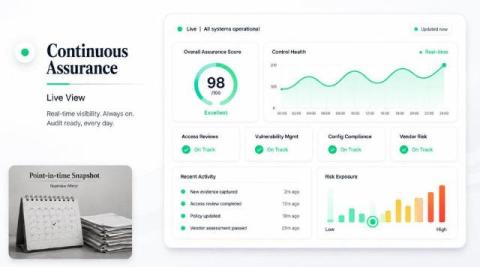
Continuous Control Monitoring: What Annual Testing Misses

An annual control assessment produces evidence that a control operated on one day out of three hundred and sixty-five. Sampling narrows it further, since testing twenty-five items from a population of a thousand evidences the control for those twenty-five on that day. The certificate describes a moment and gets read as a year. ‍ Continuous control monitoring closes that interval by testing automatically and often.

How Regulated Data Leaks Through AI, One Paste at a Time

A support coordinator has a difficult letter to write. The customer record is open in one tab, a consumer AI assistant in another, and the deadline is this afternoon. She selects the record, copies it, pastes it into the prompt box, and asks for a polite draft. Thirty seconds later she has a good letter and a regulatory problem, and nobody in the organization knows about either. ‍ The sequence below traces that single action through to its consequences.

Cyber Risk Appetite Statements That Can Be Breached

Most cyber risk appetite statements cannot be breached. A board approves language about maintaining a low tolerance for disruption, the statement enters the policy library, and no observable event in the following three years violates it. A statement no event can cross is a value rather than a control. ‍ Making one testable requires four terms that get used interchangeably and mean different things, thresholds expressed in units something can exceed, and a defined response for when it does.

Best AI Governance Platforms and Software (2026 Comparison)

You approve five AI tools; your employees use 20. According to UpGuard's State of Shadow AI report, 81% of the workforce is already bringing unmonitored AI tools to work, and legacy security tools are leaving massive gaps in workforce Shadow AI and regulatory compliance. Modern AI governance platforms give you real-time visibility and runtime guardrails to close that gap. They back it up with automated auditing, so you have evidence when someone asks for it.

Best Digital Risk Protection (DRP) Software, Platforms, and Solutions

Most teams shopping for digital risk protection solutions already run three tools at once: one for brand monitoring, one for dark web monitoring, and another for social media defense. The signals don't line up, the alerts pile up, and there’s no single view to show what's exposed. Attackers keep wearing a trusted brand's face, which is why fragmentation matters.

Thousands of Exposed Fuel Gauges Just Left the Internet

Most of the exposure research we publish goes one way. We count some category of internet-exposed devices, the number is bigger than you hoped, and it is climbing. Webcams. Industrial control systems. NTP servers old enough to vote. The story is almost always "there is more of this exposed than there should be, and it is getting worse.".

Assessing Third-Party AI Vendor Risk Before It Becomes a Problem

Every SaaS tool your organization onboards now carries a hidden layer of AI risk. The chatbot on your CRM, the transcription service your sales team runs, the code assistant embedded in your IDE. Each one processes company data through models you did not build, in ways your vendor questionnaire was not written to catch. Traditional third-party risk management was designed to evaluate infrastructure, access controls, and data handling.

Monitoring AI Agent Behavior in Production

Monitoring AI agents in production is a fundamentally different problem from monitoring traditional software or even generative AI models. Because agents run autonomously, chain multi-step reasoning across tools and systems, and change behavior as their underlying models evolve, standard software metrics like uptime and CPU utilization miss almost everything that matters. ‍

AI Guardrail Platforms Compared for Enterprise Deployment

Enterprise AI guardrails are the technical controls that prevent AI systems from doing things they shouldn't, applied at the moment of execution rather than after the fact. They sit between the AI model or agent and the systems, data, and users it interacts with, filtering inputs, inspecting outputs, and constraining behavior against enterprise policy.

Who's Accountable When an AI Agent Makes the Wrong Call?

On a Tuesday morning in Q3, a procurement agent at a mid-market manufacturer approved a $340,000 payment to a vendor account. The vendor name matched the approved-vendor list. The invoice format matched the standard template. The agent verified both, cross-checked the amount against historical purchase orders, and released the payment through the treasury API within eleven minutes of the invoice arriving. No human touched the transaction.

Mapping One Control Set to NIST CSF, ISO 27001 and CIS v8

Most security programs answer to three frameworks at once and document themselves three times. A customer questionnaire asks for ISO 27001 evidence, a cyber insurer asks for NIST CSF alignment, an assessor references CIS safeguards, and the same firewall rule gets described in three vocabularies for three audiences. The duplication is self-inflicted rather than required, and a holistic approach to cybersecurity GRC starts by recognizing that one program is being described repeatedly. ‍

How to Build a Durable AI Governance Program: A 3-Pillar Framework

AI adoption inside the enterprise has outpaced the governance built to contain it — 57% of employees have used AI tools for work without telling their manager. Policies get written and committees get formed, but exposure keeps accumulating, because data governance, AI oversight, and security are almost always run as three separate programs. In this video, Kovrr breaks down the three pillars that need to connect, and what separates a durable AI governance program from a documented one.

Risk management maturity model: How to assess and improve your program

Accelerating security solutions for small businesses‍ Tagore offers strategic services to small businesses. A partnership that can scale‍ Tagore prioritized finding a managed compliance partner with an established product, dedicated support team, and rapid release rate. Standing out from competitors‍ Tagore's partnership with Vanta enhances its strategic focus and deepens client value, creating differentiation in a competitive market.

The AI Inventory Problem Nobody Solved

By now, most organizations have invested in AI governance. Far fewer have solved the problem that makes governance possible in the first place: knowing what AI they are actually running — and with 57% of employees using AI tools at work without telling their manager, the gap is wider than most inventories admit. In this video, Kovrr breaks down what an AI asset inventory actually is, why traditional asset management never catches shadow AI, and what it takes to keep the record accurate.

How Bitsight Helps Financial Institutions Align With Bank Negara Malaysia's RMiT Policy Document

Financial institutions are not short on cybersecurity policies, frameworks, or regulatory requirements. Turning those requirements into a living risk management program can be challenging. Organizations need a program that can keep pace as technology environments expand, cloud adoption grows, third parties are added, and external exposures change. Especially as the threat landscape continues to evolve.

The Illusion of AI Containment: Why AI Guardrails Won't Save Your Supply Chain

AI is quickly becoming one of the most useful tools available to security researchers. Its ability to analyze enormous volumes of data, identify vulnerabilities, reconstruct attacks, connect seemingly unrelated signals, and help defenders respond faster than humans could alone is incredibly beneficial.

The Vendor Assurance Confidence Gap: Why It's Widest With Your Most Critical Vendors

Vendor assurance efforts are increasing, but risk leaders don’t trust the results of that effort. In KPMG’s Global Third-Party Risk Management (TPRM) Survey, only 15% of risk leaders said they have high confidence in the data that underpins their TPRM program. Only 17% rate their data quality as excellent. Security teams are running more assessments and sending more questionnaires than ever, but fewer than one in five leaders trust what any of that produces.

How to Transform Cybersecurity Data Into Risk Metrics

Enterprise security teams sit on enormous volumes of operational data. Vulnerability scanners produce thousands of findings weekly. Endpoint agents generate millions of events daily. SIEM platforms ingest logs from every system in the environment. Threat intelligence feeds fire off indicators by the hour. All of this data is useful for operational security work.

How to Quantify Cyber Risk Effectively: A Practical Enterprise Guide

Effective cyber risk quantification means moving past subjective heatmaps and translating technical vulnerabilities into dollar-denominated loss exposure and probability distributions that the CFO, board, and cyber insurance underwriter can act on. It is the discipline that turns cyber from a technical cost center into a strategic risk portfolio managed alongside every other category of enterprise exposure.

AI Agent Sprawl and How Enterprises Are Controlling It

AI agent sprawl is the uncontrolled proliferation of AI agents, autonomous assistants, and LLM-powered tools across an organization without centralized tracking or governance. It mirrors historical IT challenges like SaaS sprawl and shadow IT, and it emerges when decentralized business units build or deploy agents independently, without coordinated oversight from security, IT, or risk teams. ‍ The difference is that these agents are active software actors.

AI Agent Governance: How Enterprises Should Approach It

Governing AI agents at enterprise scale requires a fundamental change in how security, risk, and compliance teams think about AI oversight. The generative AI era focused governance on output quality: what the model says, what it produces, and whether the content meets policy standards. ‍ The agentic era demands governance of action and delegated authority: what the AI is allowed to do, what systems it can touch, and how its decisions trace back to human accountability.

TITAN AI Demo Series: Query Vendor Risk Within Claude

Your security team already lives in Claude. Now TITAN AI does too. SecurityScorecard's new Model Context Protocol (MCP) connector brings TITAN AI directly into Claude. Your team can query vendor risk, scores, and findings without leaving the tool they already use every day. No new dashboard, no extra login, just answers where the work already happens. In this episode of SecurityScorecard's Demo Tuesday series, see the TITAN AI MCP connector in action inside Claude.

The Top AI Agent Security Vendors of 2026: A Buyer's Guide

Enterprise buyers evaluating AI agent security in 2026 face a market that has fragmented into specialized categories, each solving one layer of the problem well and other layers poorly. Identity vendors govern non-human credentials. Runtime vendors constrain what agents can do at the moment of execution. Established security platforms extend their existing offerings into the agentic space. ‍

CRQ Platform Comparison for Financial Services Organizations

‍Cyber risk quantification (CRQ) has moved from optional to operational in financial services. The average cost of a data breach in the sector reaches $5.56 million, and regulatory mandates including DORA, NYDFS Part 500, and SEC cyber disclosure rules demand quantified, defensible loss exposure figures the finance function can act on. ‍

How AI-Related Security Incidents Should Be Identified and Managed

AI-related security incident detection starts with knowing what AI systems are running across the organization. Without a complete, continuously updated inventory of sanctioned, shadow, and third-party AI tools, security teams cannot detect incidents involving systems they do not know exist. From there, effective incident management requires a structured response framework that connects detection to containment, investigation, remediation, regulatory notification, and governance integration. ‍

How Accurate Are CRQ Models? Understanding Statistical Significance

Cyber risk quantification (CRQ) models are as accurate as the data and methodology behind them, and the conversation about CRQ accuracy that plays out across security and finance teams is often stuck on the wrong question. Risk is about future events that may or may not happen, and if they do, the impact will vary. ‍ Looking for certainty in a probabilistic model is a category error. The useful question is not whether a CRQ model produces the "right" number.