Security | Threat Detection | Cyberattacks | DevSecOps | Compliance

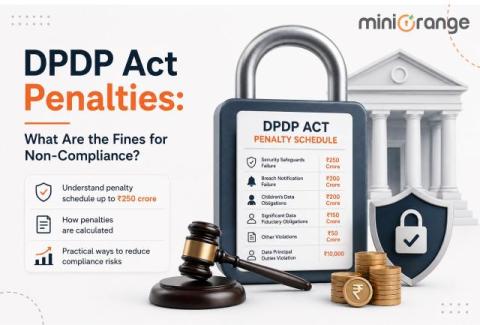
DPDP Act Penalties: Fines for Non-Compliance Explained

The Digital Personal Data Protection (DPDP) Act, 2023, has shifted data privacy from a regulatory obligation into a critical business risk. With the DPDP Rules, 2025 providing operational clarity, businesses are expected to implement reasonable security safeguards, manage consent, protect children's data, and respond promptly to personal data breaches.

Why WatchGuard Is Investing Across the Frontier AI Ecosystem

Artificial intelligence is quickly becoming one of the most transformative technologies in cybersecurity. Unfortunately, it's not transforming the industry exclusively for defenders. Attackers are already experimenting with AI to accelerate reconnaissance, analyze software for vulnerabilities, develop fully-functional exploits, and automate nearly all parts of the attack lifecycle.

Cato CTRL Threat Brief: AsyncAPI Supply Chain Attack Delivers Miasma Malware Through Trusted npm Packages

On July 14, 2026, attackers compromised release processes connected to the AsyncAPI open- source project and published malicious versions of four widely used npm packages with a combined reach of approximately 2.9 million weekly downloads.

Kovrr's Insurance Data Insights: Connecting Cyber Exposure to Coverage

‍ ‍Cyber insurance has become a standard line item in enterprise risk management, and for good reason. The financial consequences of a significant cyber event, whether a ransomware attack that halts operations for weeks or a data breach that triggers regulatory scrutiny and third-party liability, can far exceed what any operational budget was sized to absorb. Insurance exists to handle that tail. Most organizations recognize this benefit and carry a policy.

The Security Risks of AI Agents in the Enterprise

AI agents introduce a category of security risk that traditional application security, identity management, and even standard AI security programs were not designed to handle. Unlike a generative model that only produces text, an agent takes autonomous action against real systems, chains API calls together to accomplish goals, and often holds permissions broad enough to touch data across multiple business systems.

What is cyber resilience? Why it matters and how to build it

Accelerating security solutions for small businesses‍ Tagore offers strategic services to small businesses. A partnership that can scale‍ Tagore prioritized finding a managed compliance partner with an established product, dedicated support team, and rapid release rate. Standing out from competitors‍ Tagore's partnership with Vanta enhances its strategic focus and deepens client value, creating differentiation in a competitive market.

Cookie Crumbles: How Exploitation of CVE-2026-0257 Leads to Qilin Ransomware

During June 2026, Arctic Wolf Labs investigated multiple intrusions during which threat actors exploited CVE-2026-0257 as a consistent initial access vector, rapidly transitioning from perimeter compromise to domain-wide Qilin ransomware encryption across distinct victim environments.

The Real Cybersecurity Challenge is Operational Capacity

For years, the cybersecurity industry has assumed that the primary challenge was to see more, detect better, and deploy increasingly sophisticated tools. That paradigm no longer reflects the reality of today's cybersecurity operations. Organizations have never had so much visibility into their attack surface or so many capabilities to identify threats. However, the rapid evolution of AI is increasing the speed and complexity of attacks to a point where detection alone is no longer enough.

What the Black Hat NOC taught me about MCP & agentic SOCs (Chapter 3 of 4)

The first time an MCP (Model Context Protocol) server felt real to me, it wasn't because of a clean demo. It was because of the noise. TL;DR: The harness matters more than the protocol, and the evidence matters more than both. MCP earns its keep when it shortens the path from a good security question to trustworthy evidence, and almost everything interesting about making that work happens in the harness wrapped around the model. In this series, I will cover how to build an MCP for an AI SOC.