Security | Threat Detection | Cyberattacks | DevSecOps | Compliance

Balancing AI Innovation and Risk: Enhance Organizational Resilience

‍ Artificial intelligence (AI) offers businesses vast opportunities to boost efficiency, improve decision-making, and innovate faster. Yet, these benefits come with significant risks that can impact business operations and resilience if not managed carefully. This article explores how organizations can balance leveraging AI’s advantages while controlling its inherent risks. ‍
Cyber Risk Management: Expert Insights for Enterprise Leaders

‍ Cyber risk has long outgrown its classification as a technical concern. For organizations serious about protecting enterprise value, managing cyber exposure requires financial grounding and the ability to communicate risk in terms that drive real decisions at the board and executive level. The distance between organizations that manage cyber risk strategically and those that report on it comes down to measurement approaches and the programs built around it. ‍

Vanta was named a Leader in the Forrester GRC Wave. This is what we're building next.

Accelerating security solutions for small businesses‍ Tagore offers strategic services to small businesses. A partnership that can scale‍ Tagore prioritized finding a managed compliance partner with an established product, dedicated support team, and rapid release rate. Standing out from competitors‍ Tagore's partnership with Vanta enhances its strategic focus and deepens client value, creating differentiation in a competitive market.

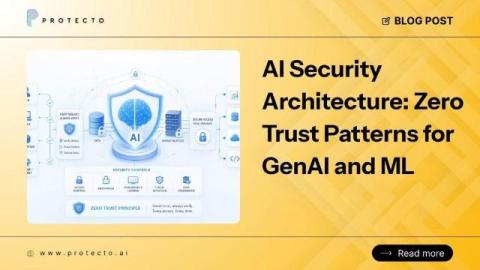
AI Security Architecture: Zero Trust Patterns for GenAI and ML

There is no doubt that AI, or Artificial Intelligence, is rapidly changing how businesses are operating. However, it also brings new risks when it comes to data. As per industry reports, 72% of companies mention that there has been a significant increase in organizational cyber risks. It is therefore necessary to have a strong AI security architecture that helps to protect sensitive information. In light of this, 85% of organizations are now increasing their cybersecurity budget.

Building the Post-Mythos Security Organization: From Episodic Security to Continuous Assurance

In an era where AI accelerates both innovation and adversarial capability, security leaders are confronting a difficult reality: traditional approaches to cyber defense are no longer sufficient. Cyberhaven’s Office of the CISO is responding with a forward-looking strategy designed not simply to keep pace with emerging threats, but to fundamentally redefine enterprise readiness in a post-Mythos world.

Why strategic CISOs need proactive risk reduction, not reactive GRC reporting

Security and GRC teams have no shortage of risk mitigation activities. They are carrying more work than ever, yet many still lack confidence in the data and recommendations produced by all that manual effort. They are also operating in a risk environment that changes faster than their current operating model was designed to support. Unfortunately, the existence of risk activity does not mean actual risk has been reduced.

Misconfigured Security Controls Open the Door for Storm-2949

The Microsoft Defender Security Research Team and Microsoft Threat Intelligence documented a campaign in which Storm-2949 abused Microsoft Entra ID accounts to exfiltrate data from Microsoft 365 and Azure environments. The attack shows how cloud intrusions increasingly unfold through identity systems, administrative features, and legitimate platform capabilities rather than obvious malware or traditional endpoint compromise.

INETCO surpasses 100 billion annual transactions as demand for payment fraud protection soars

Monitoring milestone highlights shift toward real-time transaction intelligence as financial institutions face escalating fraud and operational risk VANCOUVER, B.C. — May 21, 2026 — INETCO, a global leader in real-time payment fraud prevention, today announced the monitoring of more than 100 billion transactions per year, empowering financial institutions and payment service providers across more than 30 countries to outsmart fraudsters, stay compliant and keep every customer safe.

GitHub Internal Repositories Breached: Source Code and Internal Data Allegedly Exfiltrated in 2026 Supply Chain Attack

In a significant security incident unfolding on May 20, 2026, GitHub confirmed unauthorized access to its internal repositories. The breach involved the exfiltration of sensitive internal source code and organizational data, reportedly totaling around 3,800 to 4,000 private repositories. A threat actor surfaced on underground forums advertising the stolen materials for sale, complete with directory listings of compressed archives and sample verification offers.