Security | Threat Detection | Cyberattacks | DevSecOps | Compliance

The Abbott Cyber Incident Reveals Why Infrastructure Security Is No Longer Enough for Healthcare

Healthcare has spent years strengthening its infrastructure against ransomware, patching vulnerabilities, deploying endpoint detection, and implementing zero-trust architectures. Yet, attackers continue to find new ways to compromise healthcare organizations.

Attackers Exploit AI Hallucinations to Send Users to Phishing Sites

Threat actors are using a new technique called “phantom squatting” to trick AI tools into directing users to phishing sites, according to researchers at Palo Alto Networks’ Unit 42. Since AI models frequently hallucinate phony information, they sometimes point users to websites that don’t exist. Threat actors are now registering these AI-hallucinated domains and using them to host phishing sites.

When the Breach Isn't Yours, But the Risk Still Might Be

Every time a cyber breach breaks headlines, leadership teams pose the same urgent question: Does this affect us? But a third-party risk team is likely already asking: Was one of our vendors, suppliers, partners, or other third parties involved? And increasingly: What if it was not our direct vendor, but one of theirs?

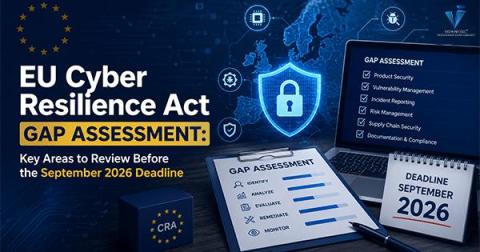
EU CRA Gap Assessment: Are You Ready for 2026?

Most compliance teams have filed the EU Cyber Resilience Act under “2027” — the date the regulation becomes fully applicable. That’s the wrong filing date. From 11 September 2026, manufacturers must already report actively exploited vulnerabilities and severe incidents affecting products with digital elements, more than a year before the rest of the regulation takes effect.

Oracle Just Shipped 1,449 Security Patches in One Quarter. We Checked How Much of It Is Actually New.

Oracle's July 2026 Critical Patch Update (CPU) is nearly three times larger than any release in the company's history. To understand it, we parsed all 23 of Oracle's quarterly advisories going back to 2021, matched them against the official CVE record, and compared Oracle against eight other major vendors. We set out to answer three questions: How much of this is genuinely new? Does it really reflect AI-accelerated patching? And how unusual is it?

Finding eight high-severity vulnerabilities in NodeBB in six hours

TL;DR While improving our AI Pentest, we ran a whitebox assessment on NodeBB, a forum software powered by NodeJS. The result? Eight high-severity vulnerabilities that would all be exploitable on default instances of NodeBB. This includes Cross-Site Scripting (XSS), two of which require interaction with a custom Federation server that the AI agent had to set up itself. Another affects practically every input on NodeBB due to a template injection.

The New Face of AI Risk

Cybercrime used to have a ‘"tell." It was the digital equivalent of a villain stroking their cat - clunky grammar, misspelt links and suspicious attachments that screamed ‘phishing’. But the arrival of AI has changed everything. Typos have been replaced by perfect prose. Generic lures have evolved into highly personalized attacks that mimic your internal language and align with your project timelines.