Security | Threat Detection | Cyberattacks | DevSecOps | Compliance

Approaching Azure Kubernetes Security

The Splunk Security Research Team has been working on Kubernetes security analytic stories mainly focused on AWS and GCP cloud platforms. The turn has come now for some Azure Kubernetes security monitoring analytic stories. As outlined in my "Approaching Kubernetes Security — Detecting Kubernetes Scan with Splunk" blog post, when looking at Kubernetes security, there are certain items within a cluster that must be monitored.

File Integrity Monitoring: Detecting suspicious file activity inside a container

In this blog, we will explore suspicious file activity inside a container and see how to effectively implement a file integrity monitoring (FIM) workflow. We’ll also cover how Sysdig Secure can help you implement FIM for both containers and Linux hosts.

Attack of the mutant tags!Or why tag mutability is a real security threat

Tag mutability can introduce multiple functional and security issues. In container land, tags are a volatile reference to a concrete image version in a specific point in time. Tags can change unexpectedly, and at any moment. In this article, we’ll learn how we can prevent them.

Azure you shot an ARO through our hearts... Confidently observe and secure Azure Red Hat OpenShift with Sysdig and Arctiq

It has arrived! Azure Red Hat OpenShift 4 is here and generally available; now, how do you add even more granular security and faster time to repair (MTTR) for your teams? Sysdig, that’s how!

On-Demand Webinar: Extending Your Fortigate Next-Gen Firewall to Kubernetes

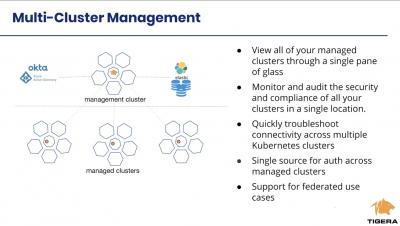
Companies are leveraging the power of Kubernetes to accelerate the delivery of resilient and scalable applications to meet the pace of business. These applications are highly dynamic, making it operationally challenging to securely connect to databases or other resources protected behind firewalls. Tigera and Fortinet have joined forces to solve this operational challenge. With the combination of FortiGate Next-Gen firewalls and Calico Enterprise, you gain full visibility into the container environment and can define fine-grained policies to determine which Kubernetes workloads are allowed to talk to the enterprise’s crown jewels running outside the Kubernetes cluster.

Kubernetes Security: Lateral Movement Detection and Defense

What is Lateral Movement? Lateral movement refers to the techniques that a cyber-attacker uses, after gaining initial access, to move deeper into a network in search of sensitive data and other high-value assets. Lateral movement techniques are widely used in sophisticated cyber-attacks such as advanced persistent threats (APTs).

Detect reverse shell with Falco and Sysdig Secure

Reverse shell is a way that attackers gain access to a victim’s system. In this article, you’ll learn how this attack works and how you can detect it using Falco, a CNCF project, as well as Sysdig Secure. Sometimes, an application vulnerability can be exploited in a way that allows an attacker to establish a reverse shell connection, which grants them interactive access to the system.

Expanding the IBM & Sysdig Relationship to Manage Cloud Security Risk

Today, we are pleased to announce the expansion of Sysdig’s relationship with IBM to extend cloud security governance with IBM Cloud Pak for Multicloud Management. Through a new OEM agreement, Sysdig Secure and the Sysdig Secure DevOps Platform are now available through IBM and IBM Business Partners. The combined IBM and Sysdig offering delivers centralized cloud visibility, governance and automation with in-depth container security intelligence for Red Hat OpenShift.