Security | Threat Detection | Cyberattacks | DevSecOps | Compliance

Threat hunting: a top priority for businesses of all sizes

Today's threat actors are well-organized, highly skilled, motivated, and focused on their targets. These adversaries could be lurking on your network or threatening to break into it, using increasingly sophisticated methods to reach their goal. Simply put, there's often no need for adversaries to deploy malware at the early stages of the attack.
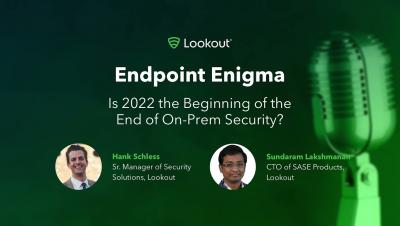
Endpoint Enigma | Is 2022 the Beginning of the End of On-Prem Security?

Nearly two years after we were forced to experiment with remote work, 2022 will be an inflection point for both threats and cybersecurity solutions. Tune into our annual predictions episode to hear what Lookout CTO of SASE Products Sundaram Lakshmanan thinks will happen next year. We'll be discussing everything from software supply chains to threat hunting and data protection.

The CrowdStrike Falcon OverWatch SEARCH Threat Hunting Methodology

The CrowdStrike®️ Falcon OverWatch™️ team is one of the industry’s most sophisticated threat hunting teams, responsible for continuous hunting across a massive global data set. Key to the team’s success is OverWatch’s carefully tuned methodology, SEARCH, which supplies the framework needed to balance the people, process, and technology, providing successful threat hunting results every minute of every day and leaving the adversary nowhere to hide.

Listen To Those Pipes: Part 1

If you haven’t already read the episode on process hunting, I recommend that you go back and do so, at least for a couple of my jokes, and to help keep our clicks/metrics up. Where that episode concentrated on tracking processes, this blog will concentrate on, you guessed it, pipes. And due to the depth I tried to go with this one, it has been split into a two-part series, so make sure to come back for the second part after you’ve finished this one.

Elevating What a TIP Can Be - The ThreatQ Platform

In a previous blog I reviewed the foundational use case for a TIP, which is threat intelligence management—the practice of aggregating, analyzing, enriching and de-duplicating internal and external threat data in order to understand threats to your environment and share that data with a range of systems and users. However, one of the unique benefits of the ThreatQ Platform and where organizations are deriving additional business value, is that it also allows you to address other use cases.

No Regrets Using Autoregress

If you’re like me, you’ve occasionally found yourself staring at the Splunk search bar trying to decide how best to analyze a series of data, iterating against one or more fields. If your brain gravitates towards traditional programming syntax, the first thing that pops into your mind may be application of a for or while loop (neither of which follow Turing convention in SPL). With commands like stats, streamstats, eventstats, or foreach at your disposal, which one should a hunter use?

Process Hunting with a Process

Quite often you are in the middle of a security incident or just combing through your data looking for signs of malicious activity, and you will want to trace the activity or relationships of a particular process. This can be a very time-consuming and frustrating task if you try to brute force things (copying/pasting parent and child process IDs over and over again). And in the heat of battle, you may miss one item that could have led you to something interesting.

Threat Hunting Like a Pro - With Automation

It’s no secret that cyber attacks are on the rise. Not only are they becoming more frequent, but the malicious actors who mount these attacks are constantly improving their skills and evolving the tools in their arsenals. Protecting your organization is challenging at best; especially since we measure the return on investment for cybersecurity as ‘preventing losses’ instead of ‘increasing revenue.’